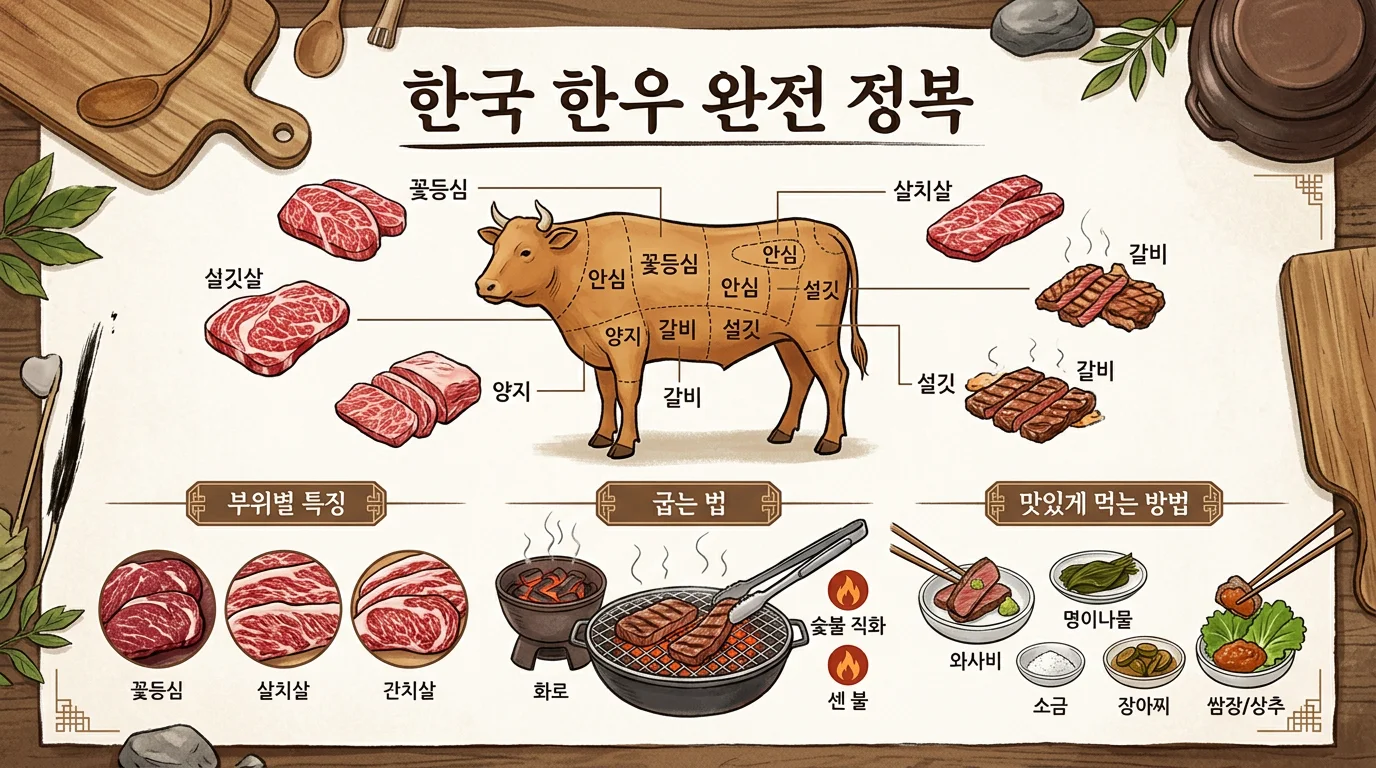
🥩 韓牛(ハヌ)完全攻略(部位・焼き方・美味しい食べ方)
영어·일본어 두 버전 모두 만들었어요. 부위명은 한글+영어/읽기로 병기하고, 등급 체계·한우 vs 육우 구분·상차림비·주문 단위·가격 확인 같은 실전 포인트를 두 언어판에 그대로 반영했어요. 👇
🇬🇧 English Version
📌 Title / Summary
Title: 🥩 Mastering Korean Hanwoo (Cuts · Grilling · How to Eat It Deliciously)
Summary: Korea's pride, Hanwoo! A foreigner-friendly guide to reading grades, popular cuts, how to grill each cut, and how to eat it deliciously — with salt, ssam, and sesame-oil dip.
🥩 Mastering Korean Hanwoo (Cuts · Grilling · How to Eat It Deliciously)
If you're in Korea, Hanwoo is a must-try! Hanwoo is a native Korean cattle breed that has developed through long breeding and improvement — a premium beef famous for its deep umami and tender texture. It's pricier than imported beef, but that much more special. Knowing the grades, cuts, and grilling makes it far tastier and foolproof. Here's a foreigner-friendly rundown! 🔖
⏱️ 30-Second Summary — Just Remember This!
🐂 Hanwoo → a native Korean cattle breed, premium beef
🏅 Grades → quality grade (1++·1+·1·2·3) + yield grade (A·B·C)
🥩 Popular cuts → sirloin, striploin, tenderloin, chuck flap, rib, brisket
🔥 Grilling → sear the surface on high heat → don't overcook (varies by cut)
🥬 How to eat → dip in salt/sesame-oil, wrap with ssam and garlic, finish with naengmyeon/doenjang
1. 🐂 What Is Hanwoo? (How Is It Different from Imported Beef?)
Hanwoo (韓牛): A native Korean cattle breed developed through long breeding and improvement. Known for its marbling (intramuscular fat) and umami.
Why special: Famous for tender texture and rich, nutty flavor. Pricier than imported beef (US/Australian), but popular for special occasions and fine dining.
Price: As a premium ingredient, it runs high, varying a lot by cut, grade, and restaurant.
2. 🔍 How to Confirm It's Hanwoo (Domestic Hanwoo vs. Yugu)
An easy point of confusion for foreigners. Not everything "domestic" is Hanwoo.
Check the menu/label: Look for "Hanwoo (한우)," "domestic Hanwoo (국내산 한우)," or "origin: domestic Hanwoo."
Hanwoo ≠ Yugu: "Domestic yugu (국내산 육우)" is a different animal from Hanwoo (different breed/rearing). Even if domestic, dairy cattle and yugu aren't Hanwoo.
Traceability: Hanwoo can be verified via the livestock traceability system. Specialty restaurants may keep a grade certificate on hand.
3. 🏅 How to Read Hanwoo Grades
Korean beef is graded on two axes. You can check them on the label.
Quality grade (taste/quality): From high to low, 1++ · 1+ · 1 · 2 · 3. Judged by combining marbling (intramuscular fat), meat color, fat color, texture, and maturity.
Yield grade (amount of meat): A · B · C, indicating how much meat comes from one animal (a yield indicator, not taste).
Example: Shown together like "1++A" (quality + yield).
Marbling number: The top 1++ also shows a marbling number (7·8·9). Even within 1++, the fat feel differs by 7·8·9 (9 has the most fat — the richest, nuttiest).
Note: With the 2019 grading revision, grade is no longer decided by marbling alone; meat color, texture, etc., count too. (The 1++ threshold was also adjusted from marbling 8·9 to 7·8·9.)
💡 A higher grade isn't always "the answer." 1++ is rich with fat but can feel heavy, while grades 1–2 are leaner. Choose by taste and cut.
4. 🥩 Popular Cuts to Know
Every cut differs completely in taste and texture. These are the main grilling cuts.
ℹ️ The English names below are for reference. Since each country/restaurant butchers cattle differently, English cut names may not map exactly 1:1.
Well-marbled and tender (popular for grilling)
Deungsim (Sirloin/Loin): Richly marbled and nutty. The signature Hanwoo grilling cut!
Chaekkeut (Striploin): Leaner than sirloin, mild yet tender.
Ansim (Tenderloin): Low in fat and the most tender cut. Lean and mild.
Salchisal (Chuck flap): Beside the sirloin, with deep marbling and strong flavor — a favorite among enthusiasts.
Special flavor/texture
Galbisal (Rib): Meat between the ribs — chewy and rich.
Chadolbagi (Brisket): Thinly sliced brisket; nutty and chewy as you chew. Cooks fast.
Buchaesal·Tosisal·Anchangsal·Jebichuri: Rare "special cuts." Unique texture/flavor, popular with aficionados.
For soup/braising
Yangji·Sathae: Great for soups, stews, and braises (seolleongtang, galbitang, etc.).
💡 If it's your first time, sirloin/striploin are safe; for deep flavor go for salchisal, for lean go tenderloin.
5. 🔥 How to Grill It Well
The key with Hanwoo is not to overcook. It varies a bit by cut.
Basic principle: Sear the surface quickly on high heat to build nutty, browned flavor, and don't overcook the inside. Cooking too long makes it tough and dry.
Rest at room temp: Taking it out of the fridge and letting it sit briefly at room temperature helps it cook evenly.
Flipping: Don't fuss with thick cuts too much; flip thin cuts quickly and eat right away.
By cut:
Sirloin·salchisal (well-marbled): Sear on high → about medium. The fat melts for a nutty taste.
Striploin·tenderloin (lean): Being lean, they toughen if overcooked. Medium-rare to medium is best.
Chadolbagi (thin): Cooks very fast. Grill just briefly and eat right away.
Cutting: For thick cuts, cut into bite sizes after grilling (scissors are commonly used).
💡 When eating several cuts, go lean → fatty. E.g., tenderloin·striploin → sirloin → salchisal·rib → brisket. Staff may grill for you, so ask if you're unsure.
6. 🥬 How to Eat It the Korean Way
How you eat matters as much as grilling. Here's how to bring out Hanwoo's flavor.
Salt/sesame-oil dip: For good Hanwoo, dip lightly in salt or sesame-oil dip (sesame oil + salt) to enjoy the meat's natural taste.
Ssam (wraps): Wrap meat + garlic + ssamjang + rice in lettuce/perilla leaves for one bite! It cuts the richness.
Grilled garlic·mushrooms·kimchi: Grill garlic, mushrooms, and kimchi on the plate as sides.
Pickled onion·scallion salad: Tangy sides reduce the heaviness.
First bite with salt: Enjoy the first few bites with salt for the pure taste, then vary with wraps/sauces.
7. 🍜 Finishing & Sides
Meal to finish: After the meat, finishing with naengmyeon, doenjang stew, a bowl of rice, or fried rice is the Korean way.
Yukhoe: Yukhoe (fresh raw Hanwoo) is also a delicacy (if you like it).
Drink pairing: Often paired with soju or beer (non-alcoholic options too).
Doenjang/seaweed soup: Mild broths pair well with the meat.
8. 🍽️ Where to Eat Hanwoo (+ Ordering & Costs)
Hanwoo specialty restaurant: Sells by cut; you choose grade and cut.
Butcher-restaurant (jeongyuk sikdang): You pick and buy the meat at the butcher counter and grill it at your table. Popular for value.
⚠️ Table-setting fee: Butcher-restaurants often charge a per-person "sangcharim" (table-setting) fee separate from the meat. It covers the grill, wrap veggies, side dishes, and sauces.
Hanwoo omakase: A chef serves cuts course-style — a high-end, special experience.
Regions: Areas famous for Hanwoo include Hoengseong, Eonyang, and Hampyeong.
Ordering & prices (a must for foreigners!)
Order unit: Usually ordered by 100–150g per serving. Some restaurants require 2 servings or more as a minimum.
Check the price: Confirm whether the menu price is per 100g, per serving, or per set. (It's easy to mistake a per-100g price for a per-serving price!)
💡 For value, go to a butcher-restaurant (check the table-setting fee); for a special experience, a specialty restaurant or omakase.
9. Common Questions from Foreigners ❓
Why is Hanwoo expensive? → It's premium beef from a native breed raised and improved over a long time. It varies a lot by cut/grade.
Is all "domestic" beef Hanwoo? → No. "Domestic yugu" is different from Hanwoo. Check for "Hanwoo" on the menu/label.
Is a higher grade tastier? → 1++ is fatty and nutty but can feel heavy. Choose by taste and cut.
Why does the price look so cheap? → It may be a per-100g price. Check if it's per serving or per set.
What cut for a first-timer? → Sirloin/striploin are safe; salchisal for rich, tenderloin for lean.
In what order should I eat? → Lean → fatty is recommended.
Can I eat alone? → Some places allow single orders, but many require 2+ servings. Check.
Is there raw beef? → Yes, yukhoe. As it's fresh meat, enjoy it at a specialty restaurant.
✅ Quick Checklist
Confirm "Hanwoo" on the menu/label (different from domestic yugu)
Understand grades: quality (1++–3) + yield (A·B·C); 1++ shows a marbling number (7·8·9)
Decide your taste: nutty = sirloin/salchisal / lean = striploin/tenderloin
Sear on high (browned flavor) → don't overcook
Don't fuss with thick cuts; flip thin cuts quickly
Eat lean → fatty
Good meat with salt/sesame-oil; if heavy, use ssam/garlic
Check the order unit (100–150g), price basis (per 100g / serving / set), and table-setting fee
🟦 A guide put together by the CultureHub team.
📅 As of 2026 · ⚠️ Grading criteria, prices, cut names, table-setting fees, and restaurant styles vary by policy and venue. Check before visiting.