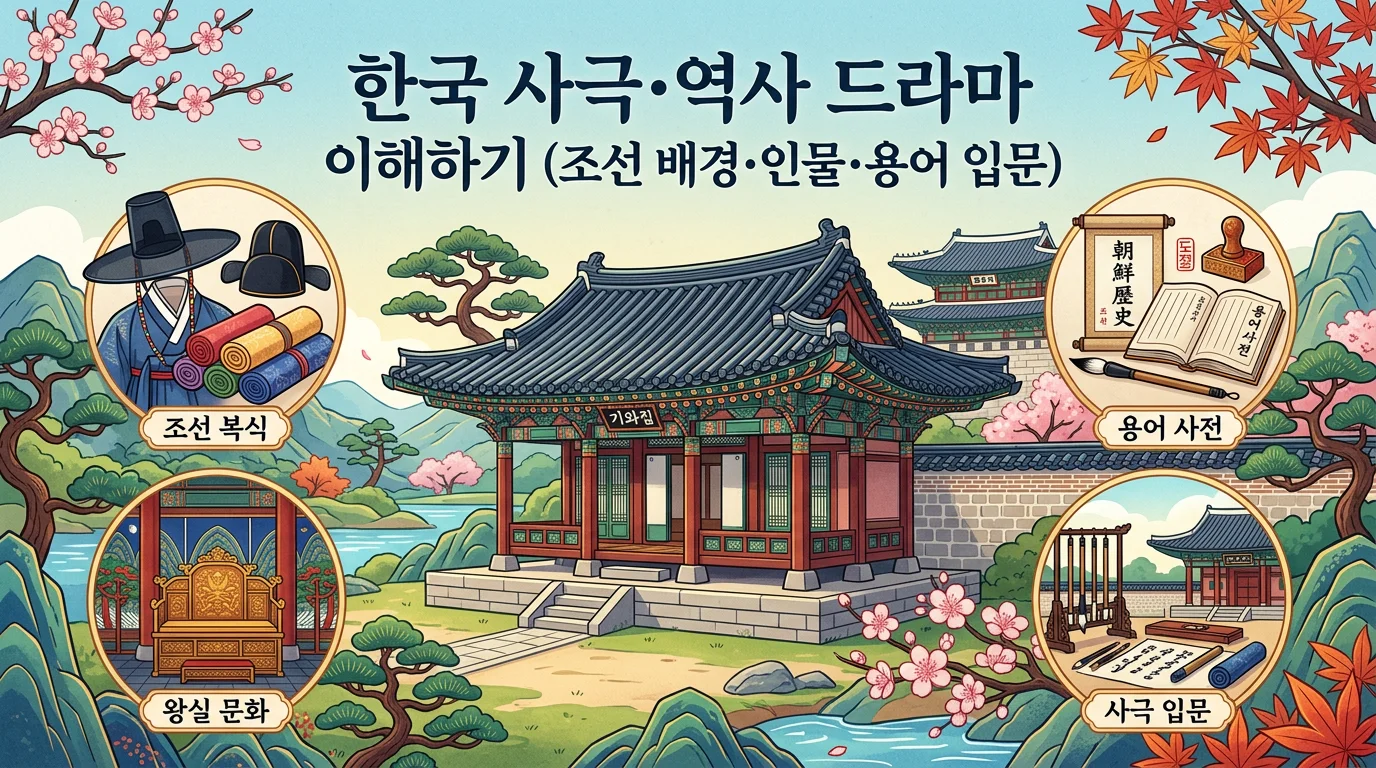
👑 Understanding Korean Historical Dramas (Joseon Setting · People · Terms)
ℹ️ Note: Many sageuk are based on real history but dramatically adapted (fusion/faction). Not every character or event in a drama is historical fact.
⏱️ 30-Second Summary — Just Remember This!
🏯 Setting → mostly the Joseon era (1392–1897), a Confucian state
👑 Royals → king, queen, crown prince (next king), queen dowager (king's mother)
🗣️ Titles → Jeonha (king), Mama (royals), Daegam/Nari (officials/nobles)
🎭 Class → yangban > jungin > sangmin > cheonmin
📜 Genre → orthodox sageuk vs. fusion sageuk (heavily adapted)
1. 🏯 What Is the Joseon Era? (The Basic Setting)
Joseon (1392–1897): A dynasty founded by Yi Seong-gye (Taejo), lasting about 500 years, until the Korean Empire was declared in 1897. Most sageuk are set here.
A Confucian state: It made Neo-Confucianism the state ideology. Loyalty, filial piety, propriety, class order, and gender/age distinctions underpinned society.
Capital Hanyang: Today's Seoul. Palaces like Gyeongbokgung and Changdeokgung often appear as settings.
Earlier eras: Some sageuk are set in the Three Kingdoms (Goguryeo, Baekje, Silla) or Goryeo, but Joseon is the most common.
The Korean Empire (1897–1910): In 1897 Joseon's name changed to the Korean Empire (Daehan Jeguk), lasting until 1910 — the period when the king became an emperor. (Mr. Sunshine, etc., is set in this modern-transition period.)
2. 👑 The Royal Family (Who's Who)
Sageuk revolve around the royal family. Knowing the relationships makes the story click.
King (Wang/Imgeum): The nation's supreme ruler.
Queen (Jungjeon): The king's official wife. Called "Jungjeon-mama."
Queen dowager (Daebi): The previous king's queen and the current king's mother (or elder). The royal family's senior figure.
Wangdaebi / Daewangdaebi: A Wangdaebi is a former king's queen; a Daewangdaebi is a queen of an even earlier generation. (Used to distinguish when there are several royal elders.)
Crown prince (Seja): The prince who will be the next king. Called "Jeoha." His wife is the crown princess (Sejabin).
Concubines (Hugung): The king's other consorts. "Bin" can mean the crown princess, or a high concubine rank.
Daegun vs. Gun: Generally, a Daegun is a prince born to the queen, and a Gun a prince born to a concubine (with exceptions by period/situation).
Gongju vs. Ongju: A Gongju is a daughter of the queen; an Ongju is a daughter of a concubine.
Succession intrigue: Palace power struggles over who becomes the next king are a sageuk staple.
💡 Endings of kings' names (Jo/Jong/Gun): They differ, as in Taejo, Sejong, Yeonsangun. "Jo" and "Jong" are posthumous temple names given after a king's death. The meaning is complex, but for beginners it's enough to see them as a "king's posthumous title." "Gun" is attached to a king who was deposed or not recognized as legitimate (Yeonsangun, Gwanghaegun).
3. 🗣️ Common Titles (Know These and You're Halfway There!)
The heart of sageuk dialogue is titles, which change completely by rank and who's speaking.
Titles toward royals
Jeonha (殿下): For the king. Close to "Your Majesty."
Pyeha (陛下): For an emperor. If "Pyeha" appears in a sageuk, it's likely a Korean Empire or other imperial (Chinese, etc.) setting. (A Joseon king is "Jeonha.")
Jungjeon-mama / Daebi-mama: Queen / queen dowager. "Mama" is attached to royal seniors.
Jeoha (邸下): For the crown prince.
So-in / So-sin: How a subject/inferior humbly refers to themselves (a humble "I").
Titles toward officials/nobles
Daegam (大監): A high-ranking official. An honorific.
Yeonggam (令監): An official just below Daegam. (Different nuance from the modern word.)
Nari / Naeuri: How an inferior addresses an official/noble (close to "Lord/Sir").
Daegam-manim / Manim: A Daegam's wife; the lady of the house.
Doryeonnim / Assi: A noble household's young man (Doryeonnim) / young woman (Assi).
💡 The same person is addressed differently depending on who's speaking. Knowing the status relationships makes dialogue much clearer.
4. 🎭 The Class System (Joseon's Hierarchy)
Joseon was a strict class society — the root of much sageuk conflict.
Yangban: The top ruling class. The term combines civil officials (munban) and military officials (muban). They took state exams and entered office, valuing scholarship and propriety.
Jungin ("middle people"): The middle class — interpreters (yeokgwan), physicians (uigwan), and technical professionals. They handled practical affairs.
Sangmin (commoners): Ordinary people — farmers, merchants, artisans. They bore taxes and labor duties.
Cheonmin (lowborn): The lowest class — slaves (nobi), butchers (baekjeong), gisaeng, shamans, entertainers. Slaves could be bought, sold, and inherited.
Gisaeng: Generally classed as cheonmin, but often active as professional artists accomplished in song, dance, poetry, and literature.
💡 Sageuk romance and conflict often arise from class differences (a noble and a lowborn, a king and a court maid). Knowing this structure clarifies the emotional arcs.
5. 🏛️ Palaces and Offices (Understanding the Setting)
Palace layout: Divided into the Daejeon (king's quarters), Junggungjeon (queen's quarters), and Donggung (crown prince's quarters).
Surakan (Sojubang): The royal kitchen that prepared the king's meals. (The setting of Dae Jang Geum.)
Naesi (eunuchs): Male officials who closely attended the king in the palace.
Court-lady ranks: The palace women had a hierarchy too.
Jejo-sanggung: The highest court lady, overseeing the inner-court household.
Sanggung: A senior court lady.
Nain: A court lady below sanggung.
Saenggaksi: A young apprentice before becoming a nain.
Eoui: The royal physician.
Uigeumbu / Podocheong: The Uigeumbu handled serious criminals by royal command; the Podocheong was the office for policing, catching bandits, and investigation.
Amhaeng-eosa (secret royal inspector): A special official the king secretly dispatched to inspect local officials. The scene of holding a mapae and shouting "Amhaeng-eosa chuldo-ya!" is famous.
Government core
Yeonguijeong, Jwauijeong, Uuijeong: The three top state councilors (premier-level), called the "three chief ministers."
Panseo: The minister of each of the Six Ministries (Personnel, Taxation, Rites, War, Punishments, Works).
The Samsa (Three Offices): Three bodies that balanced royal and ministerial power — frequent in sageuk.
Saheonbu: Inspected officials.
Saganwon: Remonstrated with (advised) the king.
Hongmungwan: Advised on scholarship and policy.
Pumgye: Officials' ranks (Jeong 1st to Jong 9th). Higher is more senior.
💡 The state exam (gwageo): A national exam to become an official, with tracks like the civil exam (mungwa) and military exam (mugwa). As the key path for yangban into office, passing or failing it is a frequent sageuk plot point.
6. 📜 Types of Sageuk (Orthodox vs. Fusion)
Orthodox sageuk: Faithful to real history and research, based on sources like the royal annals (epic dramas).
Fusion sageuk: Adds fictional characters, modern sensibility, romance, and fantasy to a historical setting. Popular these days.
Faction: Fact + fiction — a story adding imagination to real figures/events.
Caution: Fusion/faction can differ from real history. Enjoy them, but distinguish from historical fact.
7. 🌟 Real Figures Who Often Appear
King Sejong the Great: Created Hangul (Hunminjeongeum). Regarded as Joseon's greatest sage-king.
Yi Sun-sin: The great admiral of the Imjin War, famous for the turtle ship and the Battle of Hansando.
Jeongjo: A reformist king who built Suwon Hwaseong Fortress.
Yeonsangun: A king deposed for tyranny (hence "Gun").
Gwanghaegun: A king with divided assessments, also deposed and thus a "Gun."
Jang Hui-bin (Royal Noble Consort Jang): Rose from concubine to queen before a tragic end — a symbol of palace intrigue.
Jang Yeong-sil: A Joseon scientist (astronomical instruments, rain gauge) who rose despite his low birth.
💡 If a name is unfamiliar, search that figure after watching. Comparing with real history is its own fun.
8. 💡 Tips to Enjoy Sageuk 200%
Use subtitles/translation: Sageuk have lots of archaic language and honorifics. English/Japanese subtitles help.
Focus on titles: Distinguishing Jeonha, Mama, Daegam, and Nari reveals character relationships.
Link it to palace visits: Visiting Gyeongbokgung or Changdeokgung makes the dramas vivid (even more so in hanbok!).
Start with entry works: Begin with romance/fusion sageuk, then expand to orthodox ones.
Prep the history a bit: Just knowing Joseon and a few kings' names boosts immersion.
9. Common Questions from Foreigners ❓
Are all sageuk set in Joseon? → Mostly, but some are set in the Three Kingdoms or Goryeo.
Jeonha vs. Pyeha? → Jeonha is for a king, Pyeha for an emperor. "Pyeha" suggests a Korean Empire or imperial setting.
Daegam vs. Nari? → Daegam is an honorific for a high official; Nari is how inferiors address an official/noble.
Why are Daegun and Gun different? → Generally Daegun = the queen's son, Gun = a concubine's son (with exceptions).
What do Jo/Jong/Gun at the end of a king's name mean? → Jo/Jong are posthumous temple names; Gun is for a deposed or illegitimate king.
Is sageuk real history? → Orthodox sageuk stays faithful, but fusion/faction is heavily adapted.
Which sageuk should I start with? → Romance/fusion sageuk are good entries. Pick a figure or era you're curious about.
✅ Quick Checklist
Setting: Joseon (1392–1897) → Korean Empire (1897–1910), a Confucian state
Royal relations: king, queen, crown prince, queen dowager/wangdaebi, concubines
Titles: Jeonha (king), Pyeha (emperor), Mama (royals), Daegam/Nari (officials)
Class: yangban > jungin > sangmin > cheonmin
Palace/offices: Surakan, Sanggung/Nain, Naesi, the Samsa, Amhaeng-eosa
Understand the state exam (mungwa/mugwa)
Distinguish Jo/Jong/Gun and orthodox vs. fusion (adapted)
Boost immersion by visiting Gyeongbokgung/Changdeokgung
🟦 A guide put together by the CultureHub team.
📅 As of 2026 · ⚠️ Sageuk often dramatically adapt historical fact. Not all characters and events match real history, so verify the accurate history separately.