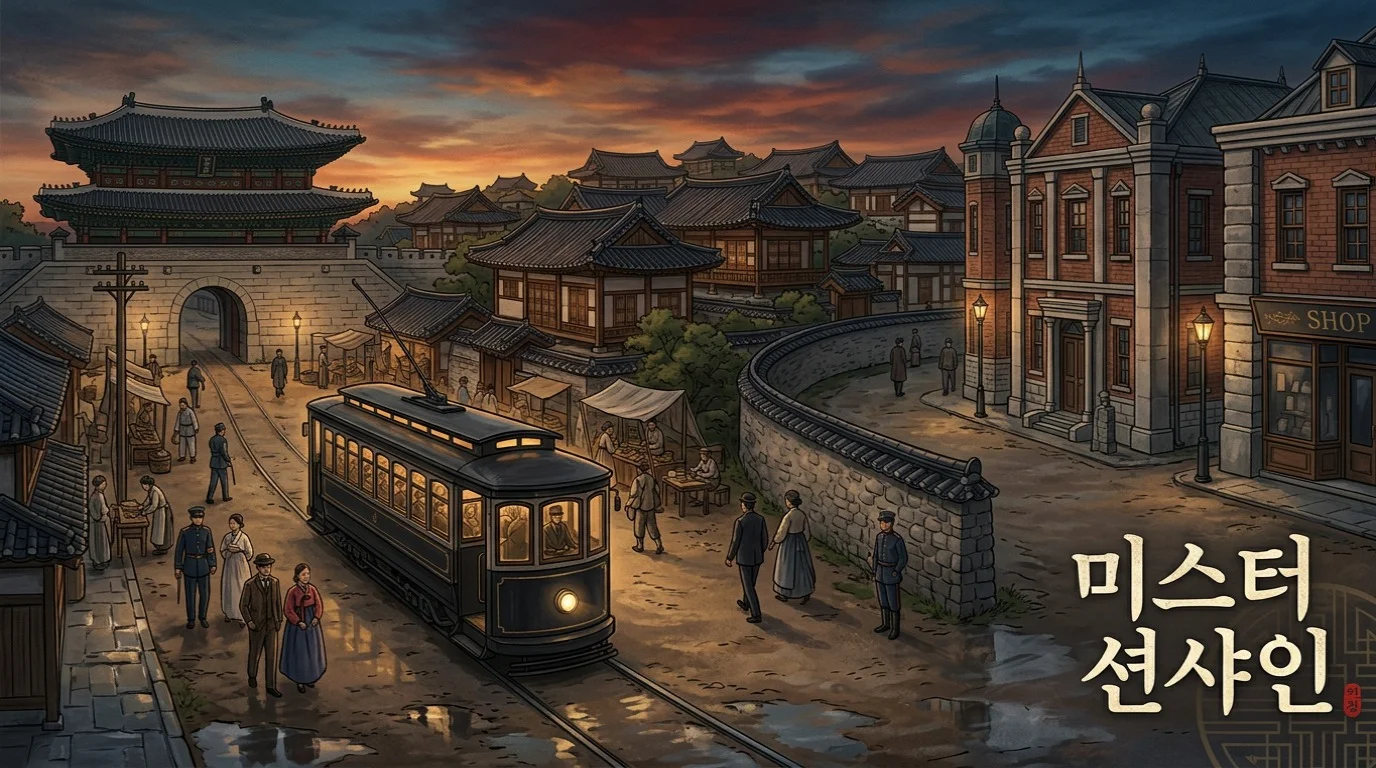
🎬 Mr. Sunshine — Spoiler-Free Story & History Guide for Newcomers
⚠️ Note — This is an introduction to help you enjoy the drama. Mr. Sunshine is set in a real historical era, but its characters and detailed storylines are "historical fiction" with invented elements added. So please remember it is not "history exactly as it happened." Also, which streaming services (OTT) can show it varies by country and time, so it's best to check each platform directly.
⏱️ 30-Second Summary — Just Remember This!
🎬 Series → A 24-episode tvN period drama, released in 2018
🕰️ Setting → The early 1900s, the final years of the Korean Empire
⚔️ Heart → The righteous army and unnamed people who resisted Japan's encroachment
💕 Story → Love and solidarity among people of different nationalities, classes, and beliefs
📖 Real history → The Sinmiyangyo, the Korean Empire, the Eulsa Treaty, the righteous army
🎭 Fiction → The main characters and their relationships, a U.S. officer's activities, etc.
⭐ Appeal → Cinematic visuals, layered characters, a historical message that lingers
1. 🎬 The Drama at a Glance
Mr. Sunshine is a 24-episode period drama that aired on the Korean cable channel tvN in 2018. It was written by Kim Eun-sook, famous for Descendants of the Sun and Goblin, and directed by Lee Eung-bok, who also worked on Goblin. Both are among Korea's most acclaimed creators, so the show drew great attention even before it aired.
The series is praised as a work that recreated early-1900s Hanseong (today's Seoul) with cinematic detail, using a large production budget and elaborate sets. For filming, a roughly 6,000-pyeong (about 20,000 ㎡) "Sunshine Studio" was built in Nonsan, Chungcheongnam-do — a space recreating Hanseong's modern-style buildings, streetcars, Japanese-style houses, and hanok, and it still operates today as a filming-location tourist spot. After airing, it was released overseas through global platforms such as Netflix and was loved by viewers in many countries. (Which platforms can show it varies by country and time, so please check each service.)
2. 📖 A Look at the Plot — No Spoilers
The story begins amid the turmoil of the Sinmiyangyo in 1871. In a Joseon where the walls of social class stood as high as the sky, a boy born into low status leaves behind a homeland that could not protect him, boards a U.S. warship, and departs. After enduring long years on unfamiliar American soil, he in time becomes a U.S. soldier and once again sets foot on Korean ground. The boy who left and the grown man who returned — the long span of time between them gives this character his depth.
The Joseon he faces again is not the Joseon of before. Streetcars run through the streets, people drink coffee, and Western-style hotels and buildings rise — a new landscape of the enlightenment era unfolding. Yet behind that glamour lay a shadow. This was the Korean Empire, its sovereignty trembling under pressure from Japan and other powers: an era that sparkled on the outside but was crumbling within. This strange air, mixing old and new, hope and unease, runs throughout the drama and creates its distinctive mood.
In the very heart of that era, he meets a young woman from a distinguished family, Go Ae-shin. Two people of different class and nationality, holding entirely different feelings toward their country. From this meeting, one person's love gradually begins to touch the fate of a nation. Around the two appear characters each with their own circumstances and stories — some standing against the era, some riding it — colliding and intertwining.
That's why this work is neither a simple romance nor a stiff history lesson. It portrays, in fine detail, the moments of choice in which people living through a turbulent era decide what to protect and what to let go. Starting with a dazzling first impression, it grows deeper and heavier with each episode, so once you step in, you'll find it hard to stop, wondering what comes next.
From here, the relationships the characters form and the choices they make are the greatest joy of the work. So we'll save the detailed developments and the ending, and recommend knowing just this much before you watch. 🔖
3. 🕰️ Historical Background — What Was the Korean Empire?
For a long time, Korea was a kingdom called Joseon. Then, in 1897, King Gojong ascended as emperor and changed the country's name to the Korean Empire (Daehan Jeguk). This was not merely a change of name — it was an attempt to declare, at home and abroad, that Korea was a sovereign, independent state not subject to the rule of any other country.
The Korean Empire tried to reform the nation by introducing new systems such as streetcars, railroads, electricity, and modern schools and armies. But amid the rivalry and pressure of great powers including Japan and Russia, safeguarding its independence grew ever harder. Mr. Sunshine shows exactly this era — one where traditional Joseon and a new modern culture coexisted, while the nation's sovereignty was rapidly slipping away. Just knowing this background makes it instantly clear why the characters are so desperate.
4. ⚔️ A Keyword to Know — The Righteous Army (Uibyeong)
The righteous army was not the nation's regular military, but an armed resistance force organized voluntarily to confront foreign invasion and the loss of national sovereignty. In English it is often described as the "Righteous Armies" or "volunteer resistance forces."
The late–Korean Empire righteous armies included not only Confucian scholars and the yangban (aristocracy), but also disbanded soldiers, farmers, hunters, laborers, and people of many other backgrounds. There were also women, like Yun Hui-sun, who composed righteous-army songs and supported the cause with funds and supplies. That said, the class and gender order of the time did not entirely disappear within the righteous army. It is best to see the drama as a work that builds on the diverse real participation in the righteous army, but reconstructs it symbolically and dramatically so that modern viewers can understand it easily.
5. 👥 The Central Characters and Their Ties
The five central characters each carry different social status, nationality, and wounds.
🇺🇸 Eugene Choi (Lee Byung-hun) — Born the son of a slave, he crosses to America and returns as a U.S. military officer. Wrestling with the question "Which country do I belong to?", he is the axis of the story. (In the work's official character profile, he is set as a U.S. Marine officer.)
🎯 Go Ae-shin (Kim Tae-ri) — A young woman of a distinguished yangban family who seeks to protect her country.
⚔️ Gu Dong-mae (Yoo Yeon-seok) — Born into the outcast baekjeong (butcher) class shunned by Joseon society, he returns by way of Japan.
💐 Kim Hui-seong (Byun Yo-han) — The heir of a privileged family.
🌸 Kudo Hina (Kim Min-jung) — A woman who runs Hanseong's "Glory Hotel," navigating a chaotic era with her command of several languages and her grasp of information.
Eugene is a Joseon-born man who became American; Ae-shin is a yangban woman determined to protect her country; Dong-mae is of the shunned baekjeong class; Hui-seong is the heir of a privileged house; and Hina is someone who had to survive between Joseon and Japan. Their emotional ties matter, but the larger thread of the work is what choice each of them makes in a perilous era. The characters symbolize different positions of the time — the class system and nationality, collaboration and resistance, the press and armed force.
6. 🔗 Watching History and Drama Side by Side
Seeing which real history the drama's backdrop connects to makes it far easier to understand.
🚢 The Sinmiyangyo (1871) — A real event in which a U.S. fleet entered the waters around Ganghwa Island demanding trade and diplomatic negotiations, and fighting broke out between Joseon and American forces. → In the drama, this turmoil is used as the reason young Eugene leaves Joseon.
🏛️ The Korean Empire (1897–1910) — The period in which Joseon declared itself a sovereign, independent state and attempted modernization, but gradually lost its strength. → It is the stage on which the characters' stories unfold, and the very "nation" they seek to protect.
📜 The Eulsa Treaty (1905) — An agreement that Japan forced upon the Korean Empire, stripping it of its diplomatic rights and reducing it to something like a Japanese protectorate. (In Korean it is Eulsa Neukyak; Koreans emphasize its coerced nature by calling it a "neukyak," a forced treaty.) → It is the crucial historical backdrop against which resistance in the drama grows fiercer.
⚔️ The righteous army movement — A real resistance movement in which ordinary people voluntarily sought to protect their country. → It runs through the entire drama as the story of "unnamed heroes."
7. 🎭 Where Does Real History End and Fiction Begin?
Mr. Sunshine is not a historical documentary, but historical fiction made against the backdrop of a real era. Knowing this lets you enjoy it without misunderstanding.
✅ Real history — The broad historical backdrop, such as the Sinmiyangyo, the Korean Empire, the Eulsa Treaty, and the righteous army movement.
✏️ Fiction — The central stories of the protagonists: Eugene Choi, Go Ae-shin, Gu Dong-mae, Kim Hui-seong, Kudo Hina, and others.
✏️ Dramatic device — The premise of Eugene staying in the Korean Empire as a U.S. officer and becoming involved in various events. (This does not exactly match real history.)
✏️ Adaptation — Dramatic license is included in the order of events, the characters' relationships, and the costumes, weapons, and organizations.
In short, this work is excellent as a starting point for understanding the emotions of the people of that time and the mood of the era, but it's best not to take its details as historical fact exactly as shown.
8. ✨ What Makes This Drama Special
🎨 Cinematic visuals — The streets of Hanseong from over a century ago, costumes blending hanbok and Western dress, soft lighting — every scene is as beautiful as a painting.
🧩 Layered characters — People each carrying different status, nationality, and wounds make different choices in a turbulent era, enriching the story.
💬 Symbolic lines and expressions — The work repeatedly uses expressions like the English word "LOVE," flames and flowers, homeland and names to convey the characters' emotions. Many Korean lines are hard to translate directly, so the impression can shift somewhat depending on the subtitle language.
🕯️ A message that lingers — Behind its splendid surface lies deep respect for ordinary people who left no name in history, so the resonance stays with you long after.
❓ Frequently Asked Questions (FAQ)
Q. Can I watch it without knowing any history? Yes! "The Korean Empire was Korea during a time when its sovereignty was faltering," and "the righteous army were people who voluntarily protected their country" — knowing just this much is enough to enjoy it.
Q. Is it a true story? The era and the major events (the Sinmiyangyo, the Korean Empire, the Eulsa Treaty, the righteous army movement) are real history. But the protagonists' stories, and premises like a U.S. officer staying in the Korean Empire, are fiction created for the drama.
Q. Why does Japan keep appearing? Because in this period Japan was taking away the Korean Empire's sovereignty. It is a major axis of the drama's conflict.
Q. Where can I watch it? It can be found on services like Netflix or TVING, but availability varies by country and time, so please check each platform.
Q. Is it a romance or a historical drama? Both. It is a tender love story, and at the same time a work that captures the pain of an era and the choices people made.
✅ Quick Checklist
☑️ Understand the background: "the Korean Empire = Korea when its sovereignty was faltering."
☑️ Note that the Sinmiyangyo, the Eulsa Treaty, and the righteous army movement are real historical background.
☑️ Remember that the protagonists' stories and "a U.S. officer staying in the Korean Empire" are fiction.
☑️ Discover the detailed relationships and ending by watching for yourself (mind the spoilers).
☑️ Check each streaming service for where it's available.
ⓘ This post is unofficial content written by an individual creator who uses JoyStoria, to help readers appreciate the drama and understand its historical background. The title "Mr. Sunshine" and all related rights belong to their respective holders, and this post has no official relationship with the broadcaster or production company. The cover image was created independently and does not use real actors or scenes from the drama.
🟦 A guide put together by the JoyStoria team.
📅 As of: 2026 · ⚠️ Airing details, available platforms, and figures may change by season, service, and location.
JoyStoria does not endorse any particular title or platform; please check each streaming service for the latest information before watching. Because Mr. Sunshine is a creative work based on real history (historical fiction), we recommend verifying exact historical facts through proper historical sources or relevant institutions.