🔍 Stranger (2017): Spoiler-Free Story & Korea Guide for Global Viewers
⚠️ Please note
Stranger is set against Korea's real judicial system (prosecution and police), but only the institutional framework and investigative environment — offices like the Prosecutors' Office and police stations — are grounded in reality; the specific case, characters, and plot are entirely fictional. It is best seen not as a retelling of a real incident, but as fiction inspired by real institutions and atmosphere. Also, where the show can be streamed and which subtitles are available differ by country and time, so please check the service in your region.
⏱️ 30-Second Summary
Title — Stranger (Secret Forest), aired on tvN in 2017
Setting — Korea around 2017; tension between the Prosecutors' Office and police
Core — A prosecutor with dulled emotions + a righteous detective join forces
Story — A quiet, tightly woven mystery that begins with one murder case
Real elements — Korea's prosecution/police institutions and investigative setting
Fictional elements — The specific case, characters, and plot are invented; the lead's condition is a dramatic device
Appeal — Immersion built from dialogue and glances rather than spectacle
1. 🎬 About the Work
Stranger (Korean title: 비밀의 숲 / Secret Forest) is a 16-episode crime-mystery drama that aired on the Korean cable channel tvN from June 10 to July 30, 2017. Ahn Gil-ho served as the main director, with Yoo Je-won directing the B-team, and Lee Soo-yeon wrote the screenplay. The series won both the Grand Prize (Daesang) and Best Screenplay in the TV category at the 54th Baeksang Arts Awards, and Cho Seung-woo won Best Actor in the TV category. It was also named one of The New York Times' "Best International TV Shows of 2017," earning acclaim overseas as well.
The leads are Cho Seung-woo as prosecutor Hwang Si-mok — whose emotional responses and empathy have been greatly dulled since childhood surgery — and Bae Doona as Han Yeo-jin, a warm detective with a strong sense of justice. Lee Joon-hyuk, Yoo Jae-myung, and Shin Hye-sun also appear in key roles. Internationally the show has been released via Netflix in many countries, though availability and subtitles may vary by region and time.
2. 📖 Story Preview — No Spoilers
At the heart of the story is prosecutor Hwang Si-mok. Since a childhood surgery, his emotional responses and empathy have been greatly dulled. He rarely shows feeling and his expression barely changes, so he can seem cold and distant to those around him, and he stands almost alone within his organization. Yet that is exactly what makes him remarkable: unswayed by favor or sentiment and unbothered by others' glances, he can look at nothing but the plain facts. Where the world lets things slide, he alone pauses and asks, "Is that really so?"
The place he works is a Korean Prosecutors' Office around 2017. On the surface it looks orderly and upright, but inside it is a world where interests and unseen relationships quietly intertwine. Amid powerful figures, the people around them, and an unspoken atmosphere that needs no words, a man like Hwang Si-mok — who weighs only the facts — comes across as an outsider. Rather than flashy crime scenes, the show pours its care into rendering this organizational air and the subtle tension between its people.
One day, Hwang Si-mok comes face to face with a murder case. Through it, he becomes connected to Han Yeo-jin, a detective with a strong sense of justice and warmth toward people. A prosecutor who barely feels emotion and a detective rich in feeling who works the field on foot — two seemingly opposite people begin to move the story forward as they view the same case through different eyes. The prosecution and the police, two worlds that don't always get along smoothly, collide and interlock over a single case.
Stranger is not a drama that hands you answers quickly. A single line of dialogue, a passing glance, even a brief silence all carry meaning, so you find yourself chewing over the clues right alongside the characters. Within a tension where it's hard to know who to trust, the truth reveals itself one careful layer at a time, never in a rush.
What the two of them discover from here, what choices they make, and where the case leads — those we'll leave for you to enjoy firsthand. We'll only say in advance that, without relying on big action or loud twists, it keeps you unable to look away through quiet conversation and slowly tightening tension.
3. 🕰️ Background
The stage of this drama isn't a special era or a fantasy world, but Korea around 2017. There is, however, one piece of background overseas viewers will really benefit from knowing: Korea's investigative structure at that time.
Korea has two large institutions — the "prosecution," which investigates cases and indicts (sends them to trial), and the "police," which handle field investigation and public safety. Breaking it down a little makes it easier: the "Prosecution Service" is the institution to which prosecutors belong, and a "prosecutor" is a legal expert who judges criminal charges and brings them to trial. The "police" is the institution in charge of field investigation and safety, and an officer within it who investigates cases directly is commonly called a "detective." Keeping these four terms distinct makes the show much easier to follow.
The two institutions cooperate, but they can also fall into a subtle tension over authority. In particular, around 2017 — the period this drama depicts — the prosecution held not only the power to indict but also broad direct-investigation authority and the power to direct police investigations, so the gap in authority and the tension between prosecution and police form an important backdrop to the story. Part of why a prosecutor who rarely shows emotion and a warm detective moving "together" feels special is that the two institutions were never a smoothly cooperating pair to begin with.
One caveat worth noting: from 2021, Korea implemented a "prosecution–police investigative authority adjustment," giving police primary investigative authority and a degree of authority to close investigations, among other major changes. So the prosecution–police relationship in the drama shouldn't be seen as identical to Korea's current investigative structure; it's best understood against the institutions and social mood of 2017, when the work was made.
4. ⚔️ Key Terms to Know
Prosecution vs. police — the two institutions described above. When you hit a scene where "a prosecutor and a detective seem to be sparring," reading it as a difference in the two organizations' roles and authority makes the show click much better.
The "sponsor" tie — the "sponsor" this show talks about is not an advertising backer. It means a corrupt relationship in which a businessperson or interested party provides money, entertainment, or favors to an influential figure like a prosecutor, expecting help or preferential treatment in return; Korean media sometimes use the phrase "sponsor prosecutor." The show's central concern is how such corrupt hospitality and collusion can cloud judgments that ought to be fair. This does not mean Korean society as a whole treats such ties as normal — rather, this is a story that flags them as a problem.
5. 👥 Central Characters and Relationships
Hwang Si-mok (Cho Seung-woo) — a prosecutor whose emotional responses and empathy have been greatly dulled since a childhood surgery. He may look cold and blunt, but because of it he is unswayed by interests or sentiment and can look only at the facts. He stands in a near-solitary position within his organization.
Han Yeo-jin (Bae Doona) — a police detective with a strong sense of justice and warmth toward people. Seemingly the opposite of the prosecutor who rarely shows emotion, she represents the "police" viewpoint that values the field and people.
The two are not a pair to be reduced simply to romance. How two people from different institutions and with different temperaments fall into step toward the same truth is the heart of this work. Beyond them, various figures inside the prosecution appear, each carrying their own positions and interests, creating a tension in which it's hard to judge who to trust.
6. 🎭 What's Real and What's Invented?
Stranger is not a retelling of a true story but a work of fiction. So it helps to sort the real from the invented this way.
What is real — the institutional backdrop that Korea has two institutions, prosecution and police, that can fall into tension over authority, and the social concern about "sponsor" ties entangled with positions of power, are rooted in reality.
What is invented — the specific murder case, the main characters, the web of corruption, and how events unfold were all created for the drama. The institutional framework and investigative setting, such as the Prosecutors' Office and police stations, draw on reality, but the work does not reproduce any specific real incident or real person as-is.
Dramatic device — the setup that Hwang Si-mok's emotional responses and empathy have been greatly dulled since childhood surgery is a dramatic device to drive the story. It exists to build a structure in which a character who sees only facts, without bias, digs into the truth, and there's no need to take it as a medically accurate depiction of any real condition or surgical outcome.
7. ✨ Why It's Worth Watching
Stranger's greatest appeal is its "quiet tension." Rather than shootouts or big set pieces, it creates a taut atmosphere from a single line of dialogue or one glance. Cho Seung-woo's restrained performance as the emotion-guarded Hwang Si-mok and Bae Doona's contrasting warmth keep colliding on screen, deepening the immersion.
The construction of the mystery is tight, too. Scattered clues gradually mesh together toward the later stretch, so it's hard to loosen the tension until the end. If you like dramas that win on craft rather than spectacle, this one will suit you especially well — and it's precisely this quality that earned high marks from critics at home and abroad.
❓ FAQ
Q. Can I watch it without background knowledge? Yes. Just knowing Korea's prosecution/police structure and the feel of the word "sponsor" is enough. The explanations in this guide should let you follow along comfortably.
Q. Is it based on a true story? No. It builds on real institutions like the prosecution and police and the social mood, but the specific case, characters, and plot are fictional.
Q. Is it a romance drama? Romance is not the center. The two leads' relationship is closer to a "partnership" that solves the case together.
Q. How many seasons are there? This guide covers Season 1 (2017). A Season 2 (2020) was made afterward.
Q. Where can I watch it? Internationally it has been released on services like Netflix, but availability and subtitles may vary by country and time. Please check the service in your region.
Q. How many episodes are there? Season 1 has 16 episodes in total.
✅ Quick Checklist
Just this much before watching: ① The stage is Korea around 2017 (the investigative system changed significantly afterward). ② Korea has two institutions, "prosecution" and "police," which can be in a tense relationship. ③ A "sponsor" here means a corrupt tie that provides entertainment or money to an influential person. ④ It's a work of fiction, not a true story. ⑤ It's a drama to enjoy for quiet mystery and tension rather than flashy action.
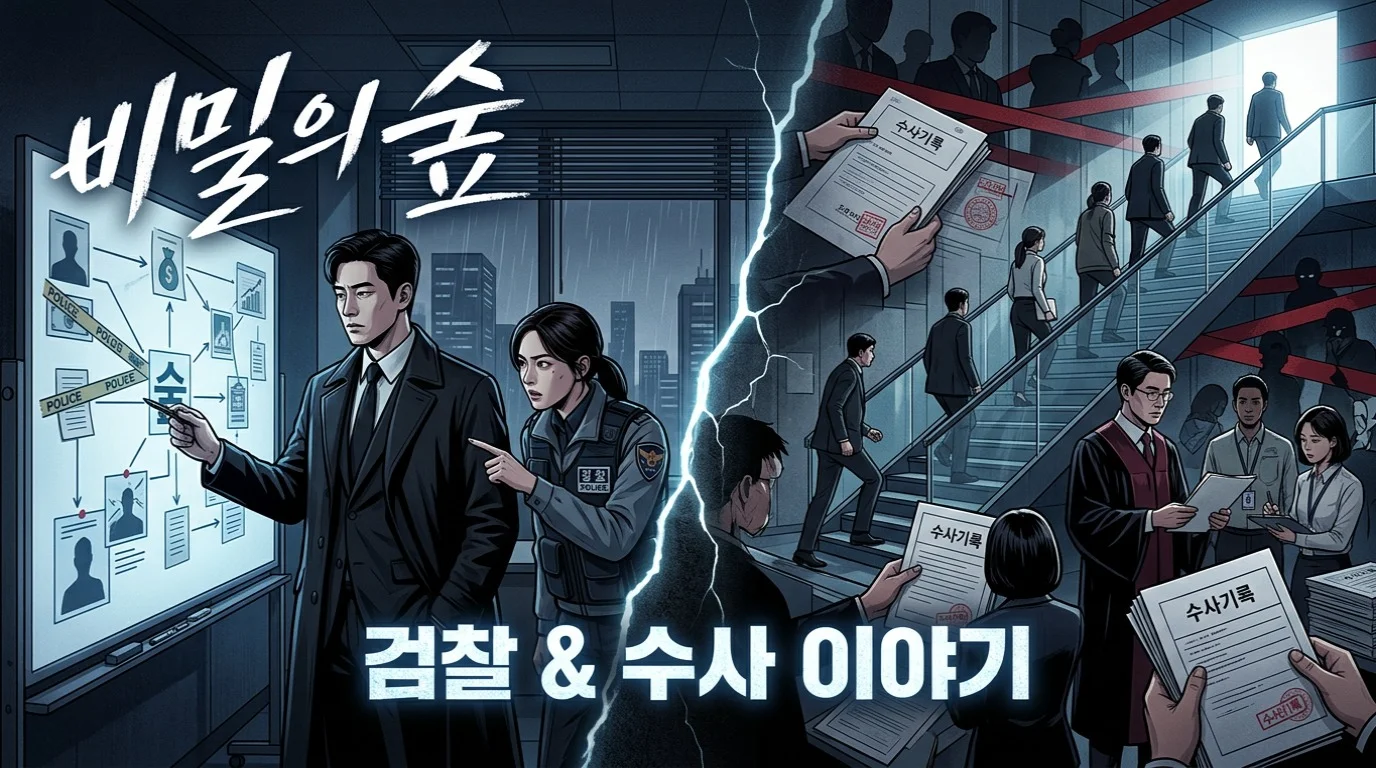
ⓘ This is an unofficial introduction written by an individual creator using JoyStoria to help with appreciating the work and understanding Korea's culture and institutions. Rights to the official videos, photos, posters, logos, characters, and the like of Stranger (Secret Forest) belong to their respective rights holders, and there is no official relationship with the broadcaster or production company. The main image is an AI-made original that uses no real actors or actual scenes from the drama.
🟦 JoyStoria
Korean dramas, deeper and easier.
We guide you through a work's story and cultural background, spoiler-free.
Let's pick your next drama together with JoyStoria.