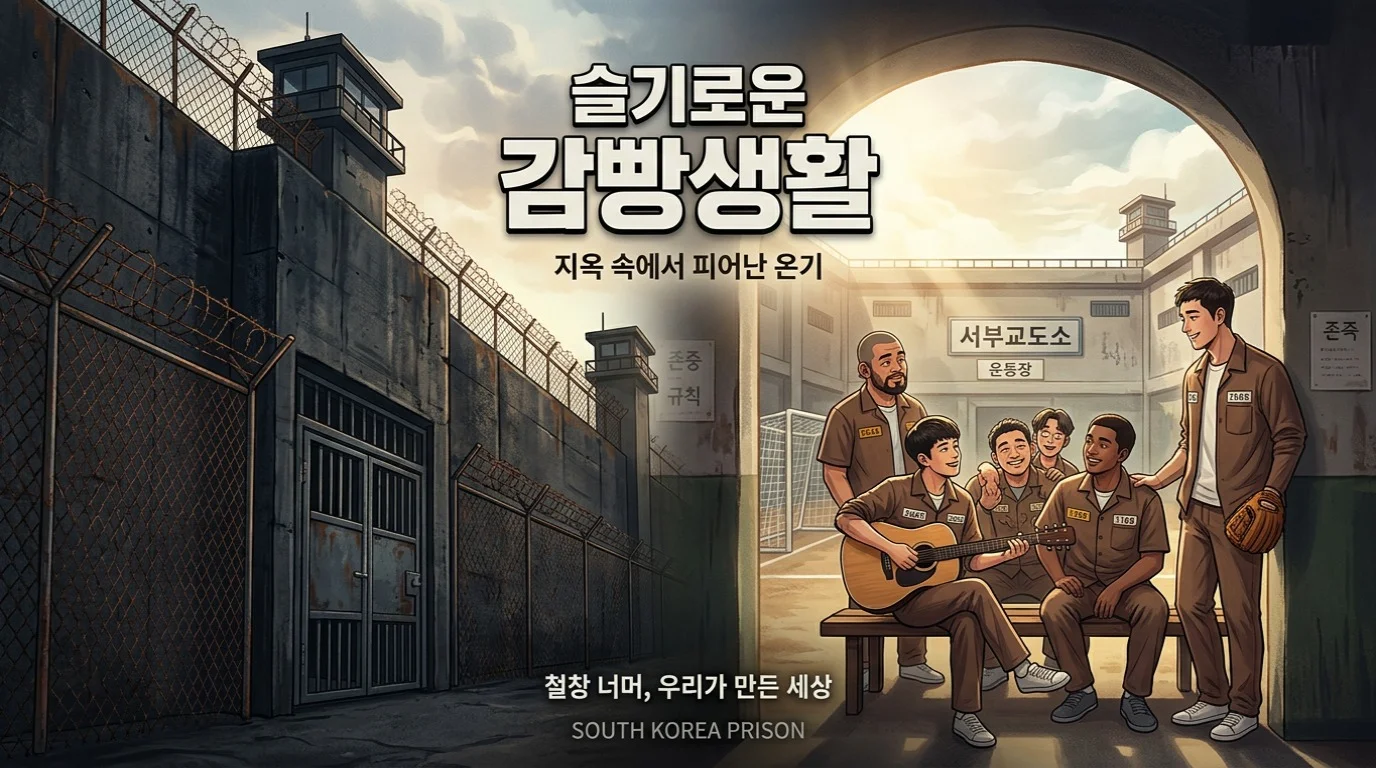
🎬 Prison Playbook: Story & Korean Prison Life — A Spoiler-Free Guide for International Viewers
⚠️ Before you read
This isn't a docudrama that recreates a specific real person or a single real event. That said, the creators interviewed people with real experience of correctional facilities and drew on many real cases to reconstruct the characters and scenes. So it's most accurate to think of it as a fictional drama grounded in real-world research. Many details of correctional life are shown with care, but there is dramatic license, and some terms and rules may differ between its 2017 broadcast and today. Also, where you can watch it (streaming platforms) varies by country and time, so please check the services available in your region.
⏱️ 30-Second Summary
Title · Prison Playbook (2017, tvN, 16 episodes)
Genre · A black comedy set in prison, and a warm human drama
Core · A star baseball pitcher becomes an inmate overnight
Story · The laughter, friendship, and heartache of people living together inside
True story? · Not a strict docudrama, but a fiction grounded in real research
Setting · A modern Korean correctional facility, around 2017
Appeal · The Reply team's signature realism, humor, and human warmth
1. 🎬 About the Show
Prison Playbook (Korean title 《슬기로운 감빵생활》) aired on the Korean cable channel tvN from November 22, 2017 to January 18, 2018, running 16 episodes. Each episode stacks up small events and stories from many characters in an episodic structure — though the running time per episode is longer than a typical drama.
It was directed by Shin Won-ho of the Reply series, with Lee Woo-jung of the same team involved in the planning/story development. The actual script was written by Jung Bo-hoon, who made his debut as a drama writer with this work. It carries the Reply team's trademark lived-in direction and warm humor — but note that Jung Bo-hoon did not co-write the Reply series. (Director Shin Won-ho later directed Hospital Playlist.)
Ratings climbed steadily, starting around 4% for the first episode and rising to about 11% by the finale (Nielsen Korea, nationwide) — a strong result for a cable drama. Which platform currently carries it depends on your country and the timing, so please check your local streaming services before watching.
2. 📖 Plot Preview — Spoiler-Free
The main character, Kim Je-hyuk, is a national-team-level star baseball pitcher everyone knows. When he takes the mound, the crowd roars and his results make the next morning's news — a player at the very top, on the verge of a major contract. His days are filled with training, games, and the fans who cheer him on.
Then one day, he throws himself into a moment when his younger sister is in danger, and unexpectedly gets caught up in a serious incident. It was a choice to protect someone he had to protect, but it leads him not to a glittering ballpark but to the doorway of an entirely different world: prison. This sharp fall "from star to inmate" is exactly where the story begins. That's the setup revealed early on, so knowing it won't spoil your viewing.
Outside, everyone recognized him; inside the walls, he's just an unfamiliar newcomer with a name tag. From how to use the bathroom to mealtimes to how to deal with people, everything is new and must be learned one step at a time. In this place — where a small room is shared by several — there are people of utterly different stories: a con artist, someone from an organized group, someone battling addiction, a long-serving veteran. At first they're wary and clash, but facing one another every day in close quarters, they gradually come to learn each other's circumstances.
There's one more special twist. His old friend happens to work as a guard at this very prison. In the strange positions of one inmate and one officer who manages him, the two meet again. A mix of gladness, awkwardness, and long-standing friendship gives the drama its own particular warmth.
Rather than pushing grand incidents, the drama quietly follows the utterly ordinary days of the people inside these walls. Sharing meals, quarreling over trivial things, laughing hard at nothing much, feeling their hearts waver before visiting family — these moments pile up. Spending the day on a fixed routine, then gathering in a small room at night to share their stories, the prison gradually starts to look like a small society. Laughing, then suddenly moved — despite the heavy subject, it leaves you warm. That's this show's particular rhythm.
How the relationships form among these people, what choices each of them makes, and where Je-hyuk's time flows from here — feeling that for yourself as you watch is the greatest joy of this work. So the rest of the story, I'll leave for you to discover.
3. 🕰️ Setting — Korea's Correctional Facilities
The show is set in a modern Korean correctional facility around the time it aired, in 2017. Early on, a detention center (guchiso) — where people awaiting trial mainly stay — appears; later, a prison (gyodoso) becomes the main stage. When referring to both together, the term "correctional facility" (gyojeong-siseol) is used. Since the way of life may be unfamiliar to international viewers, knowing just a few things makes the scenes much easier to follow.
In official Korean terms, a person held before their sentence is finalized is an unconvicted detainee (misgyeol-suyongja), and a person serving a finalized sentence is a sentenced prisoner (suhyeongja). Together they are all called inmates / incarcerated persons (suyongja). (Casually, the words misgyeol-su and gigyeol-su are also used.) In the show, several inmates mostly live together in a single cell (suyong-geosil) — what people casually call a "gambang." An area or building where many cells are grouped together is called a cell block or housing unit (sadong / suyong-dong). That said, the actual living arrangement and daily routine can differ depending on the facility and the inmate's classification, health, and so on.
When family or acquaintances visit, it's called visitation (jeopgyeon). Money kept in trust for an inmate was called yeongchigeum and is now also expressed with the plainer word bogwan-geum (deposited money). With that money, an inmate can directly buy the food or daily necessities the facility permits, as self-purchased items (jabi-gumae). Rather than treating this backdrop heavily, the show conveys it through the small stories between people, so you can follow along easily even without knowing the system.
4. ⚔️ Key Terms to Know
The word "gambbang" — The "gambbang" (감빵) in the title is a friendly Korean slang word for prison. Think of it as a more casual way of saying "gambang" (cell/jail). So the title 《슬기로운 감빵생활》 carries the meaning "wisely getting through prison life." Just choosing the light word "gambbang" over the heavy, formal "prison" shows how gently and humanely this work looks at incarceration.
The role of "soji" — In the drama, "soji" refers to an inmate who handles a housing unit's cleaning, delivering items, and simple errands — an on-the-ground term. These days, official descriptions sometimes use a plainer expression like "housing-unit cleaner." The fact that even inside there are assigned roles and an order of their own is part of what makes the prison feel like a small society.
5. 👥 Key Characters and Relationships
This is an "ensemble drama" where many characters come together rather than one or two leads. That makes it hard to sum up along a single romance line — it's more fun to look at where each character stands.
Kim Je-hyuk (Park Hae-soo) — The star pitcher at the center of the story. A man who stood at the top in the outside world, he starts over as a first-time inmate for whom everything is new.
Lee Joon-ho (Jung Kyung-ho) — Je-hyuk's old friend, who happens to work as a guard at this prison. His position — facing a friend now as an inmate — adds a special texture to the story.
Kim Ji-ho (Krystal Jung) — Someone Je-hyuk has long shared his heart with. She appears as a person watching over him from the outside.
The main inmates he meets in prison — Yoo Han-yang (Lee Kyu-hyung), who came in over a drug problem; a man nicknamed "Janbaljang" (Kang Seung-yoon); a man called "Captain Yoo" (Jung Hae-in); and the wise veteran Kim Min-cheol (Choi Moo-sung) — people each with a different story who become entangled with Je-hyuk and fill out the drama. (They don't all live in the same cell at the same time.)
The guards — Sung Dong-il, Jung Woong-in, and others appear as officers keeping the prison, forming yet another kind of relationship with the inmates.
How these people become intertwined and what feelings they come to share, I'll leave as a joy for you to discover as you watch.
6. 🎭 Is It a True Story?
It isn't a docudrama that recreates a specific real person or a single event. Kim Je-hyuk and the other central characters, along with the overall story, were created for the drama.
But not everything was made purely from imagination, either. The creators drew on interviews with people who had real experience of correctional facilities and on many real cases, and said they built the characters' backstories and scenes by blending experiences told by different people. So it's most accurate to introduce this work not as a "true story" but as a "fictional drama grounded in real-world research."
7. ✨ Why It's Worth Watching
Its greatest appeal is that "it's a prison story, yet it's warm." Rather than driving toward sensational incidents, it focuses on the faces and relationships of the people living inside. Moments that make you laugh and then tear up follow naturally, so even with a heavy subject it's easy to watch.
As you'd expect from the team behind the Reply series, its skill at portraying ordinary people's daily lives with realism is outstanding. The ensemble structure — where many characters shine in their own place rather than one flashy lead — is another strength. Even set against a correctional facility, a slice of Korean society, what stays with you is that in the end it's a story about the bonds (jeong) between people.
❓ FAQ
Q. It's a prison story — is it dark and violent? No. It's classified as a black comedy and human drama. There are some heavy scenes, but the overall mood is warm and good-humored.
Q. Can I enjoy it without knowing baseball? Yes. The hero being a baseball player is just a setup; you can follow the story with no baseball knowledge at all. The heart of it is the story of the people inside.
Q. Is it based on a true story? It isn't a docudrama recreating a specific real person or single event. That said, it's a fictional drama grounded in real research, built from interviews with people who experienced correctional facilities and from many real cases.
Q. Can I understand it without knowing Korea's correctional system? Yes. Just a few terms introduced here — like unconvicted detainee, visitation, and deposited money — are enough. The drama shows them naturally within the story.
Q. How many episodes are there? It wraps up cleanly in 16 episodes. No long wait for another season — you can watch it all at once.
Q. Where can I watch it? The available platform varies by country and timing. Please search your local streaming services to check.
✅ Quick Checklist Before Watching
It isn't a strict docudrama; it's a fiction made with real-world research.
The setting is a modern Korean correctional facility (detention center / prison) around 2017.
"Gambbang" is a friendly slang word for prison.
Knowing just unconvicted detainee / sentenced prisoner (inmate), visitation, and deposited money is enough.
16 episodes; a black comedy and a warm human drama.
Available platforms differ by region and time, so check in advance.
ⓘ This piece is an unofficial introduction written by an individual creator using JoyStoria, to help viewers enjoy the work and understand its cultural background. The title and rights to 〈Prison Playbook〉 belong to their respective holders, and there is no official relationship with the broadcaster or production company. The cover image is an original illustration created without using any real actors or scenes from the drama.
🟦 JoyStoria
A friendly viewing guide for those meeting Korean dramas for the first time
Spoiler-free, misunderstanding-free, and fun.