🎬 Extraordinary Attorney Woo — A Spoiler-Free Story & Autism Guide for International Viewers
⚠️ A quick note
This is not a historical drama about real past events, but a work of fiction (a created drama) set in present-day Korea. The characters and the "Hanbada" law firm are invented. That said, some of the cases draw their motifs from real lawyers' essays and legal cases, reworked to fit the drama, alongside cases the writer created herself. And Woo Young-woo, too, is a created character, not a direct copy of any real autistic person. Also, where and when you can watch the show may vary by country and time.
⏱️ 30-Second Summary
Title — Extraordinary Attorney Woo (2022, Korea)
Setting — Present-day Korea, the courtrooms and offices of a large law firm
Core — A rookie attorney on the autism spectrum, and the cases she takes on
Story — An episodic courtroom drama with new clients and cases every one or two episodes
Basis — The overall story is fiction, but some cases draw motifs from real legal cases and lawyers' essays
Invented elements — The characters and firm are fictional; the cases mix real references and invention
Appeal — A warm perspective, distinctive characters, and stories that leave you thinking
1. 🎬 About the Show
Extraordinary Attorney Woo is a 16-episode drama that aired on Korea's ENA channel from June 29 to August 18, 2022. It was directed by Yoo In-sik and written by Moon Ji-won, with Astory, KT Studio Genie, and Nangman Crew taking part in the production.
As it aired, the show grew more and more talked-about in Korea, and through Netflix it reached audiences in many countries, drawing wide interest at home and abroad. The platforms where you can watch it may change by country and over time, so before you start, it's worth checking which service carries it in your region. (This is for reference and may change.)
2. 📖 Story Preview — Spoiler-Free
The main character, Woo Young-woo, is a young attorney on the autism spectrum. She has an astonishing memory that rarely lets anything she's seen slip away, and a remarkable mind that recalls vast passages of law as if she'd memorized whole volumes. She graduated at the top of her class from Seoul National University's law school (the graduate-level law school, or beophak jeonmun daehagwon) and passed the bar exam with distinction. Yet despite that dazzling résumé, a place willing to take her on doesn't come easily. The story begins when Woo Young-woo finally steps into the large law firm "Hanbada" as a new attorney.
Her day looks a little different from the lawyer we usually picture. On her way in, she pauses for a moment before the revolving door; she has her favorite gimbap (Korean seaweed rice rolls) for lunch; and above all, when it comes to whales, her eyes light up and she'll talk about them endlessly. These small moments settle in between the stiff courtroom scenes, letting you get to know Woo Young-woo little by little.
Inside the firm, she meets many people for the first time — a senior attorney who leads the newcomers, a peer from her school days, a staff member who treats her warmly, and a colleague whose view of her is rather different from the rest. Woo Young-woo has outstanding ability, but making eye contact, reading the room, and building relationships don't come easily to her. The world marvels at her talent yet finds her unfamiliar, and at times casts doubt — "can she really handle a lawyer's work?" — or looks at her with prejudice.
The story unfolds case by case, with new clients each time. Some cases bring laughter, some leave a lump in your throat, and some quietly ask, "what is the right thing to do?" Woo Young-woo looks at the points others tend to miss in her own way, bumping into her colleagues and also helping them. The stage of the courtroom and the days of a newcomer fresh out into society naturally overlap here.
From here on, who Woo Young-woo meets and what relationships she forms, and what choices she makes in the face of each case, we'll leave as the joy of watching for yourself.
3. 🕰️ Background
The story is set in present-day Korea, with a large law firm and courtrooms as its main stage. Rather than a serial that follows a single case from start to finish, this is largely an episodic courtroom drama that meets a new client and case every one or two episodes. Each case stands somewhat on its own, but the relationships between Woo Young-woo and her colleagues carry on across all the episodes.
One more thing worth knowing: in Korea today, you generally have to complete a three-year graduate law school (beophak jeonmun daehagwon) and then pass the bar exam to qualify as a lawyer. After that, many gain hands-on experience working alongside senior attorneys at a firm or legal institution. That's why this drama also carries the texture of workplace life — "newcomers and seniors," and "the rivalry and friendship among peers."
4. ⚔️ Key Concepts to Know
There are two ideas worth knowing to enjoy this show.
Autism Spectrum Disorder (ASD) — a developmental trait that appears very differently in degree and character from person to person. Just as the word "spectrum" suggests, it spans a wide range, like a broad rainbow, and looks different in everyone. It can show up in ways of communicating, in the senses, in interests, and more.
Savant ability (a "savant" trait) — refers to cases where someone shows an exceptional ability in a specific area such as memory, calculation, music, or art. Woo Young-woo's extraordinary memory often calls a savant trait to mind, but the show does not clearly present this as a separate, formal diagnosis. And such abilities do not appear in every autistic person. (We'll continue this distinction in section 6 below.)
5. 👥 Central Characters and Relationships
Woo Young-woo (played by Park Eun-bin) — the attorney at the center of the story. She is on the autism spectrum, and with her outstanding memory and distinctive way of observing, she finds the threads of a case that others have missed. She is someone who expresses the principles she holds dear honestly and clearly.
Lee Jun-ho (played by Kang Tae-oh) — someone who works alongside Woo Young-woo at Hanbada and treats her warmly. How the relationship between the two is drawn from here, you can see for yourself.
Jung Myung-seok (played by Kang Ki-young) — the senior attorney who leads Woo Young-woo's team. He's in the position of guiding the newcomers.
Choi Su-yeon (played by Ha Yoon-kyung) — Woo Young-woo's university peer and a colleague at the same firm. Their relationship is drawn as close yet laced with subtle feelings.
Kwon Min-woo (played by Joo Jong-hyuk) — another new attorney. His view of Woo Young-woo is quite different from the others', a character who adds tension to the story.
Han Seon-yeong (played by Baek Ji-won) — a figure in a position of leading the firm.
This drama can't be narrowed down to any single kind of relationship (romance, for instance). Prejudice and understanding, rivalry and friendship, growth and independence — many layers of relationships overlap, so watching who each character is and where they stand makes it far richer.
6. 🌿 Understanding the Autism Spectrum
For international viewers, the part that draws the most curiosity — and is easiest to misunderstand — is the topic of "autism." Keeping a few things in mind makes the show much easier to watch.
First, the autism spectrum is not one fixed image. From person to person, ways of communicating, sensory sensitivities, interests, learning styles, and the support needed in daily life differ greatly. Some people are highly fluent in speech; others need a great deal of support with speech or other means of communication.
Second, not every autistic person has a special memory or genius-level ability. Woo Young-woo's extraordinary memory and problem-solving are a creative device emphasized for the sake of a drama's lead. Some autistic people may show outstanding ability in a particular field, but this is not what autism generally looks like.
Third, the autism spectrum is understood not as an illness to be cured away like a cold, but as a lifelong neurodevelopmental trait and disability. Depending on the person, some live independently while others need ongoing support in daily life. Individualized education and support that help with communication, the senses, and daily living can make a difference — and it matters to see an autistic person's life neither as merely "a disability to overcome" nor romanticized as only "a special gift," but to hold their many traits and their needs together, as one whole person.
7. 🎭 The Show's Portrayal vs. Reality — How Far to Take It
Extraordinary Attorney Woo has been praised for warmly introducing the autism spectrum to a wide audience, while also drawing comments that it differs from reality. Telling these two apart lets you enjoy the show in a healthier way.
Devices made because it's a drama — giving the lead an extraordinary ability and letting cases resolve dramatically in a short time are devices for the sake of storytelling.
The diversity of reality — the lives of real autistic people are far more varied, and most live their own daily lives without a drama-like special ability. The prejudice and difficulties can also be more complex than what's on screen.
Something to keep in mind — this drama is a fine "starting point" for understanding autism, but it isn't the whole of it. Let the interest it opens up lead you toward real stories, too.
8. ✨ What Makes It Shine
There are many reasons this show moved so many hearts. Woo Young-woo's honest, singular way of seeing the world makes even the familiar feel new. The cases in each episode go beyond mere courtroom disputes to quietly ask "what is right," and rather than handing you an answer, they leave you something to think about.
Park Eun-bin's delicate performance in the lead, the vividly distinctive supporting characters, and a warm tone that heats the heart without weighing it down are all big draws. Somewhere between laughter and a tug at the heart, you may find yourself coming to look upon "difference" with a little more generosity.
❓ FAQ
Q. Can I watch it even if I know nothing about Korean dramas or autism? Yes, you'll be fine. It's made to be enjoyable without any background. Just reading sections 6 and 7 of this guide will make it even easier.
Q. Is it based on a true story? It isn't a work that transplants any one person's true story. The characters and the firm are invented, but some cases draw their motifs from real lawyers' essays and legal cases, reworked for the show.
Q. Is an ability like Woo Young-woo's what autistic people are generally like? No. Cases where someone shows outstanding ability in a specific area (a savant trait) are found only in some autistic people. Woo Young-woo is a character created for the story.
Q. How many episodes are there, and where can I watch it? There are 16 episodes in total. The platforms available vary by country and time, so please check the services in your region. (Subject to change.)
Q. Is it a heavy drama? It deals with the courtroom, but the overall tone is warm and easygoing. With both laughter and emotion, it's easy to watch without strain.
Q. Is romance the center of it? Romance is one thread, but growth, prejudice, friendship, and more are woven together, so it's hard to see it as only that.
✅ Quick Checklist
It's a work of fiction, not real history or a true story.
The lead is a created character on the autism spectrum with an extraordinary memory.
Autism varies greatly from person to person, and special abilities appear in only some people.
It's an episodic courtroom drama with new cases every one or two episodes.
16 episodes in total; viewing platforms differ by region and time (subject to change).
If you want to enjoy it spoiler-free, see the ending for yourself!
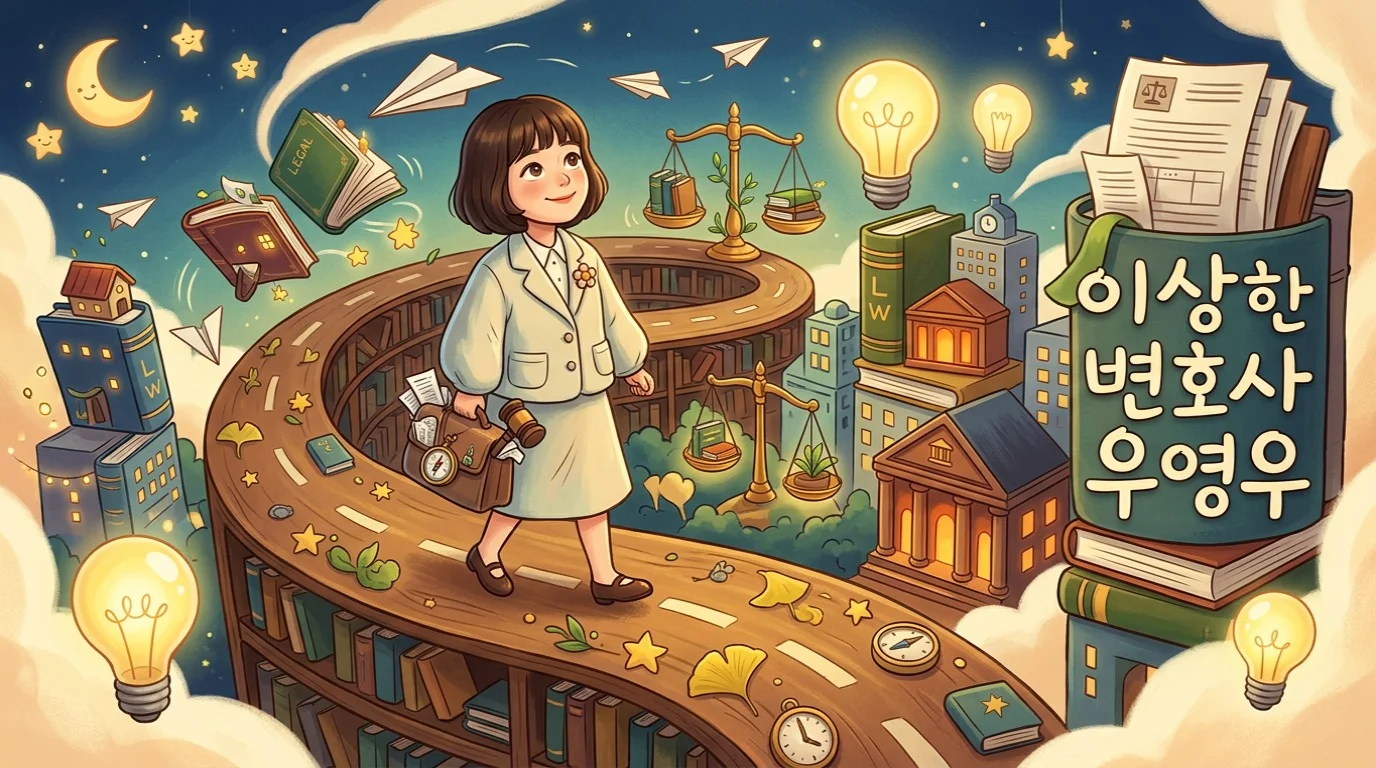
Image: created with AI by a JoyStoria contributor · an unofficial original illustration unrelated to any actual drama scenes or cast members
ⓘ This piece is an unofficial introduction written by an individual creator using JoyStoria, to help with appreciating the work and understanding the autism spectrum and Korean culture. The copyright, trademark, and other related rights to 〈Extraordinary Attorney Woo〉 belong to their respective holders, and this piece has no official relationship with the broadcaster, production companies, cast, or original rights holders. The main image does not use real actors or drama scenes; it is a separately created original illustration.
🟦 JoyStoria
We share dramas, culture, and history in an easy, warm way, at an international viewer's eye level.
Look forward to the next story! 💙