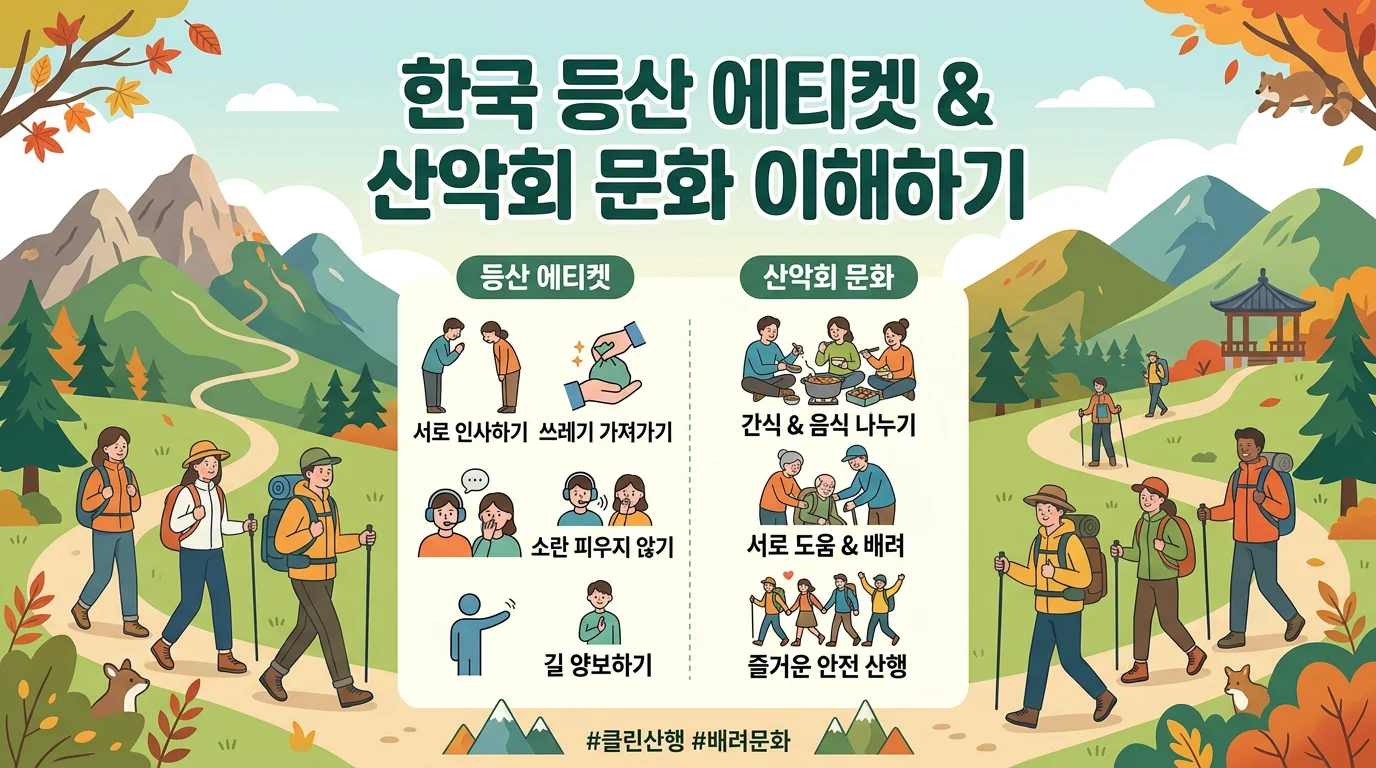
⛰️ Understanding Korean Hiking Etiquette & Hiking-Club Culture
1. Why do Koreans love hiking so much?
Accessibility: In Seoul alone, many mountains — Bukhansan, Gwanaksan, Inwangsan — are reachable from downtown by subway.
Four-season charm: Spring blossoms, summer greenery, autumn foliage, winter snowscapes — the scenery changes with every season.
Socializing & health: There's a strong culture of climbing together with friends, colleagues, and clubs, sharing camaraderie.
💡 During peak autumn-foliage season (October–November), popular mountains get very crowded. It's best to start early.
2. Basic etiquette on the mountain
Greetings: There's a custom of exchanging a light "Annyeonghaseyo" when you pass others on the trail (especially with older folks). If someone greets you first, return it warmly 😊
Yielding: On narrow trails, those going down usually step aside briefly to make way for those coming up.
Carry your trash out: Korean mountains rarely have trash cans. Taking your trash back with you is basic etiquette.
Protect nature: Stay on designated trails, and don't write on or break plants and rocks.
Summit photos: The line for photos at the summit marker can be long. Wait your turn and don't hog it.
🐢 Pace tip: Korean hikers often walk faster than you'd expect. But it's totally fine to go up slowly at your own pace — don't overdo it!
3. Safety etiquette worth knowing
Drinking: Drinking makgeolli at the summit used to be common, but lately there's a strong move to refrain from drinking while hiking for safety.
National park rules: National parks may have rules on drinking, cooking, and smoking for safety and nature protection, so check before you go.
Smoking/fire: Smoking and open flames are prohibited in many areas due to fire risk.
Entry hours: National parks have set entry hours (usually restricted before sunrise/after sunset). Avoid reckless night hikes.
Check the weather: Mountain weather is fickle. Check forecasts for rain, snow, and strong wind in advance.
4. Hiking-club culture
Korea has tons of hiking clubs (sanak-hoe). They come in many forms — company, neighborhood, online groups, etc.
Bus hikes: Clubs usually charter a tour bus and go as a group, an efficient way to visit famous mountains nationwide.
Sharing culture: People sometimes share snacks or fruit at the summit or rest areas. It's not a must, though, and it's fine to politely decline.
Socializing-focused: After a hike, people often eat together (usually makgeolli, pajeon, gukbap) to bond.
Foreigner participation: Many groups welcome foreigners. There are foreigner-friendly, English-language hiking groups like the "Seoul Hiking Group," so you can climb together even on your own.
💡 If you've come alone, joining a foreigner-oriented hiking group (via SNS, Meetup, etc.) lets you make friends and hike safely.
5. Hiking clothing & gear culture
"Full-gear" culture: Korean hikers tend to fully kit out — functional hiking clothes, boots, poles, and a backpack. Many wear hiking boots even on easy mountains.
Essentials: Non-slip hiking boots, water, snacks, a thin extra layer (for changing weather), a hat & sunscreen.
Hiking poles: Popular for protecting the knees, especially useful on the way down.
Gimbap + water: Gimbap eaten on the mountain is a classic! Buy it at a convenience store beforehand.
6. Practical tips foreigners often ask about
🚻 Restrooms: There are often few restrooms mid-trail. Use the ones at the entrance or visitor center first.
💳 Little cash needed: National park admission is mostly free, and many visitor centers/parking lots/shops take cards.
📱 Hiking apps: For directions, use Naver Map, KakaoMap, or the Korea National Park Service app to check trails and closed sections.
🐗 Wildlife: You may encounter wild boar or water deer, but they mostly avoid people. Don't feed them or get close.
7. Popular mountains near Seoul for foreigners
Difficulty and courses vary by person — just a reference.
Bukhansan National Park — Seoul's top iconic mountain, with varied courses (beginner–advanced) and city views
Bugaksan — A course with great Seoul fortress-wall and city views
Namsan — A stroll-style course even beginners can climb easily
Gwanaksan — Near Seoul National University, good access
Achasan — Gentle, popular for beginners and sunrise hikes
✅ Pre-hike checklist
Boots, water, snacks, extra layer
Check the weather & entry hours
Check the course & closures with a hiking app
Use the restroom at the entrance first
A bag to carry your trash out
Say "Annyeonghaseyo" when you pass others 😊
🟦 A guide from the CultureHub team.
📅 Updated: 2026 · ⚠️ National park entry hours, closed sections, and drinking/cooking/smoking rules vary by mountain and season. Check the park's official information before hiking.