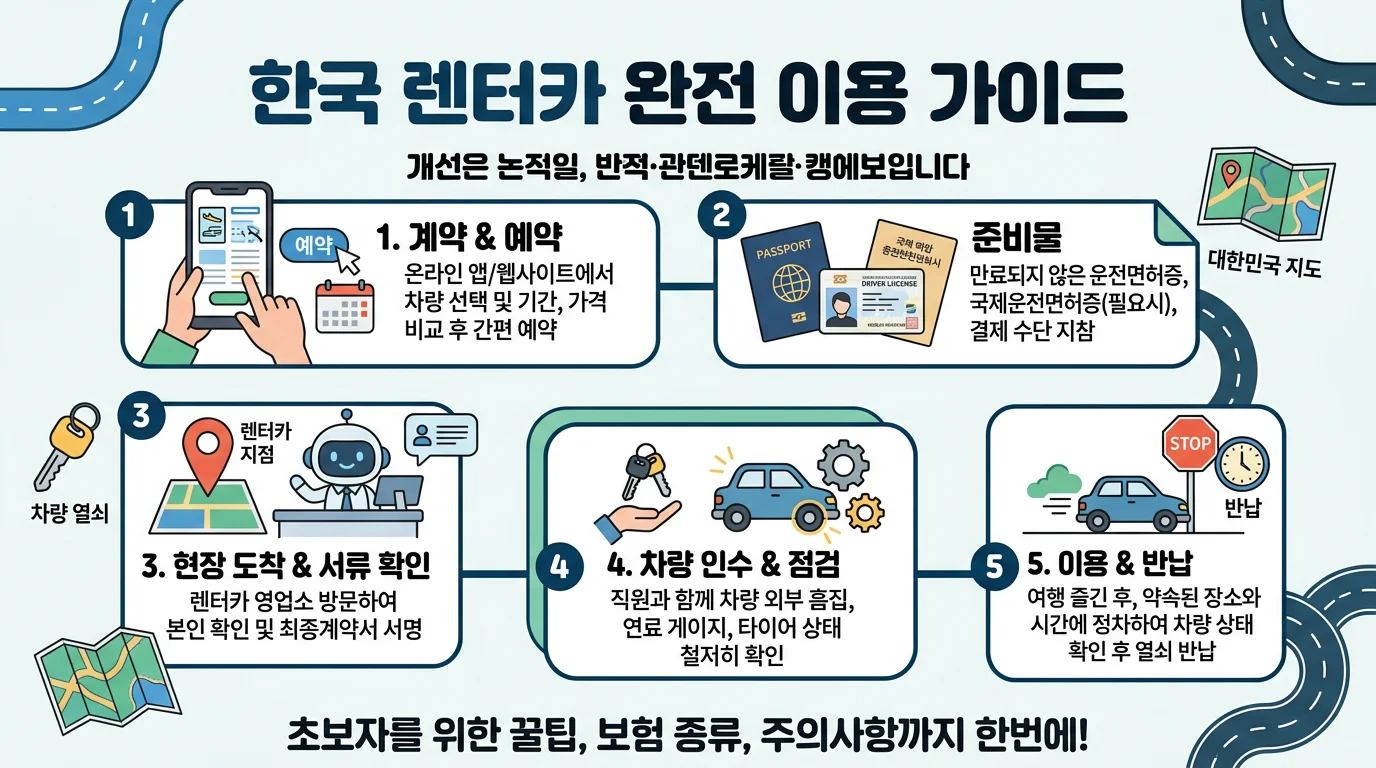
🚗 The Complete Guide to Renting a Car in Korea
⏱️ 30-Second Summary — Must-Remember
🪪 Required documents → IDP + home-country license + passport (all three!)
🛡️ Insurance → Get the "full (super) CDW"! Your out-of-pocket cost varies hugely by tier
💸 Hidden costs → Watch for the deductible + loss-of-use fee
⛽ Fuel → Always confirm the car's fuel type (gasoline/diesel/LPG/electric)
🛣️ Hi-pass → Check whether both the device AND the card are included
🚓 Road rules → Drive on the right; speed and DUI enforcement are very strict
1. 🪪 Driving Eligibility & Required Documents (Most Important!)
To drive in Korea as a foreigner, you must carry all three documents. Miss even one and the rental will be refused.
① International Driving Permit (IDP): Must be issued by a country in the Geneva Convention (1949) or Vienna Convention (1968). Get it in your home country before departure. (Foreigners cannot obtain an IDP within Korea.)
Validity: An IDP is usable within the issuing body's validity period, and in Korea you can generally drive for up to one year from your date of entry. This can vary depending on your license's validity and your residence status.
⚠️ Mainland China does not operate the IDP system, so it can't be used. Some countries like Taiwan and Indonesia may not be recognized depending on the permit format and convention membership, so check before departure. (Hong Kong and Macau IDPs are accepted.)
⚠️ Only the original is accepted. Photos, PDFs, and copies don't count, and IDPs from private companies are not accepted.
② Home-country driver's license (original): An IDP does not replace your license. You must carry your home license at all times with it. (Usually a full license held 1–2+ years.)
③ Passport: For identity and date-of-entry verification. (Agencies may check your entry date via passport or flight ticket.)
Payment card: A credit/debit card in your own name (able to process international payments) is required. Cash alone usually isn't enough to rent.
Experience/age: Usually 21+ with a license held 1–2+ years. Some premium/large vehicles have higher age requirements.
⚠️ Driving without an IDP can be punished as driving without a license. Rental companies will refuse you outright without one.
2. 🚙 The Rental Process, Step by Step
Reserve: Booking online (English supported) with companies like Lotte, SK, Hana, or local Jeju operators is convenient. Larger companies tend to have clearer insurance terms.
Pick-up: Present your passport, IDP, home license, and card at the counter and sign the contract.
Inspection (important!): With staff, carefully check existing scratches and the fuel level, and record it with photos/video. Photograph not just the exterior but also the tires, wheels, windshield, and interior — it's the surest way to avoid repair-cost disputes at return.
Return: Usually return it at the same fuel level as pick-up (if you got a full tank, return it full). A shortfall is billed. Check the car's condition together at return as well.
3. 🛡️ Insurance (Where the Most Money Is at Stake!)
Korean rental insurance is a basic comprehensive policy + self-damage insurance (optional) structure. It's the part foreigners find most confusing and lose money on, so let's look closely.
Included comprehensive insurance (liability for others / passenger injury)
Covers harm to other people, other vehicles, and property in an accident. Most cars include it by default.
⚠️ But it does not cover damage to your own rented car. That's why you need self-damage insurance.
Self-damage insurance (CDW) — get it!
This covers damage to the car you rented. Your out-of-pocket cost varies greatly by tier.
Basic CDW: Covered, but in an accident you pay a deductible + loss-of-use fee. Repair costs above the coverage limit are also on you.
Full (premium) CDW: Within the coverage limit, repair + loss-of-use fees are waived. Some cases (like single-vehicle accidents) may carry a small deductible.
Super (top-tier) CDW: Most have no or a very low deductible, and even waive the loss-of-use fee. However, coverage limits and exclusions vary by company.
⚠️ Self-damage insurance can usually only be added at the moment of contract. You can't add it later, so decide at the start.
Two hidden costs to know 💸
Deductible (your share): Even with insurance, you pay at least this amount in an accident. It can differ by tens of thousands of won or more depending on the car and insurance tier.
Loss-of-use fee: A charge for the company's loss while the damaged car is being repaired. Usually calculated as 50% of the daily rental rate × repair days. Pricier cars cost more.
Items often EXCLUDED from self-damage insurance (the #1 source of disputes!) ⚠️
Tire damage, wheel damage, glass (windshield/side mirrors), and lost car keys are often excluded. Before signing, be sure to check the coverage scope and exclusions.
⚠️ Accidents involving imported (foreign) cars can sharply increase repair, deductible, and loss-of-use costs. Where possible, pick a plan with a single combined deductible (not split by category) and a full or super CDW.
When insurance won't apply (caution)
DUI/unlicensed driving, an unregistered person driving, failure to report immediately, or vehicle misuse may void coverage. Always report any accident to the rental company immediately.
4. 🚑 If You Have an Accident
Don't panic — go in order!
① Secure safety: Turn on hazard lights; if anyone is injured, call 119 (ambulance/fire).
② Call police: For injuries or disputes, call 112 (police).
③ Report to the rental company: Contact the rental company's 24-hour accident line immediately. Without reporting, self-damage coverage may not apply.
④ Record the scene: Photograph the location, vehicles, the other party's info, and plate numbers.
Tip: Dashcams are common in Korea, so footage is important evidence in an accident.
5. ⛽ Fueling (Always Confirm the Fuel Type!)
Putting in the wrong fuel can cause costly engine damage. Always confirm the car's fuel type.
Check the label: Pumps clearly show "휘발유 (Gasoline)," "경유 (Diesel)," and "LPG" — make sure it matches your car's fuel. (Brands use different colors, so don't rely on color!)
Self vs. full-service: Self-service stations are cheaper; some have attendants.
Self-fueling steps: ① Pay (card/cash) → ② Select fuel → ③ Select amount → ④ Insert the nozzle and fuel up. (Some screens support English.)
Return tip: Keep your fuel receipt just before return — it helps prevent disputes over the fuel level.
Tip: When renting, always ask the staff, "What fuel does this car take?"
6. ⚡ Electric (EV) Rental Cars
EV rentals are common now (especially on Jeju).
Charging time: Fast charging usually reaches about 80% in 20–40 minutes (varies by car and charger). Slow charging takes longer.
Apps/cards: Operators differ by station, so you may need a charging card or app. When renting, ask whether a charging card is provided and how to use it.
Range caution: Check the battery level and charger locations before setting out. Range drops in winter.
7. 🛣️ Hi-pass (Expressway Tolls)
Korea's expressways are tolled. There are two ways to pay.
Hi-pass: With a device installed, you're charged automatically just by passing through the dedicated (blue) lane.
⚠️ Some cars have only the Hi-pass device and no card. Be sure to confirm whether both the device AND the card are included when booking or picking up.
Regular lane: Without Hi-pass, enter the regular (cash/card) lane and pay at the tollgate.
Tip: Identify the Hi-pass vs. regular lanes in advance before entering. If you wrongly enter a Hi-pass lane without it, you'll have to settle later. The rental company may also bill the toll to your card afterward.
8. 🅿️ Parking (What Foreigners Find Most Confusing!)
Payment: Most public lots use card payment or a pre-payment machine. Some use license-plate recognition, and charges may be billed after you return the rental.
Where to park: Use public lots and building garages, and avoid spots without white lines or resident-priority spaces (marked with numbers).
Contact-note culture: Koreans often leave a phone number on the windshield when parking, but for a rental you don't need to leave personal contact info. Just use designated parking areas.
9. 🚓 Korean Road Rules (Foreigner Cautions!)
Drive on the right: Cars travel on the right side (same as the U.S. and mainland Europe).
Speed limits: Expressways 100–110 km/h, city 50 km/h, school zones 30 km/h. Speed and section-enforcement cameras are everywhere!
No drunk driving: Enforcement is very strict (around 0.03% BAC). The safe rule is don't drive if you've had even one drink. (Penalties are severe.)
👶 Child car seats: Children under 6 must use a car seat. Request one in advance when booking if needed.
Seat belts: Mandatory in all seats.
No phones: Handheld phone use while driving is prohibited.
Bus lanes: Solid blue lines mark bus-only lanes; regular cars may not enter.
Fines: Camera and parking violations are billed via the rental company, sometimes with an admin fee.
10. 🚸 Common Road Signs
Signs foreigners often confuse — good to know.
School Zone (어린이보호구역): Keep to 30 km/h
Speed Camera (단속중): Speed-enforcement zone
Roundabout (회전교차로): Cars already in the circle have priority
One Way (일방통행): Travel in one direction only
U-turn (유턴): Only in permitted zones/signals
11. 🗺️ Navigation & Directions Tips
Recommended apps: Google Maps' driving directions are limited in Korea, so it's far handier to use TMAP, KakaoNavi, or Naver Map. (Also check whether the rental's built-in nav supports English.)
Search tip: On Korean nav apps, searching by phone number or place name is often easier than by address.
12. 🗺️ Good to Know
Jeju caution: Jeju has very high rental-car use, so roads near the airport get congested in peak season. Drive with extra room, especially at right turns, roundabouts, and tourist-spot parking lots. (Reserve a car early in peak season.)
Car-sharing alternative: Services like SOCAR and Greencar exist, but they require Korean phone/identity verification, so short-term foreign tourists may not be able to use them. A regular rental is usually easier.
13. Common Questions from Foreigners ❓
Is just an IDP enough? → No! You must carry IDP + home license + passport, all three.
Can I make an IDP in Korea? → No. Get it in your home country before departure.
Do I have to get self-damage insurance? → Yes, it's effectively essential. A full/super CDW greatly reduces your burden in an accident.
Are tires/glass covered? → Tires, wheels, glass, and lost keys are often excluded. Check the coverage scope before signing.
How much do I pay in an accident? → It depends on your CDW tier. A deductible + loss-of-use fee may apply, so choosing the tier well matters.
Can I use car-sharing (SOCAR, etc.)? → It needs Korean identity verification, so it's hard for short-term tourists. A regular rental is simpler.
Are there countries whose IDPs don't work? → Mainland China has no IDP system (not usable); for Taiwan, Indonesia, etc., check before departure. (Hong Kong and Macau are fine.)
✅ Quick Checklist
Bring IDP (original) + home license + passport — all three
Prepare a credit/debit card in your own name
Get full (super) CDW (only possible at contract time!)
Check the deductible, loss-of-use fee, and exclusions (tires/glass/keys)
At pick-up, photograph scratches, tires, glass, and interior
Confirm the car's fuel type (gasoline/diesel/LPG/electric)
Confirm Hi-pass device + card included
Prepare nav apps like TMAP/KakaoNavi (search by phone number/place name)
In an accident, report to the rental company immediately + 112/119
No drunk driving; 30 km/h in school zones; car seat for under-6s
🟦 A guide put together by the CultureHub team.
📅 As of 2026 · ⚠️ License, insurance (deductible/loss-of-use/exclusions), tolls, and traffic rules vary by company and policy and may change. Always confirm with the rental company and official sources before booking/signing.