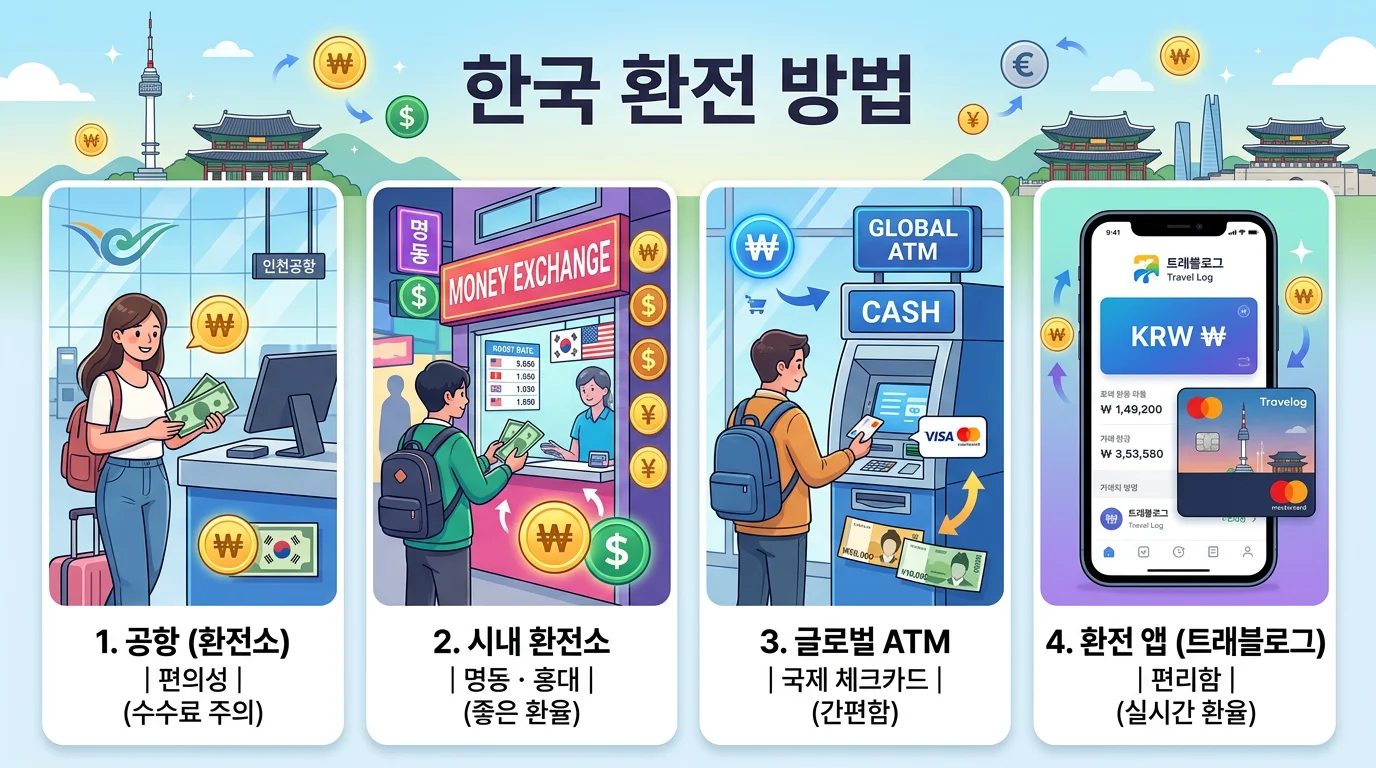
💱 How to Exchange Money in Korea
⏱️ 30-Second Summary — Just Remember This!
🏆 Rates (generally) → Myeongdong·Namdaemun shops tend to be favorable (banks can be better during preferential-rate events)
✈️ Airport → Only a small amount (transit + first meal, about ₩30,000–50,000)!
🏙️ Myeongdong·Namdaemun → Exchange larger amounts here
🏧 Global ATM → Look for the 'Global ATM' label + always select KRW
💳 WOWPASS·travel cards → Convenient alternatives for foreigners
1. 💡 Know This First (Korea's Payment Culture)
A card powerhouse: Most restaurants, convenience stores, taxis, and hotels take cards. Treat cash as a backup. In Seoul you can travel almost entirely by card. (In regional traditional markets, cash is handy.)
Where cash is needed: Traditional markets, street food, temple donations, some coin laundries/lockers, some small restaurants, and topping up a transit card (T-money).
Apple Pay: Apple Pay support has grown in Korea, but it doesn't work everywhere.
No tipping: Korea has no tipping. The menu price is what you pay.
How much to exchange? If you mostly use cards, ₩100,000–200,000 in cash per week is generally enough. (Depends on your style.)
💡 Bottom line: Only a little at the airport; exchange larger amounts in the city (Myeongdong) or via WOWPASS/ATM! Since converting back is a loss, exchange in small increments.
2. ✈️ Airport Exchange (Convenient, but Rates Are Unfavorable)
Traits: The most convenient since you can exchange right after landing, but generally less favorable than city exchange shops.
Recommended strategy: Change only your transit + first meal (about ₩30,000–50,000). Do the rest in the city!
Location·hours: Incheon Airport Terminals 1 and 2 have exchange counters and bank booths on the arrivals floor. (Some are 24h, others have set hours — check the signs.)
Airport ATM tip: Foreigners use airport ATMs a lot too. In some cases an ATM beats the exchange counter. (Select KRW when withdrawing won.)
3. 🏙️ Myeongdong·Namdaemun Exchange Shops (Generally the Most Favorable)
Traits: The private exchange shops in Myeongdong and Namdaemun Market tend to offer generally the most favorable rates. That said, with a bank's preferential-rate event, a bank can sometimes be better.
How big a difference? It varies greatly by currency and timing, but the larger the amount, the easier it is to feel the rate difference.
Favorable currencies: USD, EUR, JPY, and CNY get especially good rates due to high volume. In particular, crisp US $100 bills (large denominations) often get the best rate.
Location·hours: Well-known spots include the areas near Myeongdong Station exits 5, 6, and 7, and the Daesagwan-ap (embassy-area) shops. Many operate around 10:00–20:00 (varies by shop).
💡 Tip: Even "no commission" can have the fee baked into the rate. Always check the actual won amount you'll receive, and count the bills on the spot. Some shops require a passport.
4. 🏦 Bank Exchange
Traits: Foreigners can exchange at banks too. Rates are generally reasonable, and can be favorable during preferential-rate events.
What you need: A passport. Use a major bank branch (Hana, Shinhan, Woori, etc.) near tourist areas.
Note: There can be a wait, so unless you're exchanging a very large amount, an exchange shop or ATM may be easier.
5. 🏧 ATM Withdrawals (Global ATM)
You can withdraw won with a foreign card at Korean ATMs. But there are a few rules.
Find a 'Global ATM': Only machines labeled
Global ATMorGlobal Serviceaccept foreign cards. It's easier if the machine also shows the VISA / Mastercard / UnionPay / JCB logos. Common at Woori, KB Kookmin, Citibank, Hana, and convenience stores (GS25, CU, 7-Eleven, Emart24).Always select KRW: If the ATM asks "Charge in your currency?",
Always choose KRW (South Korean Won). Choosing your home currency means DCC (Dynamic Currency Conversion) and a worse rate (a hidden 3–5% markup).Fees: About ₩3,000–6,000 Korean-side fee per withdrawal (+ your home bank's fee). Some bank ATMs may have no extra Korean-side fee. Withdrawing more at once beats many small pulls.
Limits·hours: Per-withdrawal limits vary by ATM. Convenience-store ATMs usually run 24/7; bank ATMs may block foreign cards late at night.
PIN note: Korean ATMs usually accept only a 4-digit PIN. A different length may fail.
When it fails: If your card is declined, try a different machine or card, or check with your home bank about overseas-withdrawal blocks. Woori Bank's foreigner hotline (1599-2288) can locate the nearest Global ATM in multiple languages.
6. 💳 WOWPASS — A Prepaid Card Made for Foreigners
The most popular method among foreign travelers now. Exchange + payment + transit in one card!
How it works: Load foreign cash or a card at a kiosk, and it's automatically converted to won onto the card. You then pay and ride transit with it.
Rates: Better than the airport, a bit shy of Myeongdong's best — a mid/decent level. In exchange, it's convenient: available 24/7 at subway-station kiosks.
Getting one: Pick it up at the bright-yellow WOWPASS kiosks (Incheon Airport arrivals, Myeongdong, Hongdae, Dongdaemun, Seoul Station, Busan) or convenience stores (CU, GS25, 7-Eleven). The card issuance fee can change by policy (around ₩6,000 as of 2026, one-time).
T-money combo·top-up: Choose the card with T-money and you can ride the subway/bus right away. These days you can top up T-money in the app too (not cash-only like before).
Refunding the balance: Leftover spending balance can be withdrawn as cash at city WOWPASS kiosks — usually ① register in the app → ② verify PIN in the app → ③ withdraw at the machine. (A per-transaction fee and limit apply.)
⚠️ Airport kiosks can't dispense cash (no refunds). If you need cash on arrival day, use the airport bank counters or ATMs. The card stays valid for years, so it's reusable on a return trip.
💡 A similar kiosk-based card is the Namane card. It works on the same principle, but WOWPASS has a bigger network and recognition.
7. 🌍 Travel Cards & Exchange Apps (Wise, Revolut, etc.)
You can also handle it cash-free with cards/apps.
Wise·Revolut, etc.: Spend won at near mid-market rates in the app, or withdraw at a Global ATM. Pairing with a 0% foreign-transaction-fee card is advantageous. (Among Korea travelers, Wise tends to be used more than Revolut.)
Free withdrawal limits: Each card has a monthly free-withdrawal limit, with fees beyond it. (Check your card's terms.)
Caution — domestic-only terminals: Some small restaurants in Korea are domestic-card-only and may decline foreign cards. In particular, self-service kiosks sometimes don't read foreign cards. In those cases you'll need cash or WOWPASS.
Bottom line: As of 2026, the most stable setup is a travel card (big purchases) + WOWPASS (daily/transit) + a little cash.
8. ⚖️ At a Glance
Myeongdong·Namdaemun shops → generally favorable, good for large amounts / must go into the city
Airport exchange → most convenient, rates unfavorable / small amounts only
Bank counter → reasonable rates, good during events / passport needed, waits
Global ATM → convenient, must select KRW / withdrawal fees
WOWPASS → all-in-one exchange+pay+transit / no airport refunds
Travel cards (Wise·Revolut) → good rates, low fees / declined at some terminals
9. ⚠️ Exchange Cautions
Refuse DCC: For card payments and ATMs, select KRW (won). Choosing your home currency is a loss.
Bill condition: Torn or worn foreign notes may get a worse rate or be refused. Clean, large denominations are better.
Check on the spot: At exchange shops, verify the amount and count the bills immediately.
Small increments: Exchanging too much means a loss when converting back. Only what you need.
Carry your passport: Large exchanges or bank exchanges may require a passport (ID).
Check the rate: Rates change daily. Search "USD KRW exchange rate" on Naver/Google for a benchmark.
10. 🧭 Strategy by Travel Style
Card-focused traveler: Small airport exchange (₩30,000–50,000) → centered on a travel card + WOWPASS, minimal cash.
Cash/market lover: Small airport exchange → main exchange in Myeongdong → cash at markets/street food.
Long-stay traveler: A WOWPASS + travel card combo, plus a big cash exchange in Myeongdong at once.
For everyone: Carry a little home currency for emergencies ($50–100) in case a card fails.
11. Common Questions from Foreigners ❓
Where's the best value? → Generally Myeongdong·Namdaemun shops. Banks can be better during events. Only a little at the airport.
Can I change it all at the airport? → Rates are unfavorable, so it's a loss. Change only transit + first meal.
Which currency at the ATM? → Always KRW (won). Choosing your home currency is a loss.
How much cash do I need? → If card-focused, ₩100,000–200,000 per week is generally enough.
What is WOWPASS? → A prepaid card for foreigners that combines exchange + payment + transit.
My card keeps getting declined. → It may be a domestic-only terminal or self-service kiosk. Prepare another card, cash, or WOWPASS.
What about exchange fees? → Even "no commission" can be reflected in the rate. Compare by the won amount you receive.
✅ Quick Checklist
At the airport, exchange only a small amount (₩30,000–50,000)
Exchange larger amounts at Myeongdong·Namdaemun shops (also compare bank events)
For ATMs, find the 'Global ATM' label + select KRW
Consider WOWPASS (exchange+pay+transit) — get the T-money combo
Check foreign-transaction fees on travel cards (Wise·Revolut, etc.)
Prepare clean large bills (crisp $100), verify the amount on the spot
Also keep cash·WOWPASS for self-service kiosks
Carry a little home currency for emergencies ($50–100)
🟦 A guide put together by the CultureHub team.
📅 As of 2026 · ⚠️ Rates, fees, limits, issuance costs, and service terms can change daily and by shop, card, and policy. Always confirm the actual applied rate and terms before exchanging/paying.