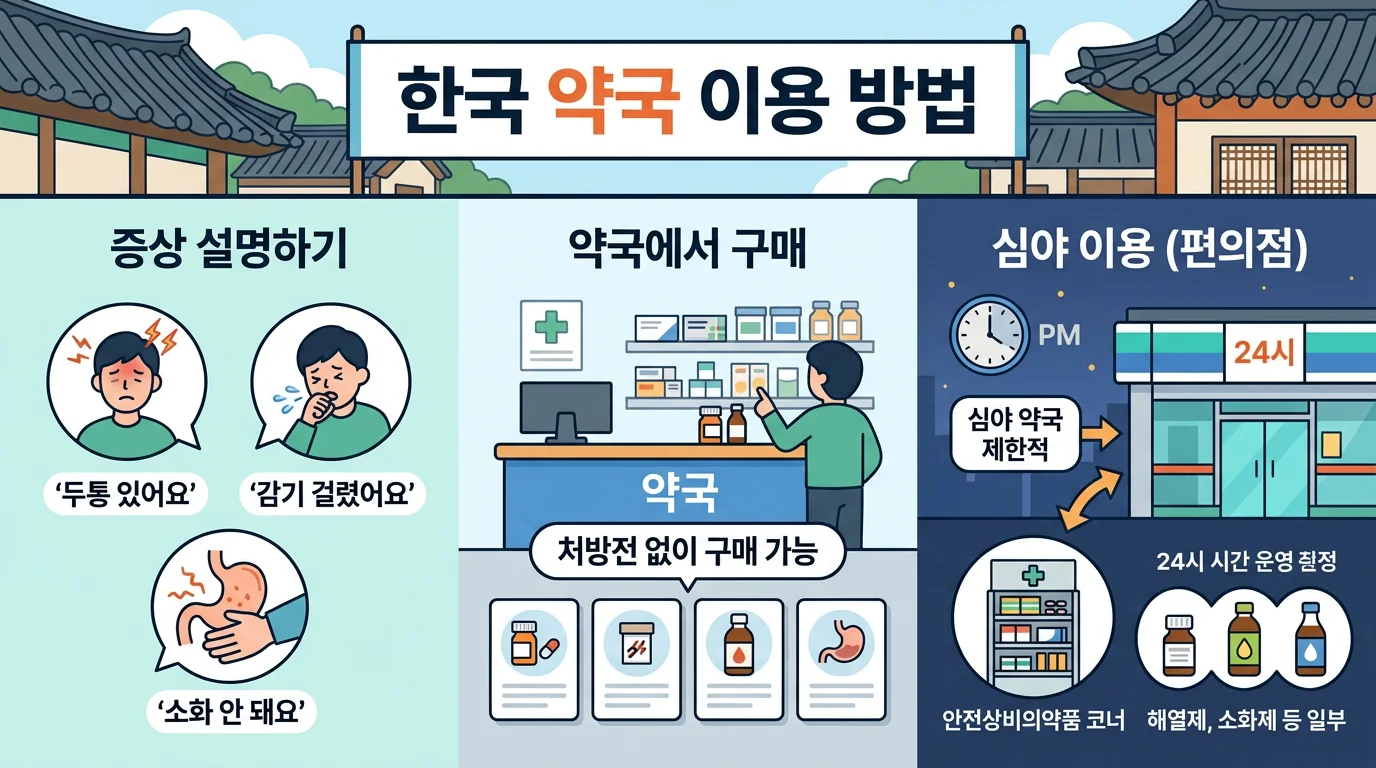
💊 How to Use Pharmacies in Korea
⚠️ Important: This is general information. For actual use, always follow the pharmacist's/doctor's guidance and the product instructions, and see a hospital or pharmacy if symptoms are severe or persist. If you have allergies, are pregnant, or are taking other medicine, tell the pharmacist in advance.
⏱️ 30-Second Summary — Just Remember This!
💊 Pharmacy (Yakguk) → green-cross (❇️) or "약/Pharmacy" sign; minor meds without a prescription
📋 Prescription meds → hospital visit → prescription → dispensed at a pharmacy
🏪 Convenience-store meds → some fever/pain, cold, digestive meds, and patches at night/holidays
🌙 Late-night pharmacy → pharmacies open late (search via the E-Gen app)
🗣️ Describing symptoms → tell the pharmacist where it hurts, and they'll recommend
1. 🏥 How Is Buying Medicine Divided in Korea?
Medicine in Korea falls into two main types.
Over-the-counter (OTC): Medicine you can buy directly at a pharmacy without a prescription. Fever/pain relievers, cold medicine, digestives, muscle-pain meds, wound ointments, etc.
Prescription medicine: Requires a doctor's prescription to be dispensed (antibiotics, strong painkillers, etc.) — medicines with risks of side effects, interactions, or misuse.
Key point: For minor symptoms, go straight to a pharmacy; for conditions needing care, it's hospital → prescription → pharmacy.
2. 💊 How to Use a Pharmacy (Yakguk)
Finding one: Most pharmacies have a green cross (❇️) or a "약 / Pharmacy" sign. Common near hospitals, shopping streets, and busy areas. Search "약국" or "pharmacy" in a map app.
Hours: Usually weekday morning to evening. Many close on Sundays, holidays, and at night. (Late-night pharmacies are the exception.)
How to buy: Describe your symptoms, and they'll recommend the right OTC medicine. For prescription drugs, show your prescription.
Payment: Card and cash both work. Basic cold and digestive medicines are relatively affordable. (Pharmacies in tourist areas, brand-name products, and supplements can be pricier.)
Tip: Pharmacies in tourist/busy areas may speak English. If not, use a translation app or the phrases below.
3. 🛒 Medicines You Can Buy Without a Prescription (OTC)
Common medicines available without a prescription. Consult the pharmacist for the exact product/ingredient.
Fever/pain relievers: For headache, fever, menstrual pain (acetaminophen, ibuprofen types, etc.)
Cold medicine: Combination cold medicine by symptom (runny nose, cough, sore throat)
Digestives/antacids: For indigestion, heartburn, bloating
Anti-diarrheals/intestinal meds: For diarrhea and upset stomach (common while traveling)
Motion-sickness medicine: For bus, boat, plane (often taken before boarding)
Wound ointment/antiseptic/bandages: For minor cuts and scrapes
Patches (anti-inflammatory patches): For muscle pain and sprains
Allergy medicine: For runny nose, itching (antihistamines)
Artificial tears/eye drops: For dryness and irritation
Also canker-sore/cold-sore meds, insect-bite meds, etc.
💡 Pharmacies also carry many "quasi-drugs" like vitamins/supplements, masks, and hygiene products — freely bought without a prescription or consultation.
4. 🌐 Knowing Ingredient Names Helps (Essential for Foreigners)
In Korea, product names differ but the ingredient is often the same. Knowing the (English) ingredient name makes communicating with the pharmacist much easier.
acetaminophen / paracetamol = 아세트아미노펜 (fever/pain)
ibuprofen = 이부프로펜 (fever/pain/inflammation)
antihistamine = 항히스타민제 (allergy/runny nose)
antacid = 제산제 (heartburn)
loperamide = one anti-diarrheal ingredient (diarrhea)
💡 Jot down the ingredient name of a medicine that worked for you back home, and you'll easily find the same-ingredient medicine in Korea.
5. 🏪 Medicines You Can Buy at Convenience Stores (Safety OTC Medicines)
When pharmacies are closed at night or on holidays, you can use convenience stores. But only a very limited range is sold.
The system: These are "safety OTC medicines" sold at 24-hour convenience stores. 13 items are designated, but each store's stock and available items may differ.
Types available (4 categories):
Fever/pain relievers (acetaminophen, ibuprofen types, etc.)
Cold medicine (combination cold liquids, etc.)
Digestives
Patches (anti-inflammatory patches)
Traits: Many come in small packs. For minor symptoms in a pinch.
⚠️ Caution: "Safety" doesn't mean no side effects. Follow the dosage on the instructions, and see a pharmacy/hospital if symptoms persist. When combining with other medicine, watch for overlapping ingredients (especially acetaminophen).
💡 Convenience-store medicine is limited, so pharmacies offer far more options during the day.
6. 🌙 When You're Sick at Night & Finding a Pharmacy/Hospital
Late-night (public) pharmacies: Open late. There aren't many, so search ahead.
E-Gen (Emergency Medical Information): The E-Gen app/website shows, based on your location, open hospitals/pharmacies, hours, departments, night-time medical facilities, and AED (defibrillator) locations.
Phone guidance: For info on open hospitals/pharmacies, you can call the Health & Welfare Call Center 129 or the local call center 120.
⚠️ At night/holidays, Naver Map and KakaoMap info may differ from actual operations, so call ahead before visiting.
Emergencies: If life is at risk, call 119 (ambulance) immediately.
7. 🚨 When to Go to a Hospital/ER Instead of a Pharmacy
For symptoms like these, don't tough it out with medicine — go to a hospital or ER (bring your passport).
Difficulty breathing, severe chest pain
Reduced consciousness, severe allergic reaction (facial/throat swelling, hives + breathing trouble, etc.)
Persistent high fever
Severe abdominal pain/dehydration, bloody diarrhea
Abnormal symptoms after a head injury (impact)
Anytime symptoms worsen rapidly or are very different from usual
💡 If you're unsure where to go, the E-Gen app can find the nearest emergency medical facility.
8. 🗣️ How to Describe Symptoms (Phrases for the Pharmacy)
Describe your symptoms and the pharmacist will recommend the right medicine.
I have a headache: 머리가 아파요 (meori-ga apa-yo)
I have a fever: 열이 나요 (yeor-i na-yo)
I have a runny nose / cough: 콧물이 나요 / 기침이 나요 (konmul-i na-yo / gichim-i na-yo)
I have a sore throat: 목이 아파요 (mog-i apa-yo)
I have a stomachache: 배가 아파요 (baega apa-yo)
I have diarrhea: 설사를 해요 (seolsa-reul hae-yo)
I have indigestion: 소화가 안 돼요 (sohwa-ga an dwae-yo)
I have an allergy: 알레르기가 있어요 (allereugi-ga isseo-yo)
I'm pregnant: 임신 중이에요 (imsin jung-ieyo)
Tip: Point to where it hurts, or show it via a translation app (Papago).
9. 🩺 What to Always Tell the Pharmacist
For safe use, tell the pharmacist:
Age (especially for children/older adults)
Pregnancy/breastfeeding status
Allergies (to specific drugs/ingredients)
Medicines you're taking (to avoid overlaps/interactions)
Underlying conditions like liver or kidney disease
For children: Children's medicine may go by weight rather than age, so tell them the weight. Don't split adult medicine for kids.
10. 💡 Practical Tips for Foreigners
Bring personal meds: If you take regular medicine, bring it from home in advance. (The same drug may be prescription-only in Korea.)
Note the ingredient name: Knowing the (English) ingredient name eases communication. (See section 4.)
Check the dosage: Confirm before/after meals and how many times a day. Photographing and translating the instructions helps.
Personal-import caution: Some medicines have restrictions on bringing in or buying. Strong ones require a prescription.
11. Common Questions from Foreigners ❓
Can I buy medicine without a prescription? → Yes, minor-symptom medicine (OTC) can be bought directly at a pharmacy.
All the pharmacies are closed at night. → Use convenience-store meds (fever/pain, cold, digestive, patches) or a late-night pharmacy (search via E-Gen).
Is English spoken? → Some pharmacies in tourist/busy areas do. If not, use a translation app or symptom phrases.
Are convenience-store and pharmacy meds the same? → Convenience stores have a very limited range. Pharmacies have far more.
Can I buy antibiotics? → No. They need a prescription (after a hospital visit).
Is medicine expensive? → Basic cold and digestive meds are affordable. Brand products, supplements, and prescription drugs can cost more.
Is there children's medicine? → Yes. Be sure to tell the pharmacist the age and weight (weight can matter more).
✅ Quick Checklist
For minor symptoms, go straight to a pharmacy (green-cross/Pharmacy sign)
If you need care, hospital → prescription → pharmacy
At night/holidays, convenience-store meds or a late-night pharmacy
Check open hospitals/pharmacies via the E-Gen app/web · 129 · 120 (call ahead)
Tell the pharmacist your age, pregnancy, allergies, current meds, and conditions
For children, give the weight; don't split adult medicine
Follow the dosage (instructions); watch for overlapping ingredients
For urgent symptoms (breathing trouble, severe chest pain, reduced consciousness, etc.), go to a hospital/ER; in emergencies, 119
🟦 A guide put together by the CultureHub team.
📅 As of 2026 · ⚠️ This is general information, not medical advice. Safety-OTC items, pharmacy operations, and the system may change. Consult a pharmacist/doctor and check the product instructions before use.