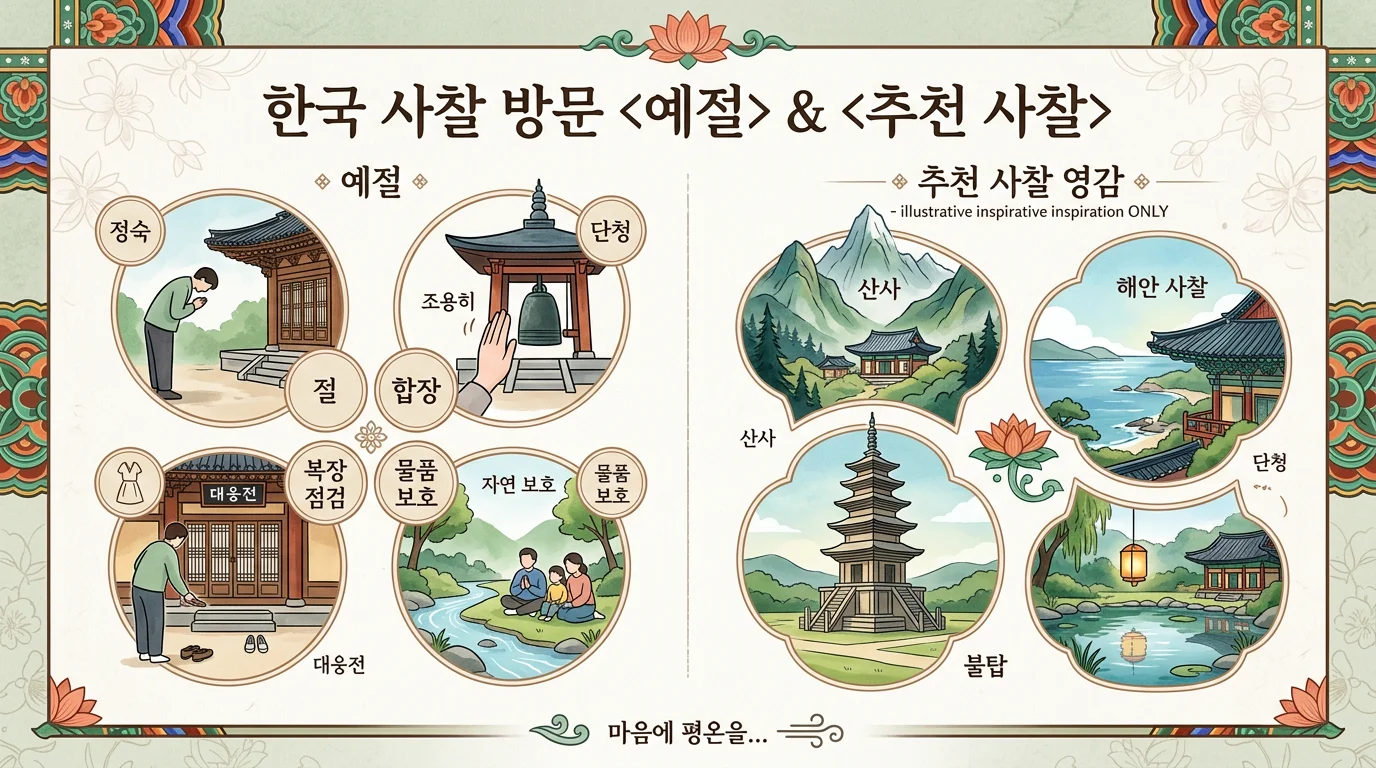
🛕 Temple Visit Etiquette & Recommended Temples in Korea
⏱️ 30-Second Summary — Just Remember This!
👕 Modest dress → cover shoulders and knees, stay quiet
🙏 Palms-together greeting → hands together, a light bow
👟 Shoes off in the hall → keep quiet inside, mind photography
📸 "No photography" signs → check before shooting Buddha statues/hall interiors
💰 Many are free → most admission fees reduced/abolished since 2023
🏯 Templestay → an overnight at a temple, popular with foreigners
1. 🛕 What Are Korean Temples?
Religion + heritage: Temples are Buddhist practice/prayer spaces and cultural heritage with beautiful architecture, Buddha statues, and paintings.
Mountain temples (sansa): Korean temples are often in the mountains. Seven of them (Tongdosa, Buseoksa, Bongjeongsa, Beopjusa, Magoksa, Seonamsa, Daeheungsa) are inscribed as UNESCO World Heritage under "Sansa, Buddhist Mountain Monasteries."
Everyone welcome: Anyone can visit, regardless of religion. Just follow the etiquette.
Admission: Since May 2023, the cultural-heritage admission fees at many temples holding state-designated heritage have been reduced or abolished, so quite a few major temples are now free. That said, some temples, parking, cable cars, or national-park sections may still have costs.
2. 👕 Before You Go — Dress & Prep
Modest clothing: Clothes that cover the shoulders and knees are best. Avoid very short shorts, miniskirts, or revealing outfits.
Comfortable shoes: Mountain temples have lots of stairs and slopes, and you remove shoes in the hall — easy-to-remove shoes help.
A quiet mind: Temples are practice spaces. Refrain from loud noise or horseplay.
Note: Programs like Templestay often provide activity wear (training clothes).
3. 🙏 Basic Etiquette at a Temple
Palms-together (hapjang) greeting: Before a monk or a hall, bring your palms together at your chest and bow lightly. This is the Buddhist greeting.
Don't step on the threshold: Step over the threshold (doorsill) of traditional buildings, not on it.
Avoid the center door: Where possible, use the side doors rather than the hall's center door — it's the polite choice.
Quiet: Keep quiet on the grounds, especially in halls and prayer spaces.
No pointing: Don't point at Buddha statues or people with a finger (gesture with your whole hand).
No food/smoking/alcohol: Refrain on the grounds.
Pets: Usually restricted. Check in advance.
4. 🛐 Manners Inside the Hall (Daeungjeon)
The main hall enshrines the Buddha — the most sacred space. There's etiquette for entering.
Remove shoes: Take off your shoes and set them neatly when entering.
Which door: Enter through the side doors rather than the center where possible.
Hat off: Remove your hat inside the hall.
Don't point your feet at the Buddha: When sitting, keep your soles from facing the statue (sit cross-legged or kneel).
Palms/bows: Worshippers do three bows. As a visitor, standing quietly with palms together is fine.
Passing by: Don't cut in front of someone who is praying.
5. 📸 Photography Manners
Check for "no photography": Hall interiors, Buddha statues, and paintings are often off-limits. Always check for "No photography" signs.
No flash: Refrain from flash to protect the heritage.
Monks/worshippers: Don't photograph monks or people praying carelessly; ask permission first.
Tripods/drones: Usually restricted. Ask the office if needed.
Grounds scenery: Buildings, gardens, and scenery are usually fine to photograph (check signs).
6. 🏯 Templestay (An Overnight at a Temple)
The most popular temple experience for foreigners.
What is it? A program where you stay a day or two at a temple, experiencing practice, meditation, ceremonies, and temple food. You can also experience balwoo gongyang (a practice of eating with set bowls according to formal etiquette).
Types: Experiential (ceremonies, meditation, tea ceremony, lotus-lantern making, etc.) and relaxation (freely resting in temple life).
Foreigner programs: There are Templestays run in English and other languages. Advance booking is required.
Booking: Book on the official Templestay website (multilingual) by selecting region, language, and experiential/relaxation type. Visit Korea also directs foreigners to the official Templestay site.
What to bring: Activity wear is usually provided. Bring toiletries, comfortable clothes, and socks.
Temple food: Experience refined, vegetable-based temple cuisine (follow the balwoo gongyang etiquette guidance).
💡 Dawn ceremonies, the stillness of a mountain temple, and balwoo gongyang are counted among foreigners' most special experiences.
7. 🏛️ The 7 UNESCO "Sansa, Buddhist Mountain Monasteries"
Korea's seven representative mountain temples are UNESCO World Heritage — places that have been centers of faith, practice, and monastic life since the 7th–9th centuries.
Tongdosa (Yangsan) · Buseoksa (Yeongju) · Bongjeongsa (Andong) · Beopjusa (Boeun) · Magoksa (Gongju) · Seonamsa (Suncheon) · Daeheungsa (Haenam)
💡 For reference, Bulguksa, Seokguram, and Haeinsa's Janggyeong Panjeon are also UNESCO World Heritage, but inscribed separately from the "7 Sansa" above.
8. 🗺️ Recommended Temples for Foreigners
Seoul & nearby (easy access)
Jogyesa (Jongno, Seoul): A leading temple in the city center, easy to reach by subway. It also runs an English Templestay. Especially beautiful during the lantern festival.
Bongeunsa (Gangnam, Seoul): A serene temple next to COEX. Popular for foreign visits and Templestay.
Gilsangsa (Seongbuk, Seoul): A quiet city temple with a lovely atmosphere — recommended for foreigners.
Jinkwansa·Hwagyesa (Seoul): Quiet mountain temples near the city, famous for Templestay.
Gyeongju (history trip)
Bulguksa: UNESCO World Heritage, the essence of Korean Buddhist architecture. A Gyeongju must.
Seokguram: Near Bulguksa, a World Heritage site famous for its Buddha within a stone grotto.
Busan·Gyeongnam
Beomeosa (Busan): A large mountain temple close to the city — great to drop by on a Busan trip.
Haedong Yonggungsa (Gijang, Busan): A seaside temple with great views, highly favored by foreigners.
Haeinsa (Hapcheon): A World Heritage temple housing the Tripitaka Koreana (Palman Daejanggyeong); its Janggyeong Panjeon is famous.
Tongdosa (Yangsan): A "jewel" temple enshrining the Buddha's relics. (A UNESCO Sansa.)
Other famous mountain/scenic temples
Woljeongsa (Pyeongchang): Famous for its fir-tree forest path on Odaesan.
Naksansa (Yangyang): A temple overlooking the East Sea — a sunrise spot.
Songgwangsa (Suncheon): A deep mountain temple famous as a "sangha jewel" temple.
Sudeoksa (Yesan): Lovely old wooden architecture and mountain-temple atmosphere.
Bomunsa (Ganghwa): A temple with beautiful sea views.
💡 For a first visit, the accessible Jogyesa·Bongeunsa·Gilsangsa (Seoul) or Bulguksa (Gyeongju) are solid choices. For Templestay, Jogyesa, Jinkwansa, Hwagyesa, and Bongeunsa are popular with foreigners.
9. 🪷 Good to Know
Lotus lanterns: The custom of hanging lanterns with wishes. Around Buddha's Birthday (8th day of the 4th lunar month), the lanterns are spectacular. (But temples can be crowded then.)
Entrance gates (Iljumun·Cheonwangmun): Passing through the gates at the entrance is meant to settle the mind.
Tapdori: A prayer custom of circling a pagoda clockwise.
Temple food (gongyang): Availability varies greatly by temple. It's often provided to Templestay/event participants.
Donations (bosi): Never forced. If you wish, place your heart in the offering box.
10. Common Questions from Foreigners ❓
Do I need to be Buddhist? → No, anyone can visit. Just follow the etiquette.
Is there admission? → Since 2023, many major temples are free. But some temples, parking, and facilities may have costs.
Can I take photos? → Grounds scenery is usually fine. For hall interiors/Buddha statues, check the signs; if prohibited, don't shoot.
Is there a dress code? → Modest clothing covering shoulders and knees is recommended.
Is Templestay available in English? → There are foreign-language programs. Book on the official Templestay site.
Do I have to enter the hall? → No. Quietly looking around from outside is fine.
Do I have to bow? → No. As a visitor, quietly bringing your palms together is enough.
✅ Quick Checklist
Modest clothing covering shoulders/knees + easy-to-remove shoes
Palms-together greeting before monks/halls
In the hall, shoes off, side doors where possible, keep quiet
Keep your feet from facing the Buddha, hat off
Check "No photography" signs (mind hall interiors/statues)
Don't step on thresholds; no pointing
Book Templestay in advance on the official Templestay site
For a first visit, try Jogyesa·Bongeunsa·Gilsangsa·Bulguksa
🟦 A guide put together by the CultureHub team.
📅 As of 2026 · ⚠️ Admission, Templestay operations, and photography rules vary by temple and season. Check each temple's and the Templestay official info before visiting.