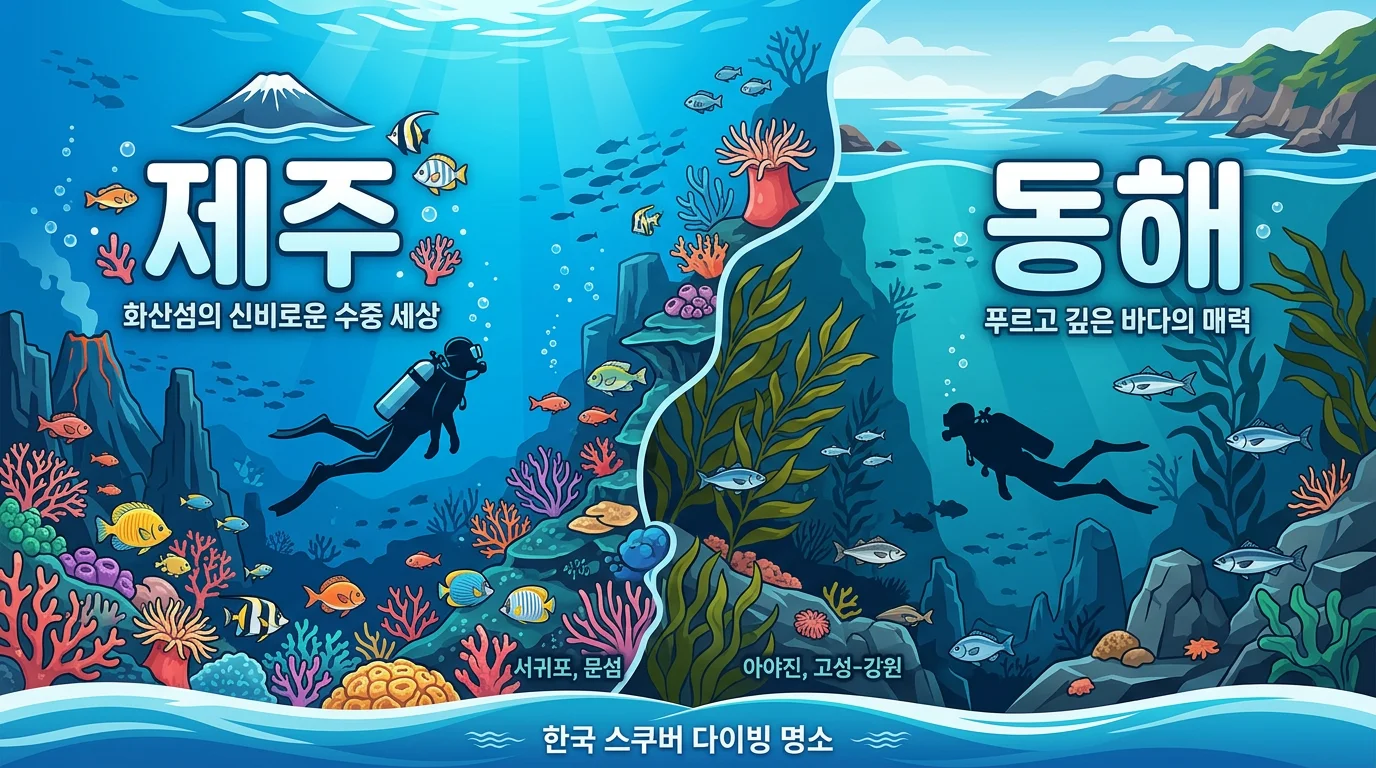
🤿 Scuba Diving Spots in Korea's Seas (Jeju · East Sea)
⚠️ Safety first: Scuba diving is an activity to do with a trained instructor/dive shop. Always check your health, the weather, and water temperature, and don't overdo it. This is general information.
⏱️ 30-Second Summary — Just Remember This!
🌸 Jeju Seogwipo → Munseom·Seopseom·Beomseom, one of East Asia's largest soft-coral colonies (Korea's flagship!)
🌊 East Sea Goseong → clear visibility on good-season days, rocky terrain (popular with metro-area divers)
📅 Seasons → Jeju spring–autumn, East Sea summer–autumn are popular
🧊 Water temp → Jeju is warmer than the East Sea; winter suits divers experienced with drysuits
🐠 Beginners → start easily with a discovery dive
1. 🗺️ Jeju vs. East Sea — Where to Go?
Jeju (Seogwipo): Korea's flagship dive area. Thanks to the Kuroshio Current, the water is relatively warm and visibility is fairly good. The soft-coral colonies of Munseom, Seopseom, and Beomseom are known as one of the largest in East Asia. You might spot the Jeju bottlenose dolphin during the boat ride or at the surface.
👉 For vivid coral, varied fish, and warm water, choose Jeju.
East Sea (Goseong, Gangwon, etc.): Popular with metro-area divers. With lots of rocky terrain, there are many days with excellent visibility when the season and weather are good. You'll see underwater cliffs, soft coral and seaweed, and various species like octopus, wrasses, and rockfish, with larger species appearing seasonally.
👉 For terrain diving with clear visibility, close to Seoul, choose the East Sea.
💡 Jeju offers coral and warm water; the East Sea offers clear visibility and access. Note the East Sea is colder than Jeju, so you'll need a thicker suit.
2. 🌸 Jeju Seogwipo — One of East Asia's Largest Soft-Coral Colonies
Three islands off Seogwipo on Jeju's south coast are the key points. You usually enter after a boat ride of about 10 minutes.
Munseom: Korea's most famous dive point. The orange, yellow, and purple soft-coral walls are fantastic. But there's often current, so it helps to have decent buoyancy control.
Seopseom: Famous for its beautiful underwater ecosystem. Discovery dives are active here too.
Beomseom: Popular for points packed with soft coral. (Sometimes called "Train Rock," etc.; names vary by shop.)
What you'll see: Soft corals, black coral, schools of damselfish, various fish, nudibranchs, etc.
Water temp·visibility: Around 25°C in summer, around 15°C in winter. Visibility varies by day and tide. (A thermocline can make it colder.)
⚠️ Protected area: The Munseom, Seopseom, and Beomseom areas are protected zones. Touching or collecting coral and marine life is prohibited. Some zones have glove rules, so follow the shop's guidance.
💡 The point you enter changes with the tides. Check that day's conditions with the shop before booking.
3. 🌊 East Sea Goseong — Clear Visibility & Terrain Diving
Goseong in Gangwon-do is the East Sea's flagship dive area, well known among domestic divers.
Traits: With abundant rocky terrain, there are many days with excellent visibility when the season and weather are good. You'll meet underwater cliffs, soft coral and seaweed, and various species like octopus, wrasses, and rockfish, with larger species appearing seasonally.
Dive styles: Beach, boat, and breakwater diving are all possible. There are step-by-step programs from beginner discovery dives.
Dive resorts: Dive resorts/shops cluster around Jukwang-myeon and Toseong-myeon (Munam, Cheonjin, Ayajin, Bongpo, etc.).
Caution: Take care not to disturb fishing or military-activity zones, and since the water is cold, equip your suit well.
💡 Other dive areas: East Sea spots like Yangyang, Gangneung, Samcheok, Uljin, and Ulleungdo, and southern-sea islands around Tongyeong and Geoje, are also known dive points.
4. 📅 When to Go? (Seasons & Water Temp)
Korea's distinct seasons split the dive calendar.
Jeju: Good from spring through autumn. (Relatively favorable temp/visibility.)
East Sea: Summer–autumn is especially popular. (Warmer water, better visibility.)
Winter (Dec–Feb): Cold water calls for a thick wetsuit or drysuit. It's better suited to divers experienced with drysuits. There are also ice-diving (freshwater) events in places like Hongcheon, Gangwon.
Temp note: Jeju is warmer than the East Sea. On the East Sea, a wetsuit can feel cold even in midsummer/autumn, so many divers use drysuits.
⚠️ Water temp, visibility, and waves change daily. Always check that day's conditions with the shop and weather info before heading out.
5. 🐠 New to It? Discovery Dive vs. Certification
Discovery dive (Discover Scuba): A program to experience shallow depths with an instructor 1:1–2:1, without certification. The in-water part is usually 20–40 minutes, and the whole thing (orientation, travel included) is 2–2.5 hours. Start here if it's your first time!
Open Water certification: The entry-level cert to become a proper diver. It usually takes a few days with theory + confined water + open water. Common agencies include PADI, SSI, NAUI, SDI, and SNSI. Jeju and East Sea shops run courses year-round.
Fun diving: If you're already certified, dive the points with a guide.
Booking: Book via platforms like Klook, MyRealTrip, or KKday, or the dive shop's website. (Platforms are easier for foreigners.)
English lessons: Some shops can, but they're limited. Check in advance.
💡 For a beginner discovery dive, it's better to focus on the dive itself rather than filming, for safety.
6. 🎒 What to Bring & Wear
Swimsuit: Easier to wear underneath in advance.
Gear: Lessons/discovery dives usually include the suit, mask, fins, regulator, BCD, etc. (Confirm what's included when booking.)
Prescription mask: If your eyesight is poor, some shops rent prescription masks. Ask ahead when booking. (Also discuss wearing contact lenses.)
Towel·change of clothes·aqua shoes·toiletries
Waterproof sunscreen·motion-sickness medicine: Since there's a boat ride, take motion-sickness medicine 30 min–1 hour before. It can cause drowsiness, so check the instructions.
Logbook: Bring it if certified. Many now use a digital logbook (PADI App, etc.).
Cash·card: Small shops may not take cards, so bring cash too.
7. 🛡️ Safety Rules (Please Follow!)
Participation limits: Pregnant women; those with cardiovascular disease, asthma/lung/respiratory conditions, eardrum issues; and the frail/elderly may be restricted. If you're unwell with a cold, fever, or cough, postpone the dive.
No alcohol: Diving after drinking is strictly prohibited.
With an instructor/buddy: Always move with a qualified instructor/guide and the buddy system.
Equalizing: Equalize your ears slowly on descent. If it hurts, stop rather than pushing.
Ascent rules: Ascend slowly and do your safety stop (to prevent decompression sickness).
Flying after diving: Generally avoid flying for at least 18 hours, and 24+ hours after repetitive dives. Finish diving the day before your last day rather than on your departure day.
Jellyfish·current: Watch for summer jellyfish and current (e.g., at Munseom), and follow the guide's instructions.
Protect the environment: Don't touch or collect coral and marine life (follow protected-area rules).
8. Common Questions from Foreigners ❓
Can I do it as a beginner? → Yes! A discovery dive can be done with an instructor without certification.
What if I can't swim? → The discovery dive is in shallow water with an instructor. But basic water comfort is needed, and you must meet health/safety conditions.
Which is better? → For vivid coral, Jeju; for clear visibility and access, the East Sea (Goseong).
Are English lessons available? → Some shops can, but they're limited. Confirm and book ahead.
When is best? → Jeju spring–autumn, the East Sea summer–autumn are easier for beginners.
What about cost? → It varies by shop/program. Confirm what's included and the points when booking.
Can I fly right after diving? → No. Avoid flying for at least 18 hours (24 after repetitive dives).
✅ Quick Checklist
Pick an area (coral = Jeju / visibility & access = East Sea Goseong)
Check the season (Jeju spring–autumn / East Sea summer–autumn)
Decide discovery vs. certification; confirm English lessons ahead
Book a dive shop/platform (check what gear is included)
Check your health (don't push it with illness/a cold)
Ask ahead about a prescription mask
Prepare motion-sickness meds (30 min–1 hr before the boat; may cause drowsiness) and waterproof sunscreen
No alcohol, go with an instructor/buddy, don't touch coral/marine life
Fly 18 hours (24 for repetitive dives) after diving; dive the day before your last day
A digital logbook (PADI App, etc.) can be used
🟦 A guide put together by the CultureHub team.
📅 As of 2026 · ⚠️ Water temp, visibility, seasons, fees, and operations can change daily with the weather and by dive shop. Always check the dive shop and weather info before visiting.