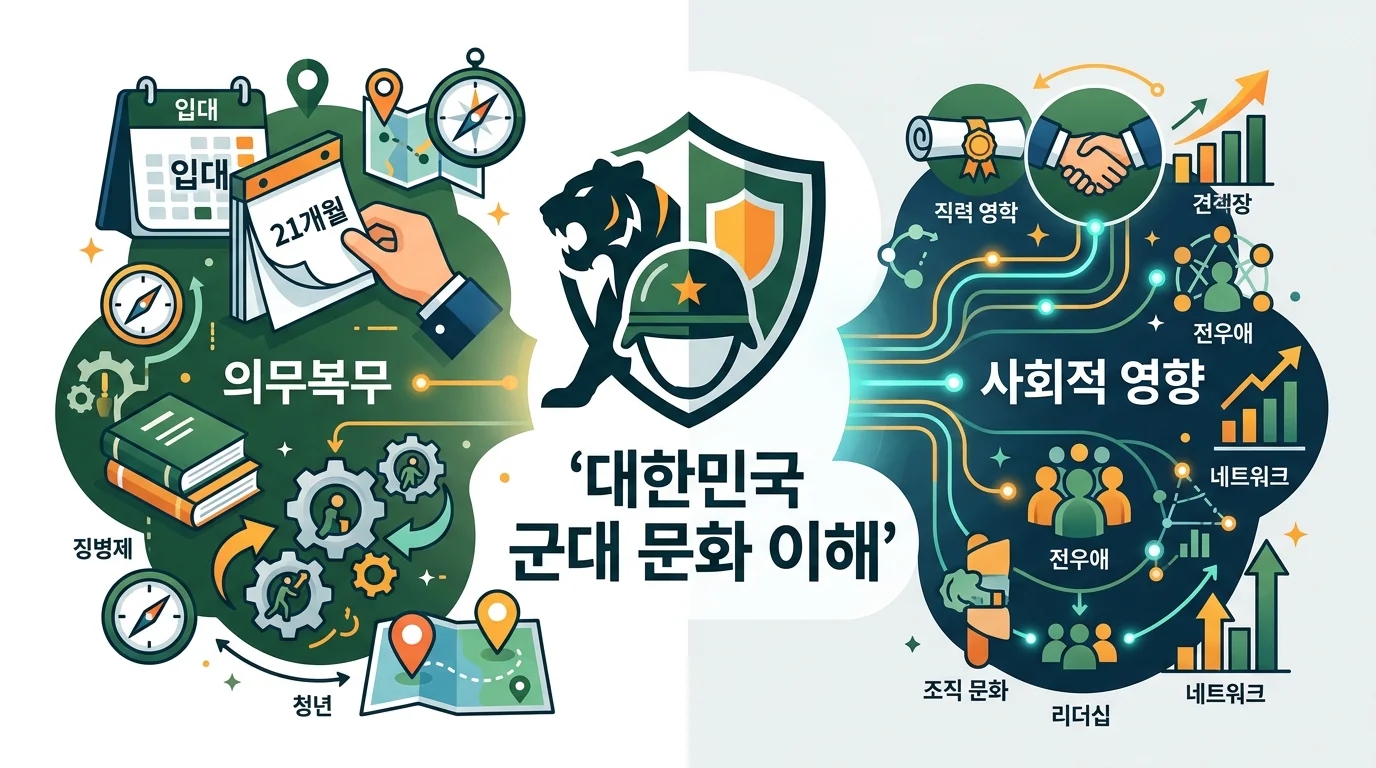
🎖️ Understanding Korea's Military Culture (Mandatory Service & Social Impact)
ℹ️ This is general information introducing the system and social phenomena. Military service is also a sensitive, debated topic in Korea, so multiple perspectives are included.
⏱️ 30-Second Summary — Just Remember This!
🪖 Service duty → Korean-national men in principle have a service duty (forms vary)
⏱️ Service period → For enlisted soldiers: Army/Marines 18 months / Navy 20 / Air Force 21
🧑💼 Various forms → active duty, supplementary (social service), alternative service, exemption
🌏 Background → the inter-Korean armistice and security situation
🎬 Social impact → wide-reaching: workplace culture, variety shows/dramas, K-pop
1. 🪖 Why Do Korean Men Serve?
Division and armistice: Since the 1953 Armistice Agreement, South and North Korea remain in a state of armistice where the war has technically not ended. This security situation is the background of the service system.
A constitutional/legal duty: Korea's Constitution stipulates a national-defense duty, and by the Military Service Act, Korean-national men in principle bear a service duty. But it is divided into active duty, supplementary service, alternative service, exemption, etc., based on the physical exam and individual circumstances.
Women: Women aren't subject to the duty, but can serve as active-duty or reserve personnel by volunteering.
Conscription: Korea is based on conscription rather than an all-volunteer force. (Career soldiers/officers are separate.)
💡 It used to be commonly called the "physical exam (sinche geomsa)," but the official name is the "military service examination (byeongyeok panjeong geomsa)." It determines active/supplementary service, etc.
2. ⏱️ Service Periods and Types
The period varies by branch and form of service.
Enlisted soldiers: Army/Marines 18 months / Navy 20 months / Air Force 21 months
Social service personnel (supplementary): For those who can't do active duty for physical/other reasons, serving at public institutions for about 21 months (a commuting format).
Alternative service personnel: For those admitted to alternative service (e.g., conscientious objection), 36 months of live-in service at correctional facilities like prisons/detention centers. (A system introduced in 2020.)
Others: There's also alternative service in specific fields — research personnel, industrial-technical personnel, arts/sports personnel, etc.
⚠️ Service periods and the system have changed gradually with policy. For exact periods and the latest rules, check official sources like the Military Manpower Administration (mma.go.kr).
3. 🈁 "Gundae" vs. "Byeongyeok" — What's the Difference? (Foreigner Confusion)
In Korean, saying "went to the military (gundae gatda)" is also used broadly to mean fulfilling one's service duty, not just active duty.
But precisely, the forms differ — active-duty service, social service, alternative service, etc.
So "I did my military service" doesn't mean everyone served in the same way.
4. 🎓 When and How Do They Go?
Timing: Men usually become subject at age 18, and university students often take a leave of absence during studies to serve (early-to-mid 20s is common).
Deferral: You can defer enlistment for reasons like studies or exams — though not indefinitely.
Process: Military service exam → enlistment → basic military training (several weeks) → unit assignment → service → discharge.
Boot camp: For the first few weeks, you get basic military training at a recruit training center.
5. 🧑💼 After Discharge — Reserves and Return to Society
Discharge (jeonyeok): After finishing, you're discharged and return to society. Students usually return to school.
Reserve forces (yebigun): Those who served as enlisted soldiers are assigned to the reserves from the day after completing service until December 31 of the 8th year, with set annual reserve training.
Career gap: A gap in studies/career forms for the length of service. It's a familiar path in Korean society, but for the individual it can be a burden of delayed studies, employment, or career.
6. 🌏 How the Military Shapes Korean Society & Culture
The service system affects society broadly, beyond the individual.
A shared experience: As something many men go through, it becomes a common topic across generations and regions ("In the military…" stories are common).
Workplace/organizational culture: Some see military experience as influencing hierarchy and teamwork styles (though this is changing across generations).
Pop culture: There are many dramas, variety shows, and films about the military.
K-pop/entertainment: Male idols and actors are also subject to the service duty, so enlisting mid-career can create an activity gap. A discharge can even become big news.
Family/partners: Enlistment, discharge, visits, and waiting are common narratives in Korean family and romantic relationships.
7. 💬 Social Context Worth Knowing
Military service is also a sensitive, contested topic in Korea, with varied views.
Fairness debates: There's active debate over service periods, exemption/deferral criteria, and alternative service for certain groups.
Low birthrate and manpower: As the population shrinks and manpower declines, system reform and expanded recruitment are continually discussed.
Female conscription debate: There's a societal pro-and-con debate over whether women should also be conscripted.
Better treatment: Soldier pay raises and improved service conditions have come in recent years.
💡 Koreans themselves are divided on these topics. As a foreigner, it's better to listen rather than assert.
8. 🤝 Tips for Foreigners in Conversation
OK once you're close: Once you're friendly, lightly asking "Did you serve?" is common. But avoid asking about exemption or non-service at a first meeting.
Military stories: Many men naturally share service anecdotes. Listening is a good way to bond.
Sensitive areas: Pressing about or judging exemption/non-service can be rude.
Avoid political assertions: Service fairness and inter-Korean relations are divided topics, so an open attitude beats one-sided claims.
Respect: It can be a hard experience for some. A respectful attitude is safer than treating it as a joke.
9. 📖 Words Foreigners Find Confusing
Ipdae (입대): Beginning military service
Jeonyeok/jedae (전역/제대): Completing service
Byeongjang (병장): A soldier rank (Private → Private First Class → Corporal → Sergeant)
Yebigun (예비군): Reserve personnel who train for a set period after discharge
Sahoe bokmu yowon (사회복무요원): Supplementary-service personnel serving at public institutions
Myeonje (면제): Exemption from the service duty
Byeongyeok panjeong geomsa (병역판정검사): The exam that determines service type (formerly called "physical exam")
10. Common Questions from Foreigners ❓
Do all Korean men serve? → In principle there's a duty. But the form varies — active/supplementary/alternative/exemption — by physical and other circumstances.
How long is service? → For enlisted soldiers: Army 18 months, Navy 20, Air Force 21.
Do women serve? → Not as a duty, but they can serve by volunteering.
Do foreign nationals serve? → It's a duty for Korean-national men. Dual citizenship and overseas residence involve complex rules, so check with the Military Manpower Administration.
Do celebrities serve? → Yes, male celebrities are subject too. A discharge can be big news.
Can I ask about military service? → Fine once you're close, but avoid pressing about exemption/non-service at a first meeting.
Can they be contacted during service? → Many units allow phone use after duty hours, but it may be restricted by training/security circumstances.
✅ Quick Checklist (Points to Understand)
Korea is in an armistice, so men have a service duty (forms vary)
Enlisted service is 18–21 months (by branch)
Various forms exist: social service, alternative service, exemption
After discharge, reserves until Dec 31 of the 8th year
Wide impact — workplaces, pop culture, K-pop
A sensitive, debated topic → be careful at first meetings; listen and respect
For exact rules, check the Military Manpower Administration (mma.go.kr)
🟦 A guide put together by the CultureHub team.
📅 As of 2026 · ⚠️ Service periods, the system, and treatment can change with policy. Check official bodies like the Military Manpower Administration for the latest.