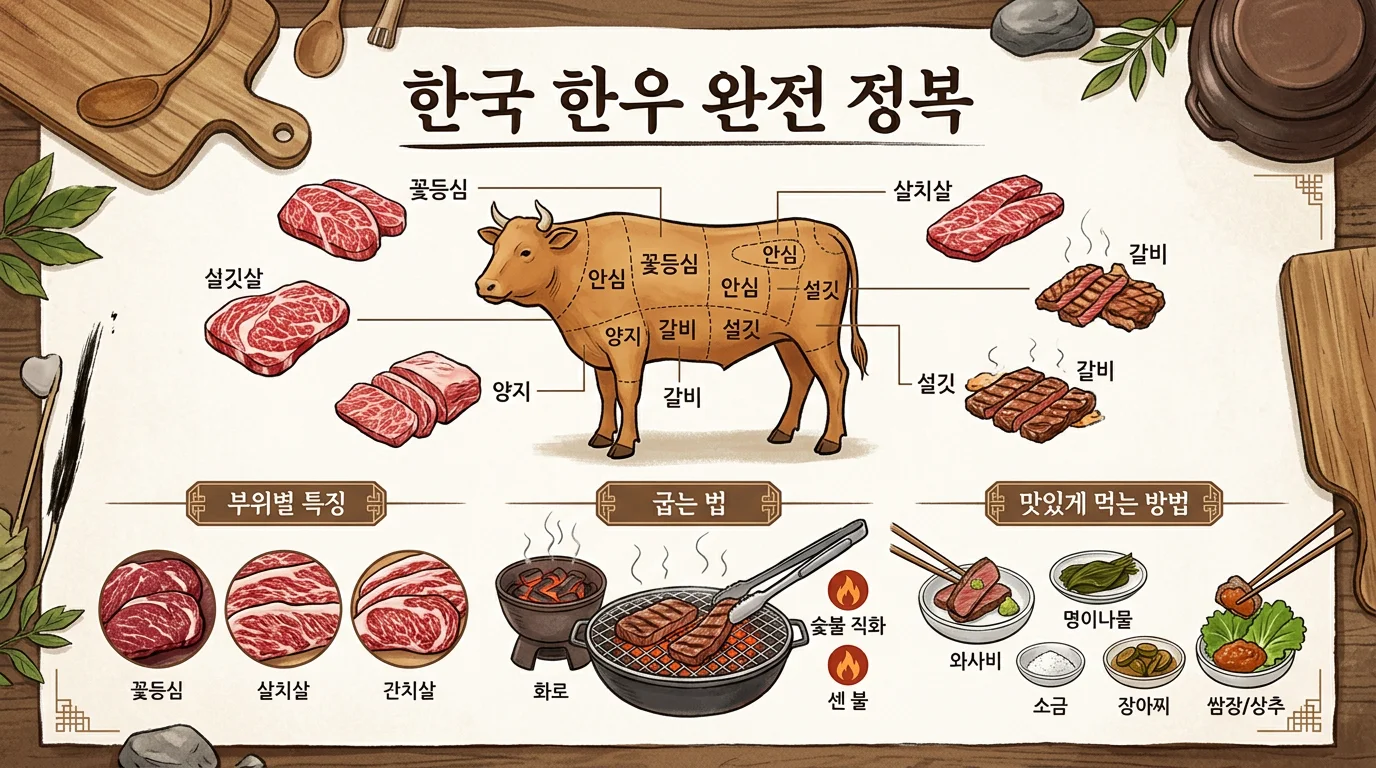
🥩 Mastering Korean Hanwoo (Cuts · Grilling · How to Eat It Deliciously)
⏱️ 30-Second Summary — Just Remember This!
🐂 Hanwoo → a native Korean cattle breed, premium beef
🏅 Grades → quality grade (1++·1+·1·2·3) + yield grade (A·B·C)
🥩 Popular cuts → sirloin, striploin, tenderloin, chuck flap, rib, brisket
🔥 Grilling → sear the surface on high heat → don't overcook (varies by cut)
🥬 How to eat → dip in salt/sesame-oil, wrap with ssam and garlic, finish with naengmyeon/doenjang
1. 🐂 What Is Hanwoo? (How Is It Different from Imported Beef?)
Hanwoo (韓牛): A native Korean cattle breed developed through long breeding and improvement. Known for its marbling (intramuscular fat) and umami.
Why special: Famous for tender texture and rich, nutty flavor. Pricier than imported beef (US/Australian), but popular for special occasions and fine dining.
Price: As a premium ingredient, it runs high, varying a lot by cut, grade, and restaurant.
2. 🔍 How to Confirm It's Hanwoo (Domestic Hanwoo vs. Yugu)
An easy point of confusion for foreigners. Not everything "domestic" is Hanwoo.
Check the menu/label: Look for "Hanwoo (한우)," "domestic Hanwoo (국내산 한우)," or "origin: domestic Hanwoo."
Hanwoo ≠ Yugu: "Domestic yugu (국내산 육우)" is a different animal from Hanwoo (different breed/rearing). Even if domestic, dairy cattle and yugu aren't Hanwoo.
Traceability: Hanwoo can be verified via the livestock traceability system. Specialty restaurants may keep a grade certificate on hand.
3. 🏅 How to Read Hanwoo Grades
Korean beef is graded on two axes. You can check them on the label.
Quality grade (taste/quality): From high to low, 1++ · 1+ · 1 · 2 · 3. Judged by combining marbling (intramuscular fat), meat color, fat color, texture, and maturity.
Yield grade (amount of meat): A · B · C, indicating how much meat comes from one animal (a yield indicator, not taste).
Example: Shown together like "1++A" (quality + yield).
Marbling number: The top 1++ also shows a marbling number (7·8·9). Even within 1++, the fat feel differs by 7·8·9 (9 has the most fat — the richest, nuttiest).
Note: With the 2019 grading revision, grade is no longer decided by marbling alone; meat color, texture, etc., count too. (The 1++ threshold was also adjusted from marbling 8·9 to 7·8·9.)
💡 A higher grade isn't always "the answer." 1++ is rich with fat but can feel heavy, while grades 1–2 are leaner. Choose by taste and cut.
4. 🥩 Popular Cuts to Know
Every cut differs completely in taste and texture. These are the main grilling cuts.
ℹ️ The English names below are for reference. Since each country/restaurant butchers cattle differently, English cut names may not map exactly 1:1.
Well-marbled and tender (popular for grilling)
Deungsim (Sirloin/Loin): Richly marbled and nutty. The signature Hanwoo grilling cut!
Chaekkeut (Striploin): Leaner than sirloin, mild yet tender.
Ansim (Tenderloin): Low in fat and the most tender cut. Lean and mild.
Salchisal (Chuck flap): Beside the sirloin, with deep marbling and strong flavor — a favorite among enthusiasts.
Special flavor/texture
Galbisal (Rib): Meat between the ribs — chewy and rich.
Chadolbagi (Brisket): Thinly sliced brisket; nutty and chewy as you chew. Cooks fast.
Buchaesal·Tosisal·Anchangsal·Jebichuri: Rare "special cuts." Unique texture/flavor, popular with aficionados.
For soup/braising
Yangji·Sathae: Great for soups, stews, and braises (seolleongtang, galbitang, etc.).
💡 If it's your first time, sirloin/striploin are safe; for deep flavor go for salchisal, for lean go tenderloin.
5. 🔥 How to Grill It Well
The key with Hanwoo is not to overcook. It varies a bit by cut.
Basic principle: Sear the surface quickly on high heat to build nutty, browned flavor, and don't overcook the inside. Cooking too long makes it tough and dry.
Rest at room temp: Taking it out of the fridge and letting it sit briefly at room temperature helps it cook evenly.
Flipping: Don't fuss with thick cuts too much; flip thin cuts quickly and eat right away.
By cut:
Sirloin·salchisal (well-marbled): Sear on high → about medium. The fat melts for a nutty taste.
Striploin·tenderloin (lean): Being lean, they toughen if overcooked. Medium-rare to medium is best.
Chadolbagi (thin): Cooks very fast. Grill just briefly and eat right away.
Cutting: For thick cuts, cut into bite sizes after grilling (scissors are commonly used).
💡 When eating several cuts, go lean → fatty. E.g., tenderloin·striploin → sirloin → salchisal·rib → brisket. Staff may grill for you, so ask if you're unsure.
6. 🥬 How to Eat It the Korean Way
How you eat matters as much as grilling. Here's how to bring out Hanwoo's flavor.
Salt/sesame-oil dip: For good Hanwoo, dip lightly in salt or sesame-oil dip (sesame oil + salt) to enjoy the meat's natural taste.
Ssam (wraps): Wrap meat + garlic + ssamjang + rice in lettuce/perilla leaves for one bite! It cuts the richness.
Grilled garlic·mushrooms·kimchi: Grill garlic, mushrooms, and kimchi on the plate as sides.
Pickled onion·scallion salad: Tangy sides reduce the heaviness.
First bite with salt: Enjoy the first few bites with salt for the pure taste, then vary with wraps/sauces.
7. 🍜 Finishing & Sides
Meal to finish: After the meat, finishing with naengmyeon, doenjang stew, a bowl of rice, or fried rice is the Korean way.
Yukhoe: Yukhoe (fresh raw Hanwoo) is also a delicacy (if you like it).
Drink pairing: Often paired with soju or beer (non-alcoholic options too).
Doenjang/seaweed soup: Mild broths pair well with the meat.
8. 🍽️ Where to Eat Hanwoo (+ Ordering & Costs)
Hanwoo specialty restaurant: Sells by cut; you choose grade and cut.
Butcher-restaurant (jeongyuk sikdang): You pick and buy the meat at the butcher counter and grill it at your table. Popular for value.
⚠️ Table-setting fee: Butcher-restaurants often charge a per-person "sangcharim" (table-setting) fee separate from the meat. It covers the grill, wrap veggies, side dishes, and sauces.
Hanwoo omakase: A chef serves cuts course-style — a high-end, special experience.
Regions: Areas famous for Hanwoo include Hoengseong, Eonyang, and Hampyeong.
Ordering & prices (a must for foreigners!)
Order unit: Usually ordered by 100–150g per serving. Some restaurants require 2 servings or more as a minimum.
Check the price: Confirm whether the menu price is per 100g, per serving, or per set. (It's easy to mistake a per-100g price for a per-serving price!)
💡 For value, go to a butcher-restaurant (check the table-setting fee); for a special experience, a specialty restaurant or omakase.
9. Common Questions from Foreigners ❓
Why is Hanwoo expensive? → It's premium beef from a native breed raised and improved over a long time. It varies a lot by cut/grade.
Is all "domestic" beef Hanwoo? → No. "Domestic yugu" is different from Hanwoo. Check for "Hanwoo" on the menu/label.
Is a higher grade tastier? → 1++ is fatty and nutty but can feel heavy. Choose by taste and cut.
Why does the price look so cheap? → It may be a per-100g price. Check if it's per serving or per set.
What cut for a first-timer? → Sirloin/striploin are safe; salchisal for rich, tenderloin for lean.
In what order should I eat? → Lean → fatty is recommended.
Can I eat alone? → Some places allow single orders, but many require 2+ servings. Check.
Is there raw beef? → Yes, yukhoe. As it's fresh meat, enjoy it at a specialty restaurant.
✅ Quick Checklist
Confirm "Hanwoo" on the menu/label (different from domestic yugu)
Understand grades: quality (1++–3) + yield (A·B·C); 1++ shows a marbling number (7·8·9)
Decide your taste: nutty = sirloin/salchisal / lean = striploin/tenderloin
Sear on high (browned flavor) → don't overcook
Don't fuss with thick cuts; flip thin cuts quickly
Eat lean → fatty
Good meat with salt/sesame-oil; if heavy, use ssam/garlic
Check the order unit (100–150g), price basis (per 100g / serving / set), and table-setting fee
🟦 A guide put together by the CultureHub team.
📅 As of 2026 · ⚠️ Grading criteria, prices, cut names, table-setting fees, and restaurant styles vary by policy and venue. Check before visiting.