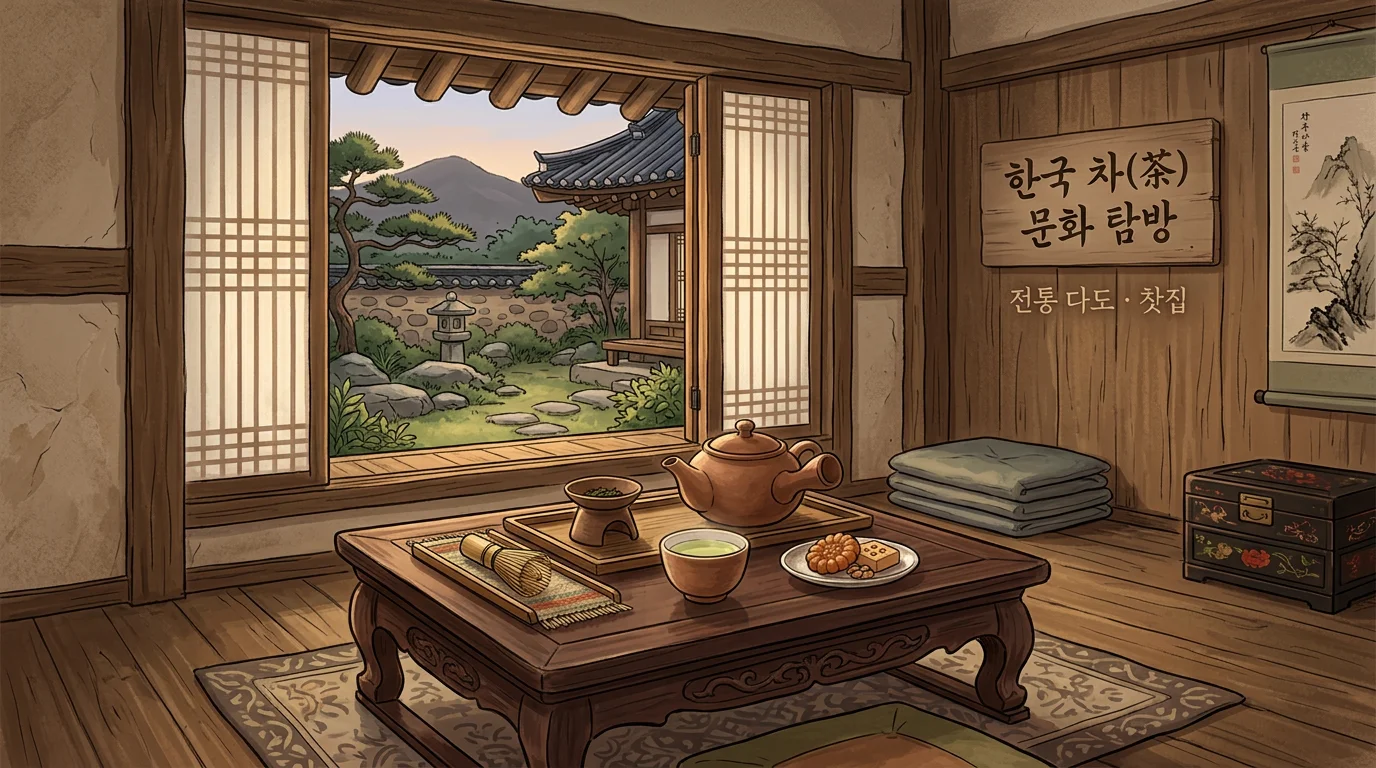
🍵 Exploring Korean Tea Culture — Traditional Tea Ceremony & How to Use a Tea House
⚠️ Note: Tea selection, prices, English support, and atmosphere vary by shop. Before visiting, check each shop's official channels or a map app for prices, location, and hours. Popular tea houses can get busy and have a wait on weekends and peak seasons.
⏱️ 30-Second Summary — Just Remember This!
🍵 Concept → Traditional teas & snacks in a hanok tea house
💰 Price → Usually one order per person, pay for what you order (varies by shop)
🌍 Foreigners → Just order from the menu, no etiquette needed
🗣️ English → English menu/tea descriptions vary by shop
📍 Areas → Plenty in Insadong, Bukchon & Samcheong-dong
1. 🍵 What Is a Traditional Tea House?
A traditional space to enjoy tea and slow time in Korea.
The basics: Like a café, you order a drink — but instead of coffee, you enjoy Korean traditional teas and dagwa (traditional snacks).
Atmosphere: Many are converted hanok (traditional houses), so they feel serene and quiet. Floor seating (sitting on the floor) is common.
Tea house vs. tea ceremony: A "tea house" (chatjip) is a relaxed place to drink tea, while "tea ceremony" (dado / darye) is the etiquette of formally brewing and serving tea. Most tea houses are enjoyed casually, without any ceremony.
Why go?: Great for a break while sightseeing, a rainy day, a quiet chat, or experiencing a traditional Korean atmosphere.
Tea house culture: Unlike coffee chains, many guests stay a while, talking quietly or reading. That said, when it's crowded, it's courteous not to linger too long.
2. 🌍 Can Foreigners Enjoy It Too?
Here are the key points.
✅ Yes, you can: You just pick a tea from the menu, so no tea or ceremony knowledge is required.
📖 Many have tea descriptions: Tourist-area tea houses (like in Insadong) get many foreign guests, so many have menus describing each tea's type and character (taste and aroma).
🈶 English support varies: Whether a shop has an English menu or descriptions differs by place. Many now offer menus with photos, which makes choosing easier. A translation app helps too.
🧘 No etiquette pressure: At an ordinary tea house, just drink comfortably. Formal tea-ceremony experiences are offered separately (at cultural centers / experience programs).
3. 🪑 How to Use It (From Entering to Paying)
If it's your first time, knowing the flow helps.
① Enter & sit: Tell them your party size and you'll be shown a seat. Some places let you choose floor or table seating.
② Check the menu: You'll find leaf teas (like green tea), traditional teas (jujube, omija), and snack sets.
③ Order: Usually one menu item per person is the norm. Pairing your tea with dagwa (rice cakes, traditional sweets) is nice.
④ Enjoy: When the tea arrives, slowly take in its aroma, color, and taste. It's a quiet space, so keep conversation gentle.
⑤ Refills/more: With leaf teas, some places let you add hot water and brew several times.
⑥ Pay: Pay for the teas/snacks you ordered. (Some shops take payment first — "prepay" — see #4 below.)
4. 💰 How Is It Priced?
It's not by the hour — you pay for what you order.
☕ Per cup/item: Rather than a time charge, you generally pay for the teas and snacks you order. It's not timed, but when it's crowded it's best not to stay too long.
🧾 One order per person: At most places, one menu item per person is standard. Some shops have you order and pay first (prepay).
💡 Price example (reference): At tourist-area tea houses, a cup of tea is often around ₩7,000–12,000 (roughly US$5–9), with snacks/shaved ice extra. (A bit high because it's a tourist area — varies by shop, so treat this as a rough guide!)
Tip: Traditional tea can feel pricier than coffee. Think of it as including the atmosphere and snacks. Check menu prices before ordering.
5. 📍 Popular Areas & Tea Houses (+ How to Find Them)
Where traditional tea houses cluster in Seoul.
🎨 Insadong: The biggest concentration of traditional tea houses. Near Anguk Station (Line 3) and Jongno 3-ga Station (Lines 1/3/5). Hanok tea houses, galleries, and traditional craft shops all mingle here.
🏡 Bukchon & Samcheong-dong: Quiet tea houses amid a hanok-village atmosphere. An easy walk from Anguk Station (Line 3).
🌃 Ikseon-dong: Converted-hanok cafés and tea houses in narrow alleys are popular.
🏯 Seongbuk-dong: A quiet neighborhood with a historic hanok tea house. Near Hansung Univ. Station (Line 4).
🔎 How to find them: Search "전통찻집 / traditional tea house" on Naver Map or KakaoMap to see nearby tea houses, reviews, and prices.
🏢 Frequently mentioned tea houses (for reference):
Gyeongin Museum of Fine Art Tea Garden (Insadong): A hanok tea house in a gallery garden, often introduced to foreign visitors for its atmosphere and traditional teas.
Sin-yet Chatjip (Insadong): An alley tea house set in an old house. Detailed tea descriptions make it easy for foreigners and beginners.
Saram-gwa Namu Chatjip (Insadong): A spacious hanok-style tea house, popular for traditional teas and snacks like grilled garaetteok (rice cake).
Museum of Beautiful Tea (Insadong): Introduced as a space where you can sip tea and also see tea ware and tea culture.
Suyeonsanbang (Seongbuk-dong): The former hanok home of novelist Yi Tae-jun, opened as a tea house since 1998. Loved by locals and foreigners alike for its serene mood and sweet-pumpkin shaved ice.
💡 These examples are for reference. Popular spots can be crowded on weekends and peak seasons, and English-menu availability, prices, and hours may change — so check each shop's official channels or a map app before visiting. (CultureHub does not endorse any specific business.)
6. 🍃 Which Tea Should You Pick? (Recommendations by Type)
Choose by taste and mood.
🍵 Leaf teas: Green tea, yellow tea, etc. Korean green tea is often pan-fired, giving a nutty, mellow aroma. Hadong, Boseong, and Jeju are famous growing regions. Recommended if you want something light and clean.
🌰 Jujube & grain teas: Jujube tea, Solomon's-seal tea, Job's-tears tea. Sweet and nutty — easy even if tea is new to you.
🍓 Tangy fruit teas: Omija tea (the "five-flavor" berry), citron (yuja) tea, plum (maesil) tea. Refreshing — great in summer and with shaved ice.
🫚 Warming teas: Ginger tea, ssanghwa tea, ginseng tea. Ssanghwa tea is a traditional herbal tea simmered from several medicinal herbs. Popular as a warm winter drink.
🌸 Aromatic teas: Chrysanthemum tea, plum-blossom tea, lotus-flower tea. Delicate floral scents to enjoy with your eyes and nose, too.
⚠️ What counts as "tea": In Korea, the word "tea" (cha) covers not only teas made from tea leaves but also drinks brewed from fruit, grains, or herbs. Most traditional substitute teas — jujube, omija, citron, ginger — are caffeine-free, so they're light even late in the day.
💊 Health note: Herbal teas like ssanghwa and ginseng contain medicinal herbs and may not suit everyone depending on your constitution, pregnancy, or medications. If unsure, check the ingredients before ordering.
🗓️ By season (reference):
🌸 Spring → Chrysanthemum tea, green tea
☀️ Summer → Omija tea, plum tea (great with shaved ice too)
🍂 Autumn → Jujube tea
❄️ Winter → Ginger tea, ssanghwa tea
7. 🧘 A Taste of the Tea Ceremony (Darye) & Etiquette
You don't need the formalities, but knowing them makes it more fun.
🏷️ The name: Korea's traditional tea etiquette is often called dado (茶道), but because it emphasizes courtesy (禮), it's also called darye (茶禮). It's less formal and more natural than the Japanese style.
🌡️ Brewing temperature: In the formal tea ceremony, tea is usually brewed with slightly cooled water around 60–70°C to reduce bitterness (hot water is poured into a "suku" cooling bowl to cool before brewing). At an ordinary tea house, though, the staff prepare it their own way, so you rarely need to adjust the temperature yourself.
🍶 Tea ware (dagu): Typically a teapot, a suku (cooling bowl), teacups, and cup saucers.
🙇 Basic etiquette: Pass and receive cups with both hands and a light bow. Drink quietly without slurping, and slowly savor the tea's color, aroma, and taste.
🎓 Want to learn properly?: At tea-ceremony experience programs (cultural centers / traditional-culture centers) you can learn to use the tea ware and perform darye yourself.
8. 🍡 Snacks & Facilities
The snacks paired with tea are as charming as the tea itself.
🍡 Traditional snacks: Yakgwa, hangwa, grilled garaetteok, injeolmi, rice cakes, and more are served with tea. (Yakgwa is a honey-sweetened traditional cookie; hangwa refers to Korean traditional confections made from rice, wheat, nuts, etc.) Many places sell a "tea + snack set."
🧊 Summer menu: Some offer cool options like omija shaved ice or traditional red-bean shaved ice (patbingsu).
🛋️ Seating: A mix of floor and table seating. Floor seats usually require removing your shoes.
📸 Atmosphere: Hanok, gardens, and old objects make for great photos. (In quiet spots, please be mindful when taking pictures.)
9. 💡 Tips & Manners
Good to know for a pleasant visit.
🔇 Quiet atmosphere: Tea houses are generally quiet. Please avoid loud talking or noisy phone calls.
🧦 Floor seating: Floor seats require taking off your shoes. Clean socks will put you at ease.
🪑 Floor vs. table: If floor seating is uncomfortable, ask whether table (chair) seating is available.
🧊 Check hot vs. iced: Traditional teas are often served hot, and only some are available iced. If you want it cold, ask before ordering.
🍡 Snacks are snacks: Snack sets can be small in portion. Think of them as a light bite rather than a meal.
💳 Card payment: Most places accept credit cards and international cards (Visa, Mastercard, etc.). Still, at small tea houses it's good to check the payment method in advance.
💸 Check prices: Tourist-area tea houses can be a bit pricey. Check menu prices before ordering.
🕐 Peak crowds: Insadong gets busy on weekends and in peak tourist season. Earlier hours are more relaxed.
🚇 Getting there: Insadong and Bukchon are near Anguk / Jongno 3-ga stations, so public transit is easy. Parking is difficult.
🗺️ Finding the door: Hanok tea houses are often tucked into alleys or on upper floors, so the entrance can be hard to find. Check the entrance and floor on Naver/KakaoMap.
10. ❓ Frequently Asked Questions
Do I need to know about tea? → No! Just pick from the menu. Many places describe the teas, too.
Do I have to learn tea etiquette? → No. At an ordinary tea house, just drink comfortably. You can learn etiquette at a tea-ceremony experience.
Is there caffeine? → Green tea has some, but substitute teas like jujube, omija, and citron are mostly caffeine-free.
How much does it cost? → In tourist areas, a cup of tea is commonly ₩7,000–12,000. It varies by shop.
Do I need a reservation? → Mostly walk-in. Popular tea houses can be busy on weekends and peak seasons.
Can I go alone? → Yes! It's a great place to quietly enjoy a cup, and many people come solo.
🗣️ Handy phrases at the tea house (English + Korean you can say or show):
"Do you have an English menu?" (영어 메뉴 있나요? — Yeongeo menyu innayo?)
"Which tea do you recommend for beginners?" (초보자에게 추천하는 차는 뭐예요? — Chobojaege chucheonhaneun cha-neun mwoyeyo?)
"Is this tea served hot or iced?" (이 차 따뜻한가요, 아이스인가요? — I cha ttatteuthangayo, aiseu-ingayo?)
"Which tea has no caffeine?" (카페인 없는 차는 뭐예요? — Kapein eomneun cha-neun mwoyeyo?)
"Can I order a tea set?" (차 세트로 주문할 수 있나요? — Cha seteuro jumunhal su innayo?)
✅ Quick Checklist
☐ Pick an area (Insadong, Bukchon, Samcheong-dong…) and check tea houses/prices on a map app
☐ Be ready to order one item per person (check if prepay)
☐ Choose a tea by taste (light = green tea / sweet = jujube / tangy = omija / warming = ginger·ssanghwa)
☐ Prefer a substitute tea if you're avoiding caffeine
☐ Decide whether to add snacks
☐ For floor seats, be ready to remove shoes (clean socks)
☐ Keep the quiet atmosphere & photo manners
☐ Visit early on weekends/peak seasons
☐ Check the alley/floor/entrance on Naver/KakaoMap
🟦 A guide put together by the CultureHub team. 📅 Based on: 2026 · ⚠️ Prices, English support, information, and shop operations may vary by season, shop, and branch. CultureHub does not endorse any specific business — please check each shop's official channels or a map app for the latest information before visiting.