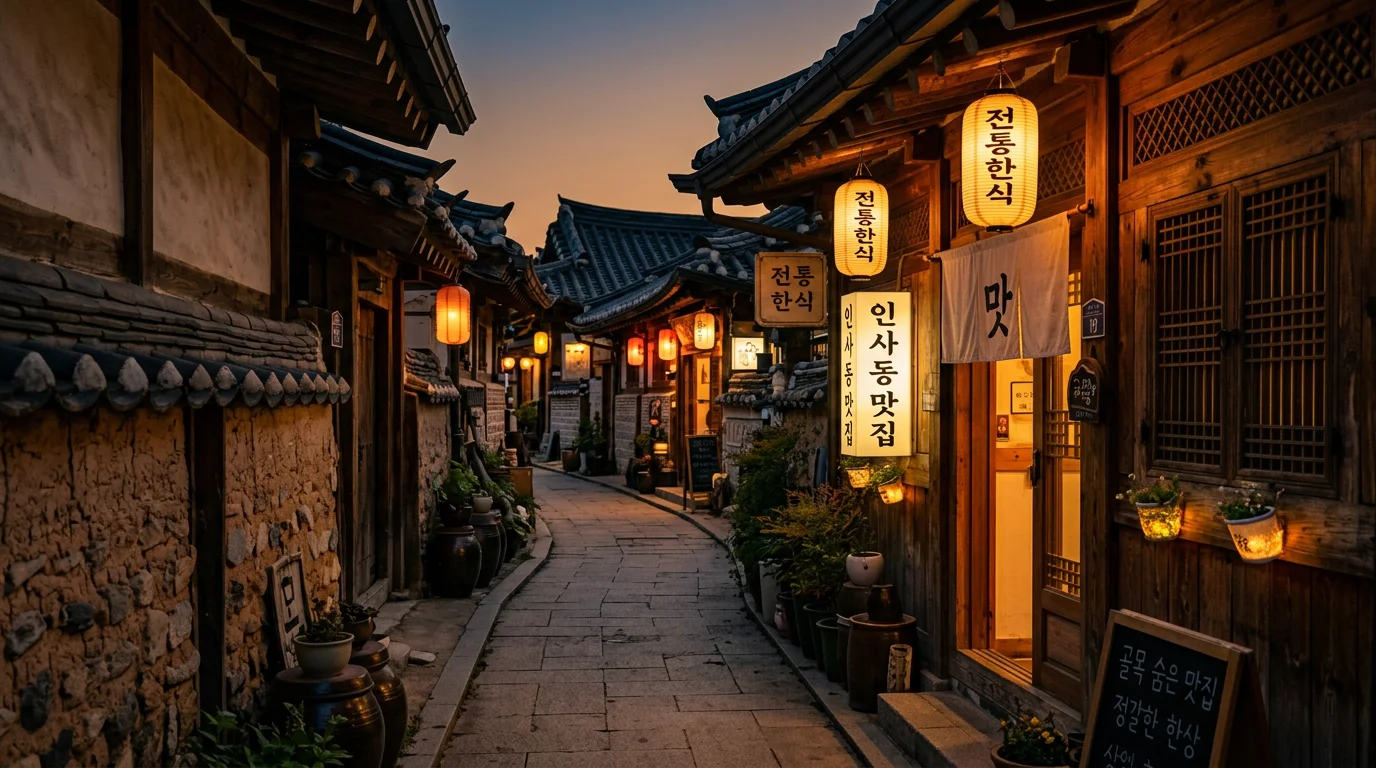
🥟 What Should You Eat in Insadong? The Traditional Spots Hidden in the Alleys
⚠️ Please note
Every price, rating, opening hour, closing day, and break time below is for reference only and changes often depending on the venue. Insadong's older shops in particular may close early once they run out of ingredients, or run different hours on different days. Always check NAVER Map, Google Maps, or the venue's official channels for the latest before you go. Popular spots like Gaeseong Mandu Koong (Gaeseong Dumpling House) can have long waits at lunch and on weekends, and most run on in-person waitlists with no reservation app.
⏱️ 30-Second Summary — Just Remember This!
🥟 The food → dumplings, sujebi, kalguksu, hanjeongsik and other traditional Korean dishes 💰 Price → mostly ₩10,000–20,000 per meal (hanjeongsik and hot pots run higher) 🌍 Foreigners → start with places that have photo or tablet menus 🗣️ Language → older shops may not speak English, so bring a translation app 📍 Location → all within walking distance of Anguk Station (Line 3) ⏰ Tip → popular spots are quietest right at opening or around 3 p.m.
1. 🗺️ What Kind of Neighborhood Is Insadong?
Insadong is a traditional culture street in Jongno District, Seoul. With its preserved hanok (traditional Korean houses) and alleys evoking the Joseon era, it's a place to enjoy Korean food, traditional tea, and Korean crafts all in one spot.
Restaurants hide along the side alleys off the main street (Insadong-gil). A defining trait of the area is that the real gems are often deep in the alleys or up on a second floor.
"Quintessentially Korean" dishes dominate: dumplings, sujebi, kalguksu, hanjeongsik, and traditional tea.
There are big, easy-to-spot restaurants because of the tourist traffic, but the places locals keep coming back to tend to sit a little further in.
2. 🚇 How Do You Get There?
Anguk Station (Line 3) is closest. Exit 6 leads straight toward the Insadong Culture Street, and it's a 3–5 minute walk to most of the restaurants here.
You can also walk over from Jongno 3-ga Station (Lines 1, 3, and 5).
Parking is tricky. The alleys are narrow and many older shops have no dedicated lot, so the subway and walking beat driving. If you do drive, check nearby public or paid lots in advance.
3. 💰 How Much Does It Cost?
For a tourist area, Insadong isn't extreme on price. Here's the rough picture (all for reference and subject to change):
Sujebi, kalguksu, dumplings: about ₩9,000–19,000 per bowl
Lighter meals like makguksu or a savory pancake (jeon): around ₩10,000 per person
Vegetarian Korean food (e.g. Osegyehyang): roughly ₩12,000–24,000 per person
Dumpling hot pot (for two): around ₩42,000–48,000
Hanjeongsik (multi-course): tens of thousands of won per person, varying a lot by quality
Korea has no tipping culture. The menu price is exactly what you pay, and you usually settle up at the counter after your meal.
4. 🍜 Standout Restaurants Worth a Visit
A few long-loved picks, sorted by type. Ratings are for reference and can shift over time.
Gaeseong Mandu Koong (dumplings & dumpling hot pot) — Insadong's signature dumpling institution. Set in a converted traditional hanok, it's now in its third generation and has been named a Michelin Guide Seoul Bib Gourmand (great food at a reasonable price) across multiple years. Dumpling soup and hot pot are the headliners, and it's popular enough to draw a line even at opening, so plan for a wait. There's a break time (roughly 3–4 p.m.), so time your visit around it.
SotNaeEum Jongno Insa Branch (steak bibimbap & Korean food) — An easy, comfortable entry point for foreign visitors. It reviews very well thanks to a photo menu, fast service, and second-floor seating with a nice window view. A safe choice if you're bringing along someone new to Korean food.
Insadong Sujebi (sujebi & seafood pancake) — A sujebi (hand-torn dough soup) specialist hidden down an alley. Its signature is a spicy oyster-based broth, so keep that in mind if you don't eat seafood. There's a break time between lunch and dinner and it closes relatively early, so if you're going in the late afternoon, check that it's open first.
Bukchon Kalguksu (kalguksu, dumplings & bossam) — A shop that's held the same spot for over a decade. The handmade dumplings, kalguksu (knife-cut noodle soup), and tender bossam (boiled pork) all get good marks. It sits deeper along Insadong-gil, easy to drop into on a stroll.
Bangtae Makguksu (bibim makguksu, potato pancake & gulrim mandu) — A hanok-style makguksu spot on Insadong 6-gil. The combo of bibim makguksu (spicy chilled buckwheat noodles) with a warm potato pancake and gulrim mandu (rolled dumplings) is popular, and at around ₩10,000 per person it's an easy, light meal.
Sanyuhwa Hanjeongsik (traditional multi-course Korean) — A good pick when you want a quiet, refined course meal. It's mostly private rooms, so it feels intimate and suits hosting elders or business guests. Since seating is by room, a reservation is recommended. The price is higher than the spots above.
💡 Finding tip: Insadong's older shops sit deep in alleys or up on a second floor and are easy to walk past. Pin your destination in NAVER Map (most accurate for local info) or Google Maps, and if you can't see a sign, check the building's second floor and the side alley one more time.
5. 🌿 Vegetarian or Vegan?
Korean food often uses meat or seafood broth, which can trip up vegetarians. Fortunately, Insadong has options.
Osegyehyang (vegetarian & vegan Korean food) — A vegetarian specialist on Insadong 12-gil. It's often recommended to vegetarian and vegan travelers for its hearty meat-free dishes, including "chicken" made with plant-based meat.
Cheongchun Sujebi (sujebi & kalguksu with a vegan menu) — It runs a vegan menu alongside a regular one, making it comfortable for a mixed group of vegetarians and non-vegetarians. Expect dumplings, kalguksu, and kongguksu (chilled soy-milk noodles). (It has a closing day, so check before you go.)
When ordering, it helps to double-check whether there's broth or fermented seafood (jeot) in a dish. See the phrases below.
6. 🍵 After the Meal, a Cup at a Traditional Tea House
Insadong is also famous for its traditional tea houses. After eating, resting at a hanok tea house makes a lovely follow-up.
You can enjoy traditional teas like jujube tea, omija (five-flavor berry) tea, and yuja (citron) tea, plus desserts like rice cakes and hangwa (traditional confections).
Charming hanok spots like Sinyet Chatjip and Namusae Tea House cluster around Insadong-gil.
Many tea houses ask for one order per person, and being in a tourist area, prices can run a touch high. Floor seating where you take off your shoes is common.
7. 🙆 Ordering & Etiquette Tips
Card payment usually works, but some older shops are cash-only. Carrying a little cash is the safe move.
Water and side dishes are typically self-serve or free to refill. Many places have a separate water and banchan station.
At spots with floor seating, you may need to take your shoes off.
Popular places are quietest right at opening (the 11 o'clock hour) or after the lunch peak, around 3 p.m.
Waits are mostly in-person, no app. You'll often write your name and wait, or simply line up.
❓ Frequently Asked by Visitors (FAQ)
Q. Is there an English menu? A. Some places like SotNaeEum and Cheongchun Sujebi have photo, tablet, or English menus, but older shops are often Korean-only. Installing Papago or Google Translate ahead of time helps.
Q. Can I pay by card? A. Usually, yes. That said, some older shops are cash-only, so it's smart to bring a little cash.
Q. Are the waits really long? A. Popular spots like Gaeseong Mandu Koong get lines at lunch and on weekends. In-person waiting is more common than reservation apps, so aiming for opening time or around 3 p.m. makes it much easier.
Q. Can vegetarians/vegans eat here? A. Options include Osegyehyang (vegetarian specialist) and Cheongchun Sujebi (with a vegan menu). Elsewhere, asking about broth and fermented-seafood use makes things safer.
Q. Do I need a reservation? A. For hanjeongsik (private-room) places like Sanyuhwa, a reservation is recommended. Most sujebi, dumpling, and kalguksu shops are walk-in, no reservation.
Q. Should I tip? A. No. Korea has no tipping culture. The menu price is the final amount, and you usually pay at the counter.
🗣️ Handy Korean Phrases for the Moment
"Yeong-eo menyu innayo?" (영어 메뉴 있나요?) → Do you have an English menu?
"Kadeu-ro gyesan-dwaeyo?" (카드로 계산돼요?) → Can I pay by card?
"Igeo chaesig-ingayo? Gogi-rang haemul yuksu an deureogannayo?" (이거 채식인가요? 고기랑 해물 육수 안 들어갔나요?) → Is this vegetarian? No meat or seafood broth?
✅ Quick Checklist
Did you check opening hours, break times, and closing days in a map app before going?
Did you bring a little cash? (Some places are cash-only.)
Did you time popular spots for opening or around 3 p.m.?
If vegetarian, did you pre-pick a vegan-friendly place?
Did you install a translation app (Papago or Google Translate)?
Do you remember that prices and ratings are for reference and can change?
🟦 CultureHub
🟦 A guide put together by the CultureHub team. 📅 Based on: 2026 · ⚠️ Pricing, English support, information, and operations may vary by season, venue, and branch. We don't endorse any specific business. Always confirm the latest details through each venue's official channels and map apps before visiting.