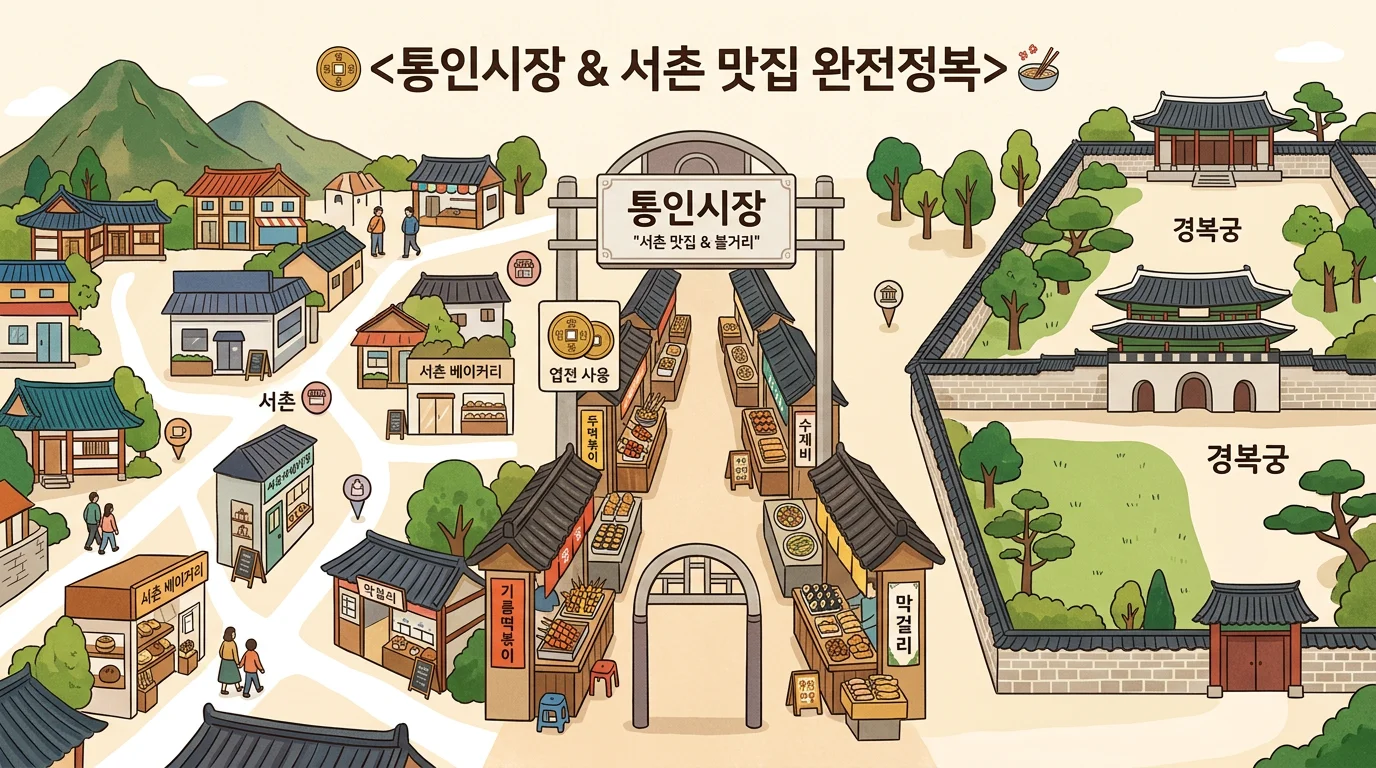
🏯 One alley beside the palace wall, and the time travel begins
⚠️ Please note
The prices, star ratings, opening hours, closing days, and coin-sale times below vary by shop, season, and day of the week, and they change often. Ratings especially are for reference, and the lunchbox café's hours and closing days appear slightly differently across sources — so please always check official channels or a map app before you go. In Seochon, many shops close on Mondays, and popular spots can have lines at weekend lunch, so give yourself some time.
⏱️ 30-second summary — just remember this!
🪙 Concept → a traditional market where you buy coins to fill a lunchbox with market food
💰 Coins → 500 won each, usually a bundle of 10 from 5,000 won (unused coins refundable)
🍢 Inside the market → oil tteokbokki · Geumsang croquettes · chicken skewers · dumplings
🍲 Near the market → Tosokchon samgyetang · Chaichi (formerly Chwicheollu) handmade dumplings
📍 Location → about a 5–9 min walk from Gyeongbokgung Station Exit 2 (Seochon)
🗓️ Watch closing days → Seochon shops often close Mondays, the lunchbox café often on Tuesdays
1. 🪙 Why Tongin Market is special — the "lunchbox café"
Tongin Market opened in 1941 as an old-school market, but today it's better known for its lunchbox café (도시락 카페). At the Customer Satisfaction Center in the middle of the market, you buy yeopjeon coins, then use them to pick side dishes, snacks, and small plates one by one from participating stalls, filling up a black lunch tray. When your tray is full, you return to the café space (2nd–3rd floor) and sit down to eat. The real fun is sampling many foods in small portions, like building your own buffet plate. Running since 2012, this system has made the market a favorite for kids, solo diners, and international visitors alike.
2. 🎫 How to use the lunchbox café
Even first-timers will find it easy once they know the steps.
① Buy coins — Pay with cash or card at the Customer Satisfaction Center (lunchbox café). You can also grab a map of participating shops here.
② Fill your tray — Shops that accept coins display a sign like "엽전 ○냥 (○ nyang)" or a participating-shop mark. Swap coins for the foods you want and load up your tray.
③ Sit and eat — Head back to the café space, grab a seat, and dig in. Chopsticks, spoons, and a microwave are provided, so you can reheat anything that's gone cold.
④ Refund leftover coins — Any coins you don't use can be refunded, so feel free to buy only as much as you'll eat.
💡 Tip: The café's operating and coin-sale times appear slightly differently across sources. It generally starts around 11 a.m. and wraps up around 4 p.m. (a bit later on weekends), but always confirm the exact times and closing days (often listed as Tuesdays and the third Sunday of the month) before you visit.
3. 💰 How much does it cost?
Coins: 500 won each, usually bought as a bundle of 10 from 5,000 won. Even 5,000 won per person makes a decent meal.
Reference prices (subject to change): tteokgalbi about 2,000 won, sundae skewer about 1,500 won, kimchi handmade dumpling about 1,000 won — all in small, single-item portions.
You can also buy rice and soup separately at the café for around 1,000 won each.
Tongin Market is more of a tourist-favorite market than a bargain local one, so it isn't "super cheap." Instead, think of it as a place to enjoy tasting lots of foods in small amounts. All figures above are for reference and can vary by shop and season.
4. 🌶️ Signature foods inside the market (real shops)
Oil tteokbokki — Choecho Wonjo Halmeoni Tteokbokki / Wonjojeong Halmeoni Kireum Tteokbokki · The market's icon. There's no broth — the rice cakes are stir-fried in oil and seasoning, so they're slightly crisp outside and chewy inside. Try the soy-based (mild) and gochujang-based (spicy) versions half-and-half. A few shops inside the market claim to be the "original," and many say they taste similar. It's mild and savory — beloved as a nostalgic taste — but if your expectations are high, it can feel plain (ratings are in the low-to-mid 3s, for reference). About 4,000 won per serving (varies by shop and how you order).
Croquettes — Seochon Geumsang (Geumsang Croquette) · A croquette specialist using Korean potatoes. Flavors range widely — potato, whole shrimp, wasabi cabbage, mozzarella, curry-chili-cheese, meat-and-veggie, sweet red bean — with a thin, crispy coating. Well-reviewed (rating about 4.5, for reference), from 3,000 won.
Chicken skewers · dumplings · Generously topped chicken skewers and hand-folded dumplings are among the small bites you can enjoy with coins. Some shops make kimchi dumplings with no meat, which is handy for vegetarians.
5. 🥖 The bakery by the west entrance — Hyoja Bakery
Near the market's west entrance sits Hyoja Bakery (효자베이커리), an old neighborhood bakery often called "Seochon's first bakery." Its cornbread and onion-topped breads are the signatures. It has over 400 reviews and rates well (about 4.0, for reference). It opens at 7:30 a.m. but is closed on Mondays, and with almost no seating it's mostly takeaway. A perfect sweet finish after something savory in the market.
6. 🍲 Seochon spots near the market, within walking distance
If the market alone isn't enough, walk toward Gyeongbokgung Station and you'll find Seochon's long-running favorites.
Tosokchon Samgyetang (토속촌 삼계탕) · A ginseng-chicken-soup institution set in a traditional hanok building, right by Gyeongbokgung Station. Hugely popular with both locals and tourists, with over 11,000 reviews (rating about 4.2, for reference). Open daily 10:00–22:00; samgyetang is in the 20,000-won range. It's spacious and turns tables quickly, so lines usually move fast, though weekend and bok-nal (hot-season) lunches get busy. Because it's so famous, expectations run high and opinions vary, so keep that in mind. (About a 5-min walk from the market.)
Chaichi (formerly Chwicheollu / 취천루) · A long-standing, family-run Chinese and handmade-dumpling spot, known for meat and boiled dumplings plus dishes like menbosha (shrimp toast) and ohyang-jangyuk (rating about 4.0, for reference). Open Tue–Sun with a mid-afternoon break, and closed on Mondays. (About a 4-min walk from the market.)
Jaha Son Mandu (자하손만두) · A handmade-dumpling institution listed in the Michelin Guide 2026. It's known for clean, lightly seasoned dumplings and dumpling soup (rating about 3.8, for reference). Note it's a bit farther — roughly a 20-min walk north toward Inwangsan / Buam-dong. Closed on Mondays, and weekend lunches can mean a wait. Great to pair with a walk or a hike.
7. 🗺️ Location · getting there · parking
Address: 18 Jahamun-ro 15-gil, Jongno-gu, Seoul (Seochon)
Subway: About a 5–9 min walk from Gyeongbokgung Station (Government Complex) Exit 2, Line 3
Market hours: Roughly 07:00–21:00 (varies by shop)
There's an arcade roof, so it's easy to browse even in rain or snow.
Parking: The market has no dedicated lot; use the nearby Hyoja-dong public parking (about a 7-min walk) or Sejong Village Singyo public parking (about a 10-min walk). Reference rate is around 3,000 won/hour, and on weekends and holidays there are time windows for street parking nearby. Lots can fill up, so public transit is recommended.
8. 💡 Handy tips and etiquette
Check the day of the week. Many Seochon spots close on Mondays (Hyoja Bakery, Chaichi, Jaha Son Mandu, etc.), and Tongin Market's lunchbox café is closed on Tuesdays.
Food cools quickly once you carry it around. In winter, eat right in front of the stall or use the café's microwave.
Weekend lunch is very crowded. For a relaxed browse, weekdays or early hours are more comfortable.
Suggested route: snacks → skewers → dessert helps spread out the waits (e.g., oil tteokbokki → chicken skewer → croquette/bread).
When you're done, tidy your food waste at the return station — that's the basic etiquette here.
It pairs beautifully with Gyeongbokgung and the Seochon hanok alleys for a half-day course.
❓ Questions visitors often ask (FAQ)
Q. Where do I buy the coins? → At the Customer Satisfaction Center (lunchbox café) in the middle of the market, with cash or card.
Q. What if I have coins left over? → Unused coins can be refunded, so buy only what you need.
Q. Will English work? → It varies by shop. Pointing at the menu and handing over a coin usually does the trick, and a translation app makes it even smoother.
Q. Can I pay by card? → You can buy coins by card, but some non-coin shops may be cash-only, so a little cash on hand is safest.
Q. Where can I get a proper sit-down meal besides the market? → About a 5-min walk toward Gyeongbokgung Station you'll find samgyetang (Tosokchon) and handmade dumplings/Chinese (Chaichi) — great for a hearty meal.
Q. I'm not great with spice — any options? → The soy version of the oil tteokbokki is fairly mild, and there are plenty of non-spicy choices like croquettes, dumplings, bread, and samgyetang.
🗣️ Handy Korean phrases on-site
"이거 엽전 몇 개예요?" (i-geo yeop-jeon myeot gae-ye-yo?) — How many coins is this?
"카드로 계산할 수 있나요?" (ka-deu-ro gye-san-hal su in-na-yo?) — Can I pay by card?
"이거 매운가요?" (i-geo mae-un-ga-yo?) — Is this spicy?
✅ Quick checklist
Check the day you're visiting (café often closed Tuesdays; many Seochon spots closed Mondays)
Bring some small cash (for non-coin shops)
Install a translation app
Pair it with Gyeongbokgung / Seochon plans
On weekends, go early or use public transit
🟦 CultureHub
🟦 A guide put together by the CultureHub team.
📅 As of: 2026 · ⚠️ Prices, ratings, English support, details, and hours may vary by season, shop, and day.
We don't endorse any specific business — please confirm the latest details with each shop's channels or a map app before visiting.