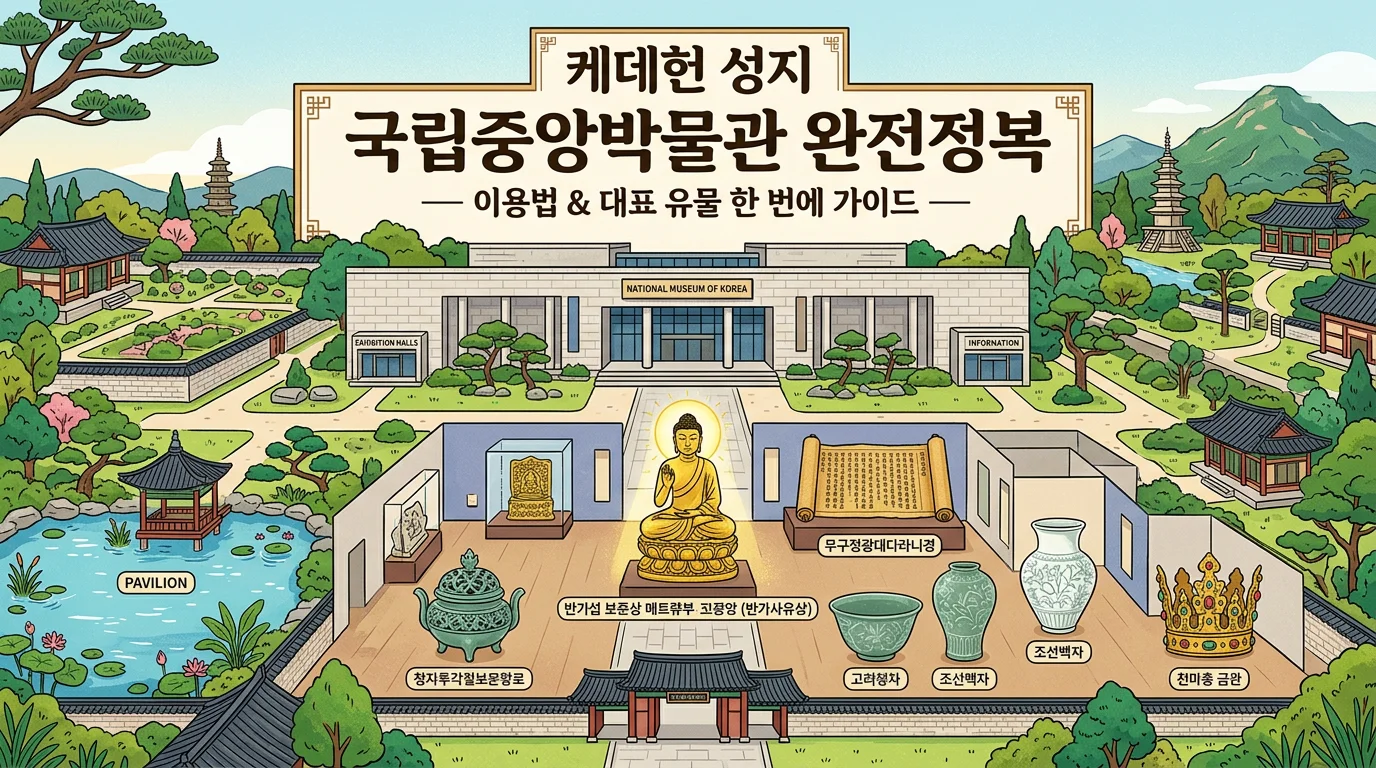
🏛️ Korean Traditional Art Back in the Spotlight Thanks to "KPop Demon Hunters" — A Complete Guide to the National Museum of Korea
⚠️ Please Note
Opening hours, closing days, special-exhibition fees, and foreign-language support change often by season and exhibition. Special exhibitions in particular vary by exhibition in whether they're free or paid and how you reserve, and popular goods (like the magpie-and-tiger badge) can sell out. Also, displayed artifacts — paintings, folk art, metalwork, and more — are rotated for preservation and gallery reorganization, and some pieces (such as the original Baekje Gilt-bronze Incense Burner) are held at other national museums. Always check the official website (museum.go.kr) or a map app for the latest information and what's on display before your visit.
⏱️ 30-Second Summary — Just Remember This!
💰 Admission → Permanent galleries are free; special exhibitions are free or paid depending on the show
🎫 Reservation → Not needed for permanent galleries; the Children's Museum and the VR experience in Immersive Hall 2 require reservations
🚇 Getting there → Ichon Station (Line 4 / Gyeongui-Jungang Line), Exit 2 → via the "Museum Nadeulgil" passage
🕘 Hours → Mon·Tue·Thu·Fri·Sun 09:30–17:30 / Wed & Sat until 21:00
🌍 Languages → Official app offers guidance in Korean, English, Chinese, and Japanese
🐯 KPop Demon Hunters → The tiger & magpie characters were inspired by Korea's magpie-and-tiger folk painting tradition
⭐ Highlights → Pensive Bodhisattva, Gyeongcheonsa Ten-story Pagoda (check whether the gold crown, Moon Jar, and folk paintings are on display)
PART 1. 🎟️ How to Visit & Tips
1. 💰 Admission — The Permanent Galleries Are Free
Best news first! The permanent galleries at the National Museum of Korea are free. That means you can enjoy a world-class museum without paying a won. The limited-time special exhibitions are free or paid depending on the show, and paid exhibitions require a separate ticket. Fees vary by exhibition (treat any figures as reference only, subject to change), so check before you go.
2. 🚇 Getting There — Ichon Station Is the Answer
The subway is easiest. Exit through Ichon Station (Line 4 or the Gyeongui-Jungang Line), Exit 2, and you'll find "Museum Nadeulgil," an underground passage leading straight to the museum. It has a moving walkway and displays of major cultural artifacts lit with LEDs, so even on a rainy or hot day you'll arrive comfortably in about 3 minutes. The address is 137 Seobinggo-ro, Yongsan-gu, Seoul.
3. 🕘 Hours — Aim for the Wed & Sat Evening Openings
Standard hours are 09:30–17:30 on Mon, Tue, Thu, Fri, and Sun (last entry 17:00). On Wednesdays and Saturdays, the museum stays open until 21:00 (last entry 20:30). If you want to avoid the busy daytime crowds, the evening hours are far more relaxed — and viewing the artifacts under the lighting has a special atmosphere.
4. 📅 Closing Days — Check Before You Go
The museum is closed on January 1, and the days of Seollal (Lunar New Year) and Chuseok (Korean Thanksgiving). Beyond these basic closing days, the permanent galleries — as a whole or in part — may close temporarily for maintenance. In 2026 there are specific permanent-gallery closure days designated (note that a full museum closure and the temporary closure of a specific gallery are different things), so once your travel dates are set, double-check that month's closing notices on the official website.
5. 🎫 Reservations — No Booking Needed for the Permanent Galleries
Individual visitors can enter the permanent galleries without a reservation. The Children's Museum requires an online reservation, and while the Digital Immersive Halls generally don't require one, the VR experience in Immersive Hall 2 runs on advance reservation. Entry numbers may be limited when crowded. Special exhibitions differ by show in whether tickets are bought on-site or booked online, so check the guidance for that exhibition.
6. 🌍 No Language Worries — Free App & Audio Guide
You'll be fine even without Korean. Download the museum's official guide app (free on the App Store and Google Play) for exhibit information and audio guides in Korean, English, Chinese, and Japanese. Major artifacts come with multilingual explanations — like having a personal guided tour from your phone. Bring earphones for extra convenience.
7. 🐯 For KPop Demon Hunters Fans — The MU:DS Shop Is a Must
The museum gift shop, MU:DS, is famous as a "goods hotspot." Since the KPop Demon Hunters craze, demand for magpie-and-tiger badges and magnets has risen sharply, and they can sell out. The Pensive Bodhisattva miniature is also one of the signature MU:DS items well known to overseas visitors. If there's something you want, it's safest to stop by early and check stock.
8. 🍜 Viewing Tips — It's Big, So Plan Your Route
The museum is truly vast (the permanent galleries alone span three floors). You can't see it all in one day, so pick the galleries you care about in advance (e.g., the Room of Quiet Contemplation, the Silla gallery, the painting gallery). There are cafés, restaurants, and shops inside for breaks, and the outdoor garden and "Mirror Pond" are great photo spots. Wear comfortable shoes, and drink water in the designated rest areas (beverages may be restricted inside the galleries).
PART 2. 🖼️ Good-to-Know: The Must-See Treasures
At a museum, "the more you know, the more you see." Even an artifact behind glass feels completely different once you know its backstory. Here are the treasures you shouldn't miss, along with the stories behind them. (Paintings, folk art, and metalwork may be rotated for preservation and gallery reorganization, so if there's a specific piece you want to see, check the collection search and exhibition guidance before your visit.)
9. 🐯 Magpie & Tiger (Hojakdo) — The Folk Tradition Behind the KPop Demon Hunters Characters
KPop Demon Hunters fans, start here! Magpie and tiger (Hojakdo, 虎鵲圖) is a Joseon-era folk painting (art of the common people) featuring a magpie and a tiger together. It made headlines when fans learned that the tiger and magpie characters in Netflix's <KPop Demon Hunters> were inspired by this folk tradition. That said, no single specific work is an official "origin" — folk painting is a genre painted by many artists. The tiger looks more comical and friendly than fearsome. The magpie is read as a bringer of welcome news and good fortune, and the tiger as a symbol of courage and authority — or as a figure gently satirizing that authority. Meanings vary from work to work, but the humor of Korean folk art shines through in the way a fearsome tiger is rendered friendly and comical.
10. 🧘 Pensive Bodhisattva — The Star of the "Room of Quiet Contemplation"
This is one of the museum's signature treasures. The Pensive Bodhisattva (Bangasayusang) rests one leg on the opposite knee, fingers lightly touching the cheek, lost in deep thought. For the two pieces, each designated a National Treasure, the museum created a dedicated space called the "Room of Quiet Contemplation." In the dark space, the two statues glow softly — many visitors say it leaves them feeling calm. The miniature is one of the signature MU:DS items.
11. 🗼 Gyeongcheonsa Ten-story Pagoda — A Marble Tower Rising Indoors
Step into the museum's first-floor lobby and you'll be awed by a white stone pagoda soaring toward the ceiling. The Gyeongcheonsa Ten-story Pagoda from Gaeseong is a Goryeo-era marble tower about 13.5 m tall, its entire surface carved with the Buddhist world — Buddhas, bodhisattvas, the Four Heavenly Kings, and more, layer by layer. Since it's displayed indoors rather than outside, you can see it regardless of weather, and even view the carvings from the floors above. It's a popular photo spot too.
12. 👑 Silla Gold Crown — Splendor from 1,500 Years Ago (Check Whether It's on Display)
Excavated from the Silla tombs in Gyeongju, the gold crown is the pinnacle of Silla's golden culture. The upright ornaments shaped like tree branches and deer antlers, along with the dangling gogok (curved jade) and gold decorations, would have sparkled with every movement. The museum holds pieces including the gold crown excavated from the north mound of Hwangnamdaechong (a National Treasure), showcasing Silla's golden culture. However, the actual pieces on display may change due to loans, preservation, or gallery reorganization, so check the collection search and exhibition guidance. Whether it was actually worn by a king or made for burial is still debated by scholars — imagining that mystery makes it even more intriguing.
13. 🏺 White Porcelain Moon Jar — Joseon's Understated Beauty (Check Whether It's on Display)
The Moon Jar is, as the name suggests, a large, round, pure-white porcelain jar resembling a full moon. With no elaborate decoration, its milky surface and slightly asymmetrical form alone express Joseon aesthetics. Because it's made by joining a top and bottom half, it isn't perfectly symmetrical — and that "natural imperfection" is precisely its charm. You'll find it in the Buncheong Ware and White Porcelain gallery, but the displayed piece may be rotated, so check before your visit.
14. 🔎 See It This Way and It's 10x More Fun
Artifacts look completely different once you know why they were made. The Pensive Bodhisattva embodies "contemplation toward enlightenment," the gold crown "royal authority," and folk paintings "the wishes of ordinary people." Touring with the audio guide in the official app makes it far more immersive. "National Treasure" and "Treasure" are state designations for especially important cultural heritage, so when you see those labels, give the piece extra attention.
❓ Frequently Asked by Visitors (FAQ)
Q. Is it really free? A. Yes, the permanent galleries are free. Special exhibitions are free or paid depending on the show, and paid ones require a separate ticket.
Q. Do I really need a reservation? A. Individual visitors can enter the permanent galleries without one. The Children's Museum and the VR experience in Digital Immersive Hall 2 require a reservation, and special exhibitions may require online booking or a separate ticket depending on the show.
Q. Is there English guidance? A. Yes. The official free app and audio guide offer explanations in Korean, English, Chinese, and Japanese, and major artifacts have English information panels.
Q. Can I actually see the tiger painting from KPop Demon Hunters? A. The characters were inspired by the Joseon-era magpie-and-tiger folk painting tradition. Such folk paintings are sometimes shown in the painting gallery, but paintings and folk art are rotated for preservation, so it's best to check whether it's on display on the day of your visit.
Q. Where do I buy the KPop Demon Hunters tiger goods? A. At the museum's MU:DS shop. They're very popular and can sell out, so stop by early.
Q. Is the Baekje Gilt-bronze Incense Burner here too? A. The famous original incense burner is at the Buyeo National Museum. At the National Museum of Korea you can see many other signature treasures.
Q. What's a good order to see things? A. First-floor Gyeongcheonsa Pagoda → Prehistory & Ancient History gallery (gold crown) → Sculpture & Crafts gallery (Pensive Bodhisattva, "Room of Quiet Contemplation") → painting gallery (folk art) works well. Highlights take 2–3 hours; a thorough visit needs half a day or more.
🗣️ Handy English Phrases On-Site
"Is the permanent exhibition free?"
"Where is the Room of Quiet Contemplation?"
"Where can I find the magpie and tiger badge?"
"Do you have an English audio guide?"
✅ Quick Checklist
Check the official website whether your visit date is a closing/maintenance day
If seeing a special exhibition, check in advance whether it's free/paid and how to book
Reserve in advance for the Children's Museum and the Immersive Hall 2 VR experience
Download the official guide app + bring earphones
Confirm the route: Ichon Station Exit 2 → Museum Nadeulgil
Use the collection search to confirm the pieces you want (gold crown, Moon Jar, folk paintings, etc.) are currently displayed
Check stock for desired goods early at the MU:DS shop
Wear comfortable shoes; drink in the rest areas (the museum is large)
🟦 A guide compiled by the JoyStoria team.
📅 As of: 2026 · ⚠️ Fees, foreign-language support, exhibition/collection info, operations, and reservation methods may change by season and exhibition.
JoyStoria does not endorse any specific business. Before visiting or booking, always confirm the latest information and whether an artifact is on display via the National Museum of Korea's official channels (museum.go.kr) and a map app. Exhibitions, goods stock, and special-exhibition fees and booking methods change frequently, so please re-confirm important plans before your visit.