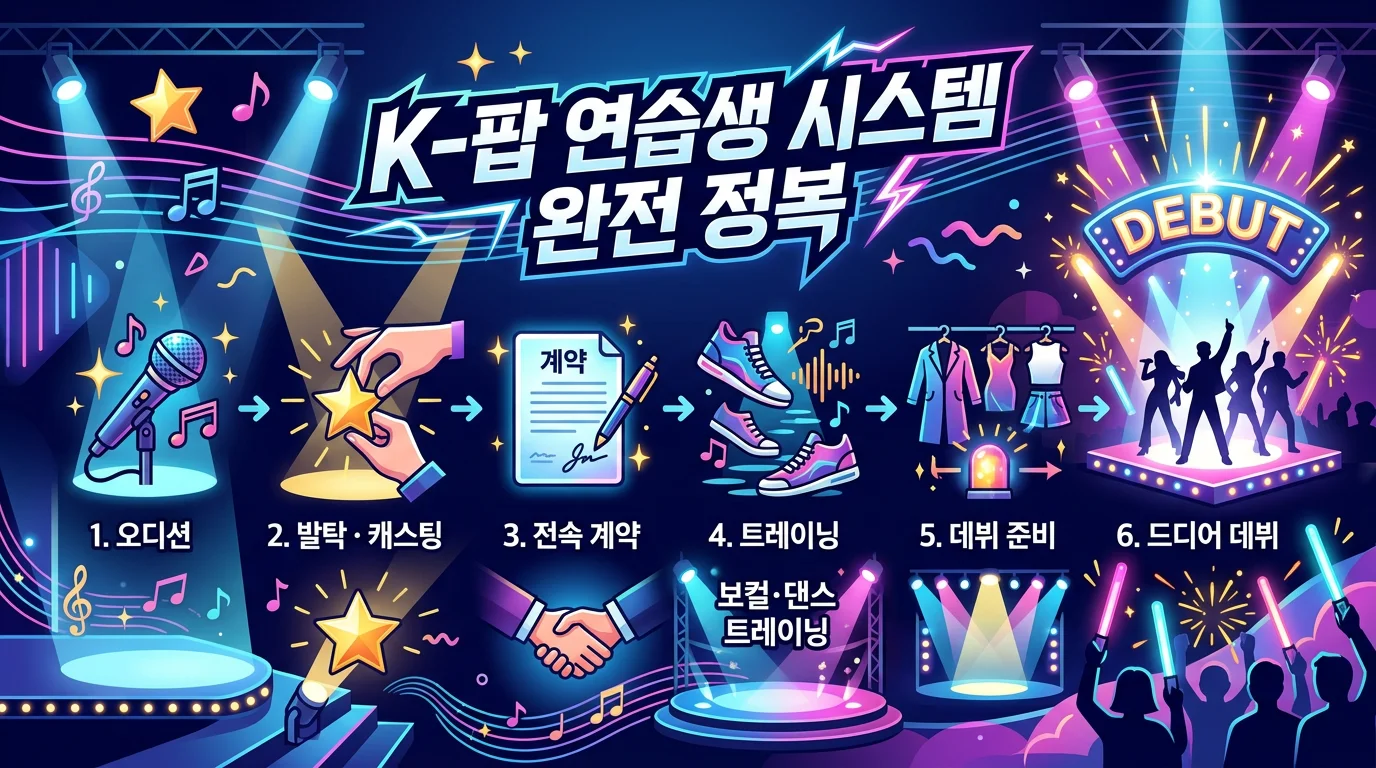
🎤 The K-Pop Trainee System, Fully Explained — From Auditions to Debut
⚠️ Please note
This guide summarizes the general flow of the K-pop industry. Training length, contract terms, revenue settlement, and debut formats vary a lot by agency and by individual. We've deliberately avoided presenting numbers as if they were "official industry averages," because in many cases no such comprehensive statistics are publicly available. Always confirm exact audition schedules, eligibility, and contract details on each agency's official website and official social media.
⏱️ 30-Second Summary — Just Remember This!
🎯 Trainee → a candidate signed to an agency, preparing to debut
🎤 Selection → public/online/global auditions or on- and offline casting
📝 Contract → there's a standard trainee contract, separate from a debuted artist's exclusive contract
⏳ Duration → from a few months to several years; huge individual variation, no official average
🏋️ Training → vocals, dance, stage, language, fitness; schedules differ by company and person
📊 Evaluation → regular evaluations track skill and growth and shape debut candidates
📺 Survival → debut members are sometimes chosen via TV or online programs
💰 Costs & settlement → how training/activity costs are covered or deducted varies by contract
⚠️ Debut → signing a trainee contract does NOT guarantee a debut
🌟 Official debut → centered on a single/album release, followed by music shows and content
1. 🎯 What exactly is a "trainee"?
A trainee is a candidate signed to an entertainment agency who trains in vocals, dance, foreign languages, and stage performance while preparing to debut as a singer or idol. Because they haven't officially debuted as a pop-culture artist yet, their activities and contract structure can differ from those of a debuted celebrity.
After selecting a trainee, the agency provides training programs, practice space, trainers, and in some cases housing and meals. The trainee takes part in set lessons and evaluations to build skill and teamwork. Whether the costs the company covers are later deducted from the artist's earnings, or treated as the company's own investment, depends on the company and the individual contract. So it's not accurate to assume every trainee starts out "in debt" to the company.
A defining feature of the K-pop system is that the company doesn't just teach singing and dancing — it plans team formation, musical direction, concept, content, and overseas activity over the long term. That said, more and more teams now have members who take part directly in songwriting and concept-making, so it's too simple to see it purely as a company deciding everything one-sidedly.
2. 🎤 How do you become a trainee? (Auditions & casting)
There are two main doors in.
The first is a public audition held by an agency. You submit singing/dancing videos online or perform in person. Major companies hold regular auditions and sometimes run "global auditions" that tour worldwide (always check the exact schedule and age requirements in the company's notice).
The second is casting (street casting) — being scouted by a company staffer on the street, at school, or on social media. These days it's increasingly common to be contacted after someone sees a cover video on YouTube, TikTok, or Instagram.
Rather than finished ability, they look holistically at basic talent, a sincere attitude, image, and growth potential (how much you can develop going forward). If you pass, you sign a trainee contract and formal training begins.
3. 📝 How do trainee contracts work?
It's important to distinguish a trainee contract from a debuted artist's exclusive contract. Korea's Ministry of Culture, Sports and Tourism provides a "Standard Contract for Trainees in the Popular Culture and Arts Field" and a separate standard contract (supplementary agreement) to protect minors. In particular, from January 1, 2026, a revised standard contract — strengthening mental-health protections and requiring clear deadlines for damage-compensation payments — has been made available on the Ministry and Korea Creative Content Agency websites.
The standard contract is not a law in itself but a recommended standard template the government provides to encourage fair contracting. It sets baseline standards on contract duration, education and costs, each party's rights and obligations, termination, human-rights protection, and dispute resolution. Actual contract terms can differ by company, so it's important to read the contract yourself. Minors should review it together with a legal guardian, and if any clause is hard to understand, it's wise to get help from a legal professional.
The general trainee standard contract sets the contract period at no more than 3 years in principle. However, because a contract can be renewed or a person can move to another company and train again, the total trainee period one person experiences can be longer than this.
Most importantly: signing a trainee contract does not guarantee a debut. Depending on the company's new-group plans, team composition, evaluation results, and market conditions, a debut can be delayed or fall through.
4. ⏳ How long is the trainee period?
There's no fixed official average, and individual variation is huge. Some debut within a few months; others prepare for several years or move through multiple agencies before debuting. Conversely, some train for a long time, never debut, and choose a different path.
Skill isn't the only factor. A company's schedule for producing a new group, the age and image of members it needs, positions within the team, musical concept, investment plans, and market conditions all play a role. So a long training period doesn't necessarily mean someone lacks skill, and a short one doesn't mean they're underprepared.
5. 🏋️ What is daily life like?
A trainee's schedule varies greatly by company, age, school life, and whether an evaluation or debut is coming up. Student trainees often attend school during the day, then head to the company after class for vocal/dance lessons and personal practice. Adult trainees may start classes and practice earlier in the day.
Combining formal lessons and personal practice, many practice several hours a day, and they may practice late into the night ahead of a monthly evaluation or debut. But not every trainee trains 8–12 hours a day or 80–90 hours a week, so this shouldn't be understood as a fixed industry schedule.
For teen trainees, the rights to education, rest, and sleep, along with physical and mental health, are especially important. Companies must consider a minor's age and school schedule, and it's good for parents or guardians to check the training schedule and living conditions together.
6. 🎵 What do trainees train in?
Training is far more comprehensive than you might expect. The main areas include:
🎤 Vocals — pitch, projection, breathing, live stability. Companies often have a "sound" they aim for and shape trainees toward it.
💃 Dance — learning choreography, synchronized group dance, stage expression
🌍 Languages — Korean (for non-Korean members), Japanese, English, Chinese, etc., for overseas activity
💪 Fitness & self-care — the physical stamina to withstand the stage, plus condition management
🧠 Mental — the mindset to endure competition and evaluation
🎬 Plus-alpha — depending on the company, acting, songwriting/composition, and personal branding
Especially now, with growing emphasis on "self-producing" (making your own music after debut), some companies give more weight to songwriting and composition training.
7. 📊 How are evaluations and the "debut team" decided?
Many agencies check skill through regular evaluations such as a Monthly Evaluation. Trainees perform as if on stage in front of executives, trainers, and sometimes the company's head, and are assessed on vocals, dance, facial expression, and overall star quality. Results are sometimes shared internally as rankings or feedback, which adds a lot of pressure. As these evaluations accumulate, promising members are grouped into a debut team, and the concept, positions, and debut timing are worked out.
Competition is fierce, so people can be added to or dropped from a debut team, or join later. That's why "made it almost to debut, then it fell through" stories show up so often in K-pop documentaries.
8. 📺 What are survival audition programs?
A survival program is a format in which trainees or debut candidates go through missions and evaluations on a TV or online program to determine the final debut members. Both expert evaluation and viewer votes or fan support may be reflected.
This approach can build a fandom before debut by showing the trainees' growth and the team-forming process. Fans watch skills improve and relationships form, and often feel a stronger attachment.
That said, not everyone who appears will debut, and disputes can arise over editing and screen time, evaluation criteria, and the fairness of the voting. So a survival program is better seen as a debut process reconstructed as broadcast content, rather than a fully transparent record of the trainee system.
9. 🏢 How do the big agencies differ?
People often say each company has its own color. But please remember the descriptions below are not official company policy — they're general impressions formed among the public and the industry.
SM Entertainment — known for a systematized approach to vocals, performance, and concept planning.
JYP Entertainment — known for emphasizing fundamentals, teamwork, and attitude/character education.
YG Entertainment — known for individual vocal color, rap, and stage individuality, with a relatively long preparation period.
HYBE Labels — rather than a single training style, a multi-label structure where different labels run different musical and development directions.
Across the board, settlement and treatment systems have improved compared to the past, and some companies now provide basic support even to pre-debut trainees.
10. 💰 Do trainees earn money? — Understanding costs and settlement
Trainees generally aren't yet at the stage of earning income from official entertainment activity, so in many cases they don't receive a salary. Instead, the company may cover costs like lessons, practice rooms, trainers, housing, and meals. Some companies also provide basic support such as transportation or living stipends.
After debut, income from music, albums, concerts, endorsements, broadcasting, merchandise, and so on is split between the company and the artist according to the contract. This is commonly called settlement. Which costs are deducted first, and in what proportion the company and artist bear costs, differs by contract.
In some contracts, activity costs such as album production, music videos, outfits, and housing are deducted from income first, so the first settlement can take a long time. In others, trainee education costs are treated as company investment, or a set amount is paid from the early stage once revenue is generated.
So it's not accurate to generalize that "all trainees debut in debt" or "you don't get a single won until all investment is repaid." Settlement methods must always be checked against the individual contract.
11. 🌟 How does a debut happen?
Once a debut team is confirmed, they don't go straight on stage — they prepare a team name, musical direction, concept, member positions, and debut schedule. After that, they often introduce the team first through member profiles, photo and video teasers, reality content, cover videos, or pre-release songs.
The official debut is usually marked by the first single or album release. Around that release they may hold a media or fan showcase, then continue with music shows, variety programs, interviews, fan signings, and social-media content. Recently, some teams reveal themselves first through online content or performances without a traditional showcase.
There's no reliable, up-to-date official statistic on what percentage of all trainees debut. But because a company's group plans are limited and contract terminations, career changes, and shelved team projects are common, it's clear that debut competition is very fierce.
12. 💡 Cultural points foreigners should know
The core of the K-pop system is that companies prepare as a team over a long period. Unlike the Western model where an individual grows on their own, the company designs training, concept, and activities together with the artist. This is why stage polish and fandom culture are so strong. At the same time, the flip side — trainees' workload, psychological pressure, and uncertainty — is also discussed, and there are growing efforts to improve it through systems like the standard trainee and youth contracts. Knowing both sides lets you enjoy K-pop in a much more well-rounded way.
13. 🚨 Audition scams foreign applicants should watch out for
As K-pop's popularity grows, there are cases of people impersonating staff at famous agencies via social-media messages, or demanding money in exchange for passing or debuting. To check whether an audition is legitimate, look at the following:
Check whether the same audition notice appears on the agency's official website or official social media
Check whether the email address that contacted you is the company's official domain
Be cautious if they guarantee passing/debut and demand a large registration fee or transfer up front
Don't immediately send sensitive personal information such as passport, ID, or home address
Minors should review the messages and any contract together with a guardian
Don't sign or pay before fully reading the contract
Even if you receive a casting message, don't verify only through the contact listed in the message — double-check through the official representative contact published on the agency's official website.
❓ Frequently Asked Questions (FAQ)
Q. Do trainees get paid? It varies by company. Many receive training, housing, and education without a salary, and some companies provide basic stipends for transport or living costs. Post-debut income is settled according to the contract.
Q. Can foreigners become K-pop trainees? Yes — many groups have foreign-national members, and many agencies hold global auditions. Check eligibility in the company's notice.
Q. Is there an age limit? There's no fixed rule, but many start in their teens. Some auditions set a recommended age range, so check the notice.
Q. If you're a trainee, do you definitely debut? No. A trainee contract does not guarantee a debut. Depending on evaluations, team composition, and market conditions, a debut can be delayed or fall through.
Q. If you appear on a survival show, does everyone debut? No. Survival shows determine the final debut team through competition, so not everyone who appears debuts.
Q. Do you have to be great at both singing and dancing for an audition? They look at talent and growth potential more than finished ability. Some are selected for a strength in a single area.
Q. How do I check whether a casting/audition contact is real? Check whether the same notice is on the official website/social media and whether the email is an official domain. Be especially careful if they demand money up front or guarantee a debut (see #13).
🗣️ Handy English Phrases on the Ground
"Are you a trainee or already debuted?"
"Does this agency hold global auditions?"
"Is there a debut guarantee in the contract?"
"Is this audition posted on the official website?"
✅ Quick Checklist
Have you checked the agency's official audition notice?
Have you read the eligibility (age, nationality, required videos)?
Do you understand that even a trainee contract doesn't "guarantee" a debut?
Do you plan to verify contract/settlement terms against the original document?
Have you verified that the contact/audition is an official channel? (scam awareness)
If you're a minor, will you review it with a guardian and, if needed, get legal advice?
🟦 This guide was put together by the CultureHub team.
📅 As of: July 2026 · ⚠️ Prices, English support, information, and operations can change by season, business, and location.
CultureHub does not endorse any specific agency. Before applying to auditions or signing a contract, always check the latest information on each agency's official channels and social media. The standard trainee and youth contracts can be found on the websites of Korea's Ministry of Culture, Sports and Tourism and the Korea Creative Content Agency (the January 1, 2026 revised version applies). Trainee and debut terms and contracts vary greatly by individual — always read important documents like contracts yourself, have minors review them with a legal guardian, and seek professional legal advice if needed.