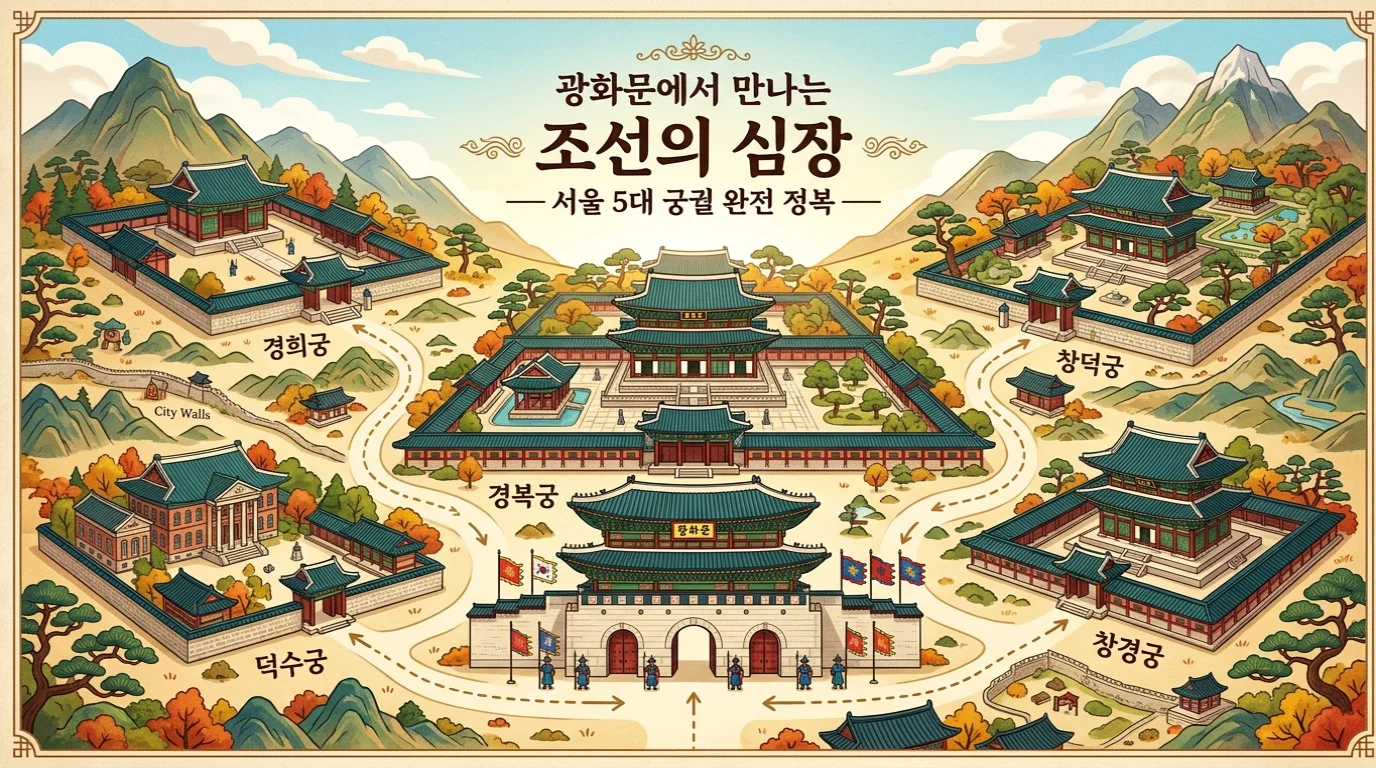
🏛️ The Heart of Joseon in Downtown Seoul — A Deep Dive into the 5 Grand Palaces
⚠️ Please Note
Admission fees, opening hours, closed days, and English-support details in this article change often by season and event. Night openings, special tours, and Changdeokgung's Huwon (Secret Garden) reservations run differently at different times, so always check the official Korea Heritage Service (Royal Palaces and Tombs Center) website or a map app before visiting. On weekends, holidays, and cherry-blossom/autumn-foliage seasons, popular palaces (especially Gyeongbokgung and Changdeokgung's Huwon) get crowded, and there may be ticketing/entry waits. The history here reflects widely accepted accounts; specific dates and interpretations can vary by source.
⏱️ 30-Second Summary — Just Remember This!
👑 Gyeongbokgung → The main palace that founded Joseon. Burned in the Imjin War, left unrestored for ~270 years, then rebuilt by Regent Heungseon
🌿 Changdeokgung → Where kings resided longest; a UNESCO World Heritage Site. Its Huwon (Secret Garden) is the highlight
🌸 Changgyeonggung → Built out of filial devotion but marked by Prince Sado's tragedy; famous for its spring scenery
🏙️ Deoksugung → The imperial palace where Gojong proclaimed the Korean Empire; Western-style Seokjojeon and a stage of modern history
🍂 Gyeonghuigung → The "West Palace," once nearly 100 buildings, largely demolished under Japanese rule and only partly restored; free
🎟️ Fees → Free to 3,000 KRW per palace; free for most when wearing traditional Hanbok (reference only, subject to change)
📅 Closed → Gyeongbokgung on Tuesdays; Changdeokgung, Changgyeonggung, and Deoksugung on Mondays (always check!)
🔎 The 5 Palaces at a Glance — Names, Keywords, Rating
Each palace has a distinct character. Before the long descriptions, get the big picture from the table below.
Palace | Korean | Keyword | Rating |
|---|---|---|---|
Gyeongbokgung Palace | 경복궁 | Grandest main palace | ⭐⭐⭐⭐⭐ |
Changdeokgung Palace | 창덕궁 | UNESCO Heritage · Secret Garden | ⭐⭐⭐⭐⭐ |
Changgyeonggung Palace | 창경궁 | Royal family · Prince Sado | ⭐⭐⭐⭐☆ |
Deoksugung Palace | 덕수궁 | Korean Empire · Seokjojeon | ⭐⭐⭐⭐☆ |
Gyeonghuigung Palace | 경희궁 | Quiet stroll · free | ⭐⭐⭐☆☆ |
The rating is a subjective guide based on sights and access. It may differ by taste.
1. 🏛️ What Are the "5 Grand Palaces"? — The 600-Year Big Picture
Seoul's palaces were at the center of Korean royalty for about 600 years, through the Joseon Dynasty (1392–1897) and the Korean Empire (1897–1910). Five palaces where kings lived and governed remain in Seoul: Gyeongbokgung, Changdeokgung, Changgyeonggung, Deoksugung, and Gyeonghuigung. All are clustered around the Gwanghwamun–Jongno area, so you can tour two or three in a day on foot.
Why so many palaces? Joseon used a dual-palace system of a "beopgung" (main/primary palace) and a "igung" (secondary/detached palace). If a fire, epidemic, or coup broke out, the king could move to another palace — so kings often moved between them.
The big flow: In early Joseon, Gyeongbokgung was the main palace. But after the Imjin War (1592) burned three palaces down, Changdeokgung served as the de facto main palace for about 270 years. In the late period, Gojong rebuilt Gyeongbokgung, then proclaimed the Korean Empire at Deoksugung.
Shared wounds and recovery: Through the Imjin War and the Japanese colonial period (1910–1945), most were burned or torn down, and much of what we see today is restored. So each palace has its own tale of "destruction and revival." Knowing this "history of wounds" makes the palaces far more vivid.
2. 🎟️ How to Visit — Fees & Hours
You enter each palace by buying a ticket at the box office or reserving online. Since the five differ in character, the way you visit varies a bit too.
Individual fees (adult, reference only, subject to change): Gyeongbokgung 3,000 KRW · Changdeokgung 3,000 KRW · Changgyeonggung 1,000 KRW · Deoksugung 1,000 KRW · Gyeonghuigung free.
Changdeokgung's Huwon (Secret Garden) limits visitor numbers and times to protect nature, so it costs an extra fee (about 5,000 KRW) on top of the main palace ticket. You enter at set time slots with a guide, and it's popular — reserve online in advance.
The Integrated Palace Ticket lets you tour the four palaces (Gyeongbokgung, Changdeokgung, Changgyeonggung, Deoksugung) plus Jongmyo Shrine on one ticket, cheaper than buying separately. Note: Changdeokgung's Huwon is NOT included in the integrated ticket — it requires a separate reservation and a separate fee. Price and validity vary by period, so check official channels.
Free admission: Wearing traditional Hanbok that meets Korea Heritage Service standards gets you free entry to most palaces (there are many Hanbok rental shops near the palaces). If it doesn't meet the standard — e.g., worn over jeans — it may not qualify, so ask the rental shop whether it's "Hanbok valid for free palace entry." Those aged 24 and under or 65 and over, and the last Wednesday of each month ("Culture Day"), are often free too.
Closed days (very important!): Gyeongbokgung is closed on Tuesdays, while Changdeokgung, Changgyeonggung, and Deoksugung are closed on Mondays. They differ, so mixing up the day can mean a wasted trip.
3. 👑 Gyeongbokgung — The Main Palace That Founded Joseon
The first built and the grandest, highest-ranking "primary palace." It's a symbolic space that witnessed both the beginning and the end of Joseon.
Birth (1395): The first main palace of Joseon, built when King Taejo Yi Seong-gye moved the capital to Hanyang (Seoul). Founding minister Jeong Do-jeon took the name from a verse in the Classic of Poetry, meaning "may the king and people enjoy great blessings (Gyeongbok) of an age of peace."
~270-year gap: After it burned completely in the Imjin War (1592), kings lived at Changdeokgung, and Gyeongbokgung was left without a full restoration for about 270 years. Some facilities remained, but it no longer functioned as a palace.
A dramatic rebuild (1867–1868): Regent Heungseon (Heungseon Daewongun), father of King Gojong, rebuilt it on a grand scale to restore royal authority. To fund the massive project he minted the "Dangbaekjeon" coin, which caused serious inflation as a side effect.
Site of tragedy, the Eulmi Incident (1895): At Geoncheonggung in the rear garden, Empress Myeongseong was assassinated by Japanese forces. This became a spark: the next year Gojong fled to the Russian legation (the Agwan Move), and Gyeongbokgung effectively lost its status as the royal palace.
Suffering under colonial rule: In 1915 the Joseon Industrial Exhibition tore down thousands of building sections; in 1926 the Government-General building was erected blocking the front of Geunjeongjeon, and Gwanghwamun Gate was moved aside — heavily damaging the palace. That colonial building was not removed until 1997, and restoration has continued since the 1990s to today.
Highlights: the main gate Gwanghwamun ("the king's great virtue illuminates the whole nation"), the throne hall Geunjeongjeon where coronations and state rites were held, Sajeongjeon where the king handled affairs, the royal bedchambers Gangnyeongjeon and Gyotaejeon (the Amisan chimneys behind Gyotaejeon are lovely), the banquet pavilion over water Gyeonghoeru, and the picturesque garden pavilion Hyangwonjeong. The Royal Guard Changing Ceremony in front of Gwanghwamun is a popular sight you can watch for free.
📷 Photo picks: Gwanghwamun view → Geunjeongjeon → Gyeonghoeru (a Hanbok shot here is even better)
4. 🌿 Changdeokgung — The World Heritage Site Kings Loved Most
The only Joseon palace inscribed as a UNESCO World Heritage Site. Here you can see the essence of the Korean garden — nature embraced as it is, not forced into symmetry.
Birth (1405): The second palace built by King Taejong, after Gyeongbokgung. It started as a secondary palace, but after the Imjin War left Gyeongbokgung in ruins, it served as the de facto main palace for about 270 years and became the palace where kings resided longest in Joseon history.
World Heritage (1997): It was inscribed for its "harmony with nature" — buildings placed along the natural terrain without leveling it. Compare it with the strictly symmetrical Gyeongbokgung and the difference is striking.
The last royals of Nakseonjae: Even after the Joseon Dynasty ended, the last royal family lived here at Nakseonjae — Sunjeonghyo (Empress, consort of Sunjong), Yi Bang-ja (wife of Crown Prince Uimin, who passed away here in 1989), and the tragic Princess Deokhye spent their final years here. As "the last breath of Joseon" lingered here, it feels all the more poignant.
Highlights: Donhwamun (1412), the oldest surviving palace main gate; the dignified throne hall Injeongjeong; Seonjeongjeon, the only palace office hall with a surviving blue-tile roof; and the living quarters Huijeongdang and Daejojeon. The highlight is the rear Huwon (Secret Garden, formerly "Biwon") — Buyeongji pond cultivated by King Jeongjo and its pavilion Buyeongjeong, the scholarly symbol Juhamnu with its Eosumun gate (like a fish meeting water), the modest scholar's-house-style Yeongyeongdang, and seasonal pavilions like Aeryeonjeong and Yeonghwadang, all woven into the forest. Spring greenery and autumn foliage are especially beautiful.
📷 Photo picks: Huwon Buyeongji → Juhamnu → Injeongjeon
5. 🌸 Changgyeonggung — Built from Devotion, Marked by Tragedy
Built from warm devotion to family, yet it also holds Joseon's most famous tragedy — which makes it the richest palace for stories.
Birth (1483, King Seongjong): King Seongjong built it to comfortably house three queen dowagers of the grandmother/mother generation. It took over the site of "Suganggung," which King Sejong had built for his father Taejong, so from the start it had a strong residential character for elders.
The Imo Incident (1762): In the courtyard of Munjeongjeon here, King Yeongjo locked his son Prince Sado in a rice chest, where he died eight days later. That prince's son became the later wise king Jeongjo. Jeongjo's filial devotion and sorrow, having witnessed his father's death, became a major thread running through late-Joseon history.
Other stories within the palace: The bedchamber Tongmyeongjeon is also remembered as a stage of court intrigue between Jang Hui-bin and Queen Inhyeon in King Sukjong's time. King Jeongjo drew his last breath at this palace's Yeongchunheon. The joys and sorrows of the royal family run deep here.
Demotion to "Changgyeongwon": In 1909 under Japanese rule, a zoo, botanical garden, and museum were built inside, and in 1911 the name itself was lowered to "Changgyeongwon," reducing it to an amusement park. Cherry trees were planted en masse to draw spring crowds. Only in 1983 was the zoo moved to Seoul Grand Park, restoring the name "Changgyeonggung" and the palace's dignity.
Highlights: Myeongjeongjeon, the oldest surviving palace throne hall (uniquely, it faces east, unlike other palaces); the main gate Honghwamun; the bedchambers Tongmyeongjeon and Hwangyeongjeon. The pond Chundangji and the modern glass Great Greenhouse are traces of the Changgyeongwon era and now popular photo spots. Spring cherry blossoms and autumn foliage are especially pretty, and it connects internally to Changdeokgung, so the two pair well.
📷 Photo picks: Great Greenhouse → Myeongjeongjeon → Chundangji
6. 🏙️ Deoksugung — The Imperial Palace of the Korean Empire
A stage of turbulent modern history where traditional palace buildings and Western-style structures coexist within one wall.
From private residence to palace: Originally the home of Prince Wolsan (King Seongjong's elder brother). When the Imjin War burned every palace, King Seonjo used it as a temporary residence, and it became a palace (the Jeongneung-dong Temporary Palace). Gwanghaegun named it "Gyeongungung" in 1611, and King Injo was even enthroned here at Jeukjodang after a coup.
The heart of the Korean Empire (1897): Gojong, who had stayed at the Russian legation after the Agwan Move, returned to Gyeongungung in 1897 and that year was crowned emperor at Hwangudan and proclaimed the Korean Empire. Deoksugung thus became the "emperor's palace," a space holding the dream of modernization and standing shoulder to shoulder with the Western powers.
Site of a painful treaty (1905): At the Western-style Jungmyeongjeon, the Eulsa Treaty — which stripped the Korean Empire of its diplomatic rights — was forced through. Modern hope and the loss of sovereignty sit within one palace.
The name's origin and the March 1st Movement: In 1907, after Gojong was forced to abdicate to Sunjong, the palace name changed from "Gyeongungung" to "Deoksugung" in a wish for Gojong's longevity. In 1919 Gojong passed away here, and his funeral became the catalyst for the March 1st Independence Movement.
Highlights: Seokjojeon, Korea's oldest neoclassical stone building; Jungmyeongjeon, site of the Eulsa Treaty; Jeonggwanheon, decorated Western-style where Gojong is said to have enjoyed coffee and music; and Junghwajeon, the throne hall of the Korean Empire. Don't miss the Royal Guard Changing Ceremony in front of the main gate Daehanmun and the downtown walking path Deoksugung Doldam-gil (Stone Wall Road). Right next to City Hall, it has the best access, and its evening views are popular too.
📷 Photo picks: Seokjojeon → Deoksugung Stone Wall Road → Daehanmun Guard Changing
7. 🍂 Gyeonghuigung — The "West Palace" That Vanished and Returned
The quietest palace, one that lost the most and recovered only in part. Small in scale, it shows most poignantly "how a palace can disappear."
Birth (1617–1623, Gwanghaegun): Built by Gwanghaegun, and because it sits to the west of Gyeongbokgung it was called the "West Palace" (Seogwol) (Changdeokgung and Changgyeonggung, to the east, were the "East Palace"). Its first name was Gyeongdeokgung.
Once a great palace of nearly 100 buildings: It was an important secondary palace where ten generations of kings from Injo onward governed. At its peak it held nearly 100 buildings (sources vary — 98, over 100, etc.), rivaling Gyeongbokgung and Changdeokgung. King Yeongjo in particular renamed it "Gyeonghuigung" in 1760 and stayed here for about 19 years.
Thorough erasure (colonial period): After 1910, a Japanese school (Gyeongseong Middle School) was built on the site, and nearly all the halls were torn down. As the most thoroughly destroyed of the five palaces, it's even nicknamed the "vanished palace."
A slow recovery: In 1989–1994, only parts were restored — the throne hall Sungjeongjeon and the main gate Heunghwamun. Small in scale, it's quiet with few visitors, great for a stroll, and admission is free, so it's easy to drop by.
Highlights: the restored throne hall Sungjeongjeon and main gate Heunghwamun, and the site of Hwanghakjeong (a former archery range). Paired with the neighboring Seoul Museum of History, you can feel Seoul's past and present at once. Walking here while imagining "how the most splendid palace came to leave only traces" leaves a lasting impression.
📷 Photo picks: Sungjeongjeon → Heunghwamun
8. 🚶 Recommended Routes & Tips
Seeing all five in one day is tough, so it's best to pick based on your interests.
Grand / basic route (half-day): Focus on Gyeongbokgung (Gwanghwamun · Guard Changing · Geunjeongjeon · Gyeonghoeru). It's so large that just this takes two to three hours. Continue to the Seochon/Samcheong-dong café streets afterward.
Garden / royal route (full day): Changdeokgung (+Huwon reservation) → Changgyeonggung (connected inside) → Jongmyo Shrine. This links the royal family's "garden and shrine" and captures the essence of the five palaces.
Modern-history route (half to full day): Deoksugung → Jeongdong-gil / Stone Wall Road → Seoul Museum of History → Gyeonghuigung. A walk through the Korean Empire and modern Seoul.
Budget & mood tips: Renting and wearing Hanbok (a Hanbok Experience) gets you free entry to most palaces — budget-friendly and photogenic. Each palace offers free guided programs (in Korean, English, etc.) at set times, so timing your visit to them adds a lot. Spring cherry blossoms (Changgyeonggung), autumn foliage (Changdeokgung's Huwon), and night-opening seasons are especially beautiful — aim for them if your schedule fits. The palaces are large with long walking paths, so comfortable shoes are a must.
❓ Frequently Asked Questions (FAQ)
Q. Can I see all five palaces in one day? A. They're close by, but one day is too much. Each palace is large, so 1–2 per day is recommended. Gyeongbokgung and Changdeokgung take about half a day each.
Q. Which palace is most impressive? A. Gyeongbokgung for grandeur, Changdeokgung's Huwon for harmony with nature, and Deoksugung for a modern-history mood. If you must choose one, Gyeongbokgung for scale or Changdeokgung as a World Heritage Site is a safe bet.
Q. Can you tell me the difference in one line each? A. Gyeongbokgung = the dynasty's start (main palace), Changdeokgung = World Heritage in nature, Changgyeonggung = devotion and tragedy, Deoksugung = emperor and modernity, Gyeonghuigung = the vanished West Palace. Just these five words are enough.
Q. Which palace should I visit if I only have one day? A. Gyeongbokgung for grand royal architecture, Changdeokgung for its UNESCO garden, and Deoksugung for modern history. If it's just one, go Gyeongbokgung — or Changdeokgung if you love gardens.
Q. How do I do a Hanbok Experience at the palaces? A. There are plenty of Hanbok rental shops around Gyeongbokgung and Changdeokgung. Wearing traditional Hanbok gets you free entry to most palaces and lets you take stunning photos against the palace backdrop — it's the most popular experience for international visitors. Bring an extra layer for cold or hot weather.
Q. Is English guidance available? A. Major palaces have English signage and timed English guided programs. But hours and days change often, so check the official website before visiting.
Q. Is it really free if I wear Hanbok? A. Yes, most palaces offer free entry when wearing Hanbok. There are many rental shops near the palaces. Note that the specific conditions may change.
🗣️ Handy Korean Phrases On-Site
"성인 한 장 주세요." (Seong-in han jang juseyo.) — One adult ticket, please.
"한복을 입으면 무료인가요?" (Hanbok-eul ibeumyeon muryo-ingayo?) — Is it free if I wear Hanbok?
"영어 해설은 몇 시에 있나요?" (Yeongeo haeseol-eun myeot si-e innayo?) — What time is the English guided tour?
"통합관람권은 어디서 사나요?" (Tonghap-gwallamgwon-eun eodiseo sanayo?) — Where can I buy the combined palace ticket?
✅ Quick Checklist
Check the closed day of the palace you're visiting (Gyeongbokgung = Tue, others = Mon)
Confirm fees, hours, and whether there's a night opening on the official website
Complete your advance reservation for Changdeokgung's Huwon (popular slots sell out early)
Decide whether to rent Hanbok (use the free admission)
Check times for free guided programs (Korean, English)
Decide whether to use the Integrated Ticket for multiple palaces
Prepare comfortable shoes (palaces are large with long paths)
🟦 A guide put together by the JoyStoria team.
📅 As of: 2026 · ⚠️ Fees, English support, information, and operations may change by season, event, and palace.
JoyStoria does not endorse any specific business or facility. Before visiting or booking, please verify the latest information through official channels such as the Korea Heritage Service (Royal Palaces and Tombs Center) and a map app. Admission fees, closed days, and Huwon reservation methods change frequently, so please reconfirm night-opening and special-tour schedules with the relevant institutions in particular. Historical accounts summarize widely accepted views; specific dates and interpretations may vary by source.