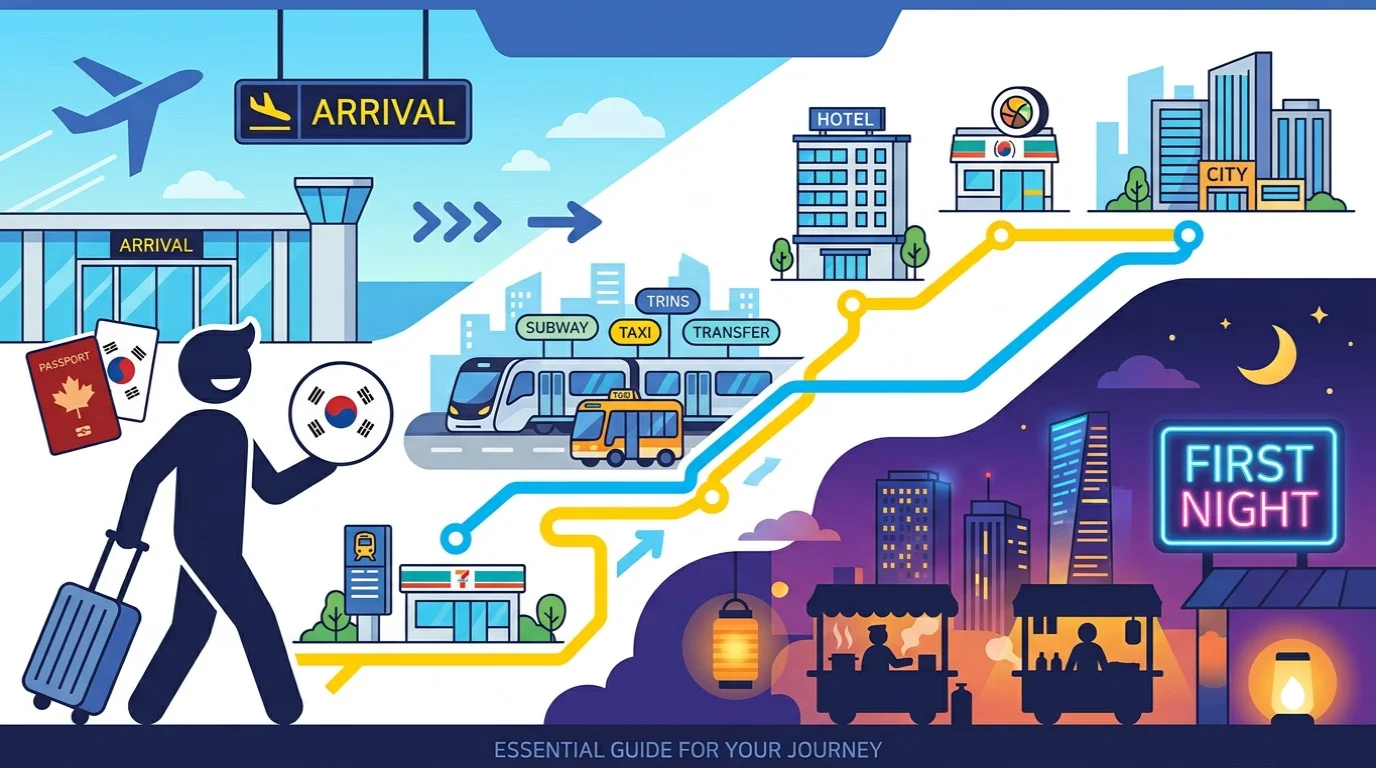
✈️ First Time in Korea? From Airport Arrival to Your First Night — This Guide Has You Covered
⚠️ Please note
Prices, app features, operating methods, refund thresholds, and transit-card coverage in this guide change often by season, business, branch, and route. In particular, transit-card prices, Climate Card coverage areas, tax-refund limits, SIM plans, and app language support should be double-checked right before your trip on official websites or map apps (Naver Map / KakaoMap). Popular restaurants and major attractions can have long waits on weekends and in peak season, so leave time in your schedule. All prices and figures below are for reference only and subject to change.
⏱️ 30-Second Summary — Just Remember These!
🛂 Entry → Visa-exempt regions can enter without K-ETA (until end of 2026)
🚌 Airport→City → AREX airport train or limousine bus are easiest
🚇 Transit card → Buy a T-money at a convenience store, top up with cash, done
🗺️ Maps → Use Naver Map / KakaoMap instead of Google Maps; Kakao T for taxis
💳 Payment → Cards work well, but carry a little cash (KRW)
📶 Internet → Get a SIM/eSIM at the airport arrivals floor
🧾 Refund → Tax refund on purchases of ₩15,000+ per store; get customs stamp before checking bags
🙅 Tipping → No tipping culture; not tipping is completely fine
🆘 Emergency → Tourist hotline 1330 (24h, multilingual), Police 112, Fire/Ambulance 119
🧭 Your Route After Landing (at a glance)
Arrive at airport (Incheon Airport)
   ↓
Immigration (K-ETA / e-Arrival Card check)
   ↓
Baggage claim
   ↓
Activate SIM / eSIM (get data)
   ↓
Buy & top up T-money card
   ↓
Currency exchange (if needed)
   ↓
Take AREX airport train or airport bus into the city
1. 🛂 Getting In — K-ETA, e-Arrival Card & Immigration
This is your first gateway into Korea. Knowing it in advance saves confusion at the airport.
K-ETA (Korea Electronic Travel Authorization): A number of countries and regions (22 in total) are temporarily exempt from K-ETA until December 31, 2026. Because non-country regions such as Hong Kong, Macau, and Taiwan are classified separately, don't just assume — check whether your nationality/region qualifies on the official K-ETA site (k-eta.go.kr).
If your country does require K-ETA, apply at least 72 hours before departure — ideally a few days ahead (processing is often faster).
Once approved, it can be used multiple times for a set period. The validity depends on the issue date and current policy, so check the period shown on your approval screen. An existing approved K-ETA is valid until it expires, and the fee is non-refundable.
e-Arrival Card: An online way to submit your arrival card in advance. You can submit it for free starting 3 days before your scheduled arrival date (e.g., if you arrive on Friday, you can fill it out from Tuesday). Submit it early and you won't need a paper form at immigration. If you didn't, just fill out the paper card on the plane or at immigration — note your accommodation address and contact in advance.
In short: Most short-term tourists just need to prepare whichever applies to them — K-ETA (for required countries) or the e-Arrival Card (for exempt countries). (Some visa holders and others are exceptions.)
What immigration may ask for: Your passport, a return/onward ticket, and your first accommodation address. Save your booking email or address on your phone for a quick answer.
Entry rules by nationality and recognition of international driving permits vary by situation, so reconfirm with your embassy or immigration authorities before departure.
2. 🚌 From the Airport into the City (Incheon Airport → City)
There are three main ways to get from Incheon/Gimpo airport into the city. Choose based on luggage, group size, and destination.
AREX (Airport Railroad): The easiest and most economical. The regular (all-stop) train can be boarded with a transit card like T-money; the express direct train to Seoul Station (assigned seats) requires a separate ticket. Great if you don't have much luggage and are comfortable with subway transfers.
Airport limousine bus: Many routes go directly to major hotels/districts with no transfers — handy with lots of luggage or a group. Check stop locations and routes by entering your destination in Naver/KakaoMap.
Taxi: Convenient for late arrivals or lots of luggage/people. Use the official taxi stand (standard/deluxe) and confirm it runs on the meter without extra "call" fees. A late-night surcharge applies (roughly midnight–4 a.m.). Avoid unlicensed drivers who solicit you.
Tip: Before heading into the city, sort out your transit card (Section 3) and SIM (Section 7) first — it makes everything smoother.
3. 🚇 Choosing a Transit Card — Match It to Your Style
Korean public transport (subway/bus) is almost entirely covered by one transit card. You can pay cash, but it's inconvenient and you miss transfer discounts. Here's a comparison of the three main options.
T-money — the all-purpose card, and the safest bet: The card costs roughly ₩3,000–5,000 and you buy it at a convenience store (GS25, CU, 7-Eleven, etc.) or a subway station machine, then top up with cash. It works nationwide on subways, buses, taxis, and even for convenience-store payments, and it works on the AREX airport train — which makes it the top pick for first-timers. You can even get a small cash refund of any remaining balance at a convenience store.
Climate Card (Gicho Donghaeng Card) — for heavy travel around Seoul: An unlimited pass for Seoul subways and buses over a set period. The physical card is about ₩3,000 (non-refundable), with options like a 1-day (~₩5,000), 7-day (~₩20,000), and 30-day (~₩62,000) pass (prices/coverage vary). It can pay off if you make many trips a day in Seoul. Note: Coverage is centered on Seoul and some adjacent areas, and it cannot be used to board the airport train departing from Incheon Airport, so keep a T-money for airport trips.
WOWPASS — exchange + transit in one: A prepaid card you load with foreign currency that also works as a transit card. Popular with tourists who want to handle exchange and transit with a single card. You can issue one at airport/city kiosks.
Bottom line: T-money if you're traveling to multiple cities, Climate Card if you're staying in Seoul and riding a lot, WOWPASS if you also want currency exchange. There's also a Mobile T-money for your phone, but for short-term travelers a single physical T-money is the simplest.
4. 🚉 Riding Public Transport in Practice — Subway, Bus, Taxi
Once you have a card, here's how to actually ride. It feels unfamiliar at first but clicks after a try or two.
Subway: Tap your card both when entering and exiting the gate (not tapping out can cause a wrong fare next time). Lines are color- and number-coded, and station signs include English and Chinese characters. Transfers on the same card within the allowed time get a discount. If your balance is too low, the gate won't open — top up in advance.
Bus: Tap as you board at the front, and tap again on the reader at the rear door as you exit (this applies the transfer discount). Check stops and routes with real-time arrival info on Naver/KakaoMap. Bus announcements are mostly in Korean, so watch your stop on a map app for peace of mind.
Taxi: If it's hard to hail one on the street, use the Kakao T app and enter your destination. Fares are metered, and cards/mobile pay are accepted. Late-night surcharges (usually midnight–4 a.m.) and intercity trips can raise the fare.
Transfer discounts: Switching subway↔bus or bus↔bus on the same card within the allowed time/number of transfers saves a lot — which is exactly why a transit card beats cash.
5. 🗺️ Maps & Must-Have Apps — Google Maps Only Half Works
In Korea, for legal/security reasons Google Maps' walking and driving directions largely don't work (transit routing only partially). So local apps are essentially required. Install them before you go.
Naver Map / KakaoMap: Accurate for directions, transit transfers, and finding restaurants and cafés. Both support English and show real-time bus arrivals and subway schedules. One is enough, but having both is reassuring.
Kakao T: Taxi-hailing app. Enter your destination and a taxi comes to your location. It partly supports English, but whether a foreign card can be registered varies by card issuer (if it can't, just pay by cash/card after the ride). It also connects to some other transport options.
Papago / Google Translate: Great for real-time camera translation of menus and signs. Papago tends to be stronger for Korean ↔ English/Japanese.
Tip: Searching place and business names in Korean (Hangul) gives far more accurate results. Copying a Korean name from the web and pasting it into the map search box works well too.
6. 💳 Payments, Currency Exchange, Cash & ATMs
Card use is very common in Korea, but cash is handy in certain situations.
Card payments: Credit/debit cards work at most restaurants, cafés, shops, and convenience stores. Visa and Mastercard are widely accepted, and JCB and American Express (AMEX) work in many places too. That said, traditional markets, street stalls, and small shops may not take foreign cards.
Carrying cash: Keep some Korean won in cash for traditional markets, street food stalls, small payments, and cash discounts. ₩10,000 notes are easier to use than large bills.
Currency exchange: Available at airport/city exchange booths and banks. Private exchange booths in areas like Myeongdong and Itaewon often offer better rates than banks. A foreign-currency card like WOWPASS is another option.
ATM withdrawals: You can withdraw won with a foreign card at a "Global ATM" (or an ATM at a convenience store/bank with a Visa/Plus/Cirrus logo). Convenience-store ATMs are often 24/7 but charge a fee.
Mobile pay: Samsung Pay, KakaoPay, and the like are common in Korea, but registration can be tricky for foreigners — a physical card or cash is usually easier.
7. 📶 SIM, eSIM & Wi-Fi (eSIM Korea)
You need data to properly use map, translation, and taxi apps, so sort this out first when you arrive.
Activate right at the airport: There are SIM/eSIM sales booths on the arrivals floor at Incheon, Gimpo, and other airports. Pick a data plan that matches your stay (e.g., 5-day, 10-day, 30-day) and it activates immediately. Your passport may be required.
eSIM: Activates via QR code with no physical SIM swap, and you can keep your existing number. Just confirm in advance that your device supports eSIM and is unlocked.
Buy in advance: Pre-purchasing online (airport pickup or instant eSIM) lets you turn it on the moment you land — no waiting.
Public Wi-Fi: Free Wi-Fi is available at airports, subway stations, cafés, shops, some buses, and public facilities. Still, for a stable connection on the move (maps/taxis), having your own data is recommended.
8. 🧾 Tax Refund — Order Matters
Foreign tourists can get part of the VAT back on qualifying purchases. The key is following the steps in order.
Threshold: Generally purchases of ₩15,000 or more per store qualify (some shops set ₩30,000). Show your passport at checkout and get a Tax Free receipt.
Immediate in-store refund: Within limits (up to ₩1,000,000 per transaction and ₩5,000,000 total for the trip), you can get the refund like an instant discount at the store. Larger amounts are refunded at the airport.
Refund amount: After fees, you typically get back about 5–8% of the purchase price (varies by item/amount).
Airport steps (mind the order): ① Before checking your bags, show the unopened/unused goods and Tax Free receipts to customs to get inspection/a stamp. If the items are already in checked baggage, they can't be verified and your refund may be voided. ② After immigration, collect the refund at a kiosk/counter in cash (immediate) or to your card (usually 2–3 weeks later).
Note: Keep items unopened/unused, and you must leave Korea within 3 months of the purchase date to claim the refund.
9. 🙅 Etiquette + 🆘 Emergency Contacts
A few small manners go a long way, and saving emergency numbers in advance is reassuring.
Manners to know
No tipping: Not tipping is the norm at restaurants, taxis, and hotels — it's not rude at all. (Some upscale hotels/restaurants include a service charge on the bill.)
Use two hands: Using both hands when giving or receiving items, money, or a drink with elders looks polite.
Transit manners: Keep phone calls and loud talking down on the subway/bus, and leave priority seats (elderly, pregnant, disabled) open.
Shoes: Some traditional restaurants, guesthouses, and homes require removing shoes indoors. A shoe rack at the entrance is the sign to take them off.
Dining culture: Water and side dishes are usually free (with refills). Sticking chopsticks upright into a bowl of rice is best avoided, as it evokes funeral customs.
Trash sorting: Trash is separated into general/recyclable/food waste. Street bins are scarce, so people often dispose of trash at their accommodation.
Emergency contacts (save these in advance)
Korea is relatively safe, but at tourist spots and in crowds, always keep an eye on your belongings (passport, wallet, phone). Saving the numbers below is reassuring.
1330 — Tourist Interpretation Hotline: A tourist-only hotline offering help with directions, transport, medical needs, and complaints, 24/7 in multiple languages. Save this one first.
112 — Police / 119 — Fire & Ambulance (medical emergencies). Call directly in an emergency (if you need interpretation, 1330 can help).
120 — Dasan Call (Seoul): Handles daily-life, transport, and administrative questions in several languages including English.
1345 — Immigration Contact Center: Visa and residence inquiries supported in multiple languages.
If you're lost, robbed, or unwell and don't know where to go, call 1330 first for guidance tailored to your situation.
❓ Frequently Asked by Foreigners (FAQ)
Q. Is a credit card enough, or do I need cash? A. Most things can be handled by card, but keep a little Korean-won cash for traditional markets, street stalls, small payments, and cash discounts.
Q. Can't I use Google Maps? A. Walking/driving directions are limited. Naver Map or KakaoMap is far more accurate and gives good transit-transfer guidance.
Q. Will English work? A. At tourist spots, hotels, and with younger people it generally works; when it doesn't, a translation app like Papago helps a lot. There's also the 24-hour 1330 interpretation service.
Q. Where do I buy a transit card, and how much is it? A. Buy a T-money at a convenience store or subway station machine (card is roughly ₩3,000–5,000) and top up with cash. Prices may change.
Q. Do I need to tip? A. No. Korea has no tipping culture, so not tipping is completely fine.
Q. Do I tap my card when exiting the subway too? A. Yes. Tap both on entry and exit so the fare is calculated correctly and you get the transfer discount.
Q. For the tax refund, what do I do before checking my bags? A. Don't check the refund items — get customs inspection/a stamp before checking your bags, then collect the refund inside the departure area.
Q. Can I drink tap water in Korea? A. Tap water is managed to a drinkable standard. That said, many people drink filtered water or bottled water from convenience stores.
Q. Can I use Uber? A. In Korea, Kakao T is far more common than Uber. For hailing taxis, Kakao T is recommended.
Q. Is there fine dust or yellow dust? A. Especially in spring, pollen, yellow dust, and fine dust can appear. Check an air-quality app and bring a mask if needed.
🗣️ Handy Korean Phrases
"카드로 계산할게요." (kadeu-ro gyesan-halge-yo) — I'll pay by card.
"가장 가까운 지하철역이 어디예요?" (gajang gakkaun jihacheol-yeok-i eodi-ye-yo?) — Where is the nearest subway station?
"영어 메뉴판 있어요?" (yeongeo menyupan iss-eo-yo?) — Do you have an English menu?
"티머니 카드는 어디서 살 수 있어요?" (T-money kadeu-neun eodi-seo sal su iss-eo-yo?) — Where can I buy a T-money card?
✅ Quick Checklist
Confirm your passport is valid for 6+ months
Check your K-ETA / e-Arrival Card rules on the official site (k-eta.go.kr)
Activate a SIM / eSIM after landing (get data)
Buy & top up a T-money card at a convenience store/station
Install Naver Map, KakaoMap, Papago, Kakao T
Decide your airport→city option (AREX, limousine bus, or taxi)
Prepare some cash (KRW) + a card that works abroad
Save emergency numbers: 1330 / 112 / 119
For shopping, confirm Tax Free stores, bring your passport, and keep receipts
🟦 A guide compiled by the CultureHub team.
📅 As of: 2026 · ⚠️ Prices, English support, information, and operations may vary by season, business, branch, and route.
CultureHub does not endorse any specific business. Before visiting or booking, always confirm the latest information through each organization's or store's official channels and map apps. In particular, entry, legal, and financial matters — such as K-ETA/visa rules, recognition of international driving permits, and tax-refund limits — should be reconfirmed with your embassy, immigration authorities, or the relevant agency.