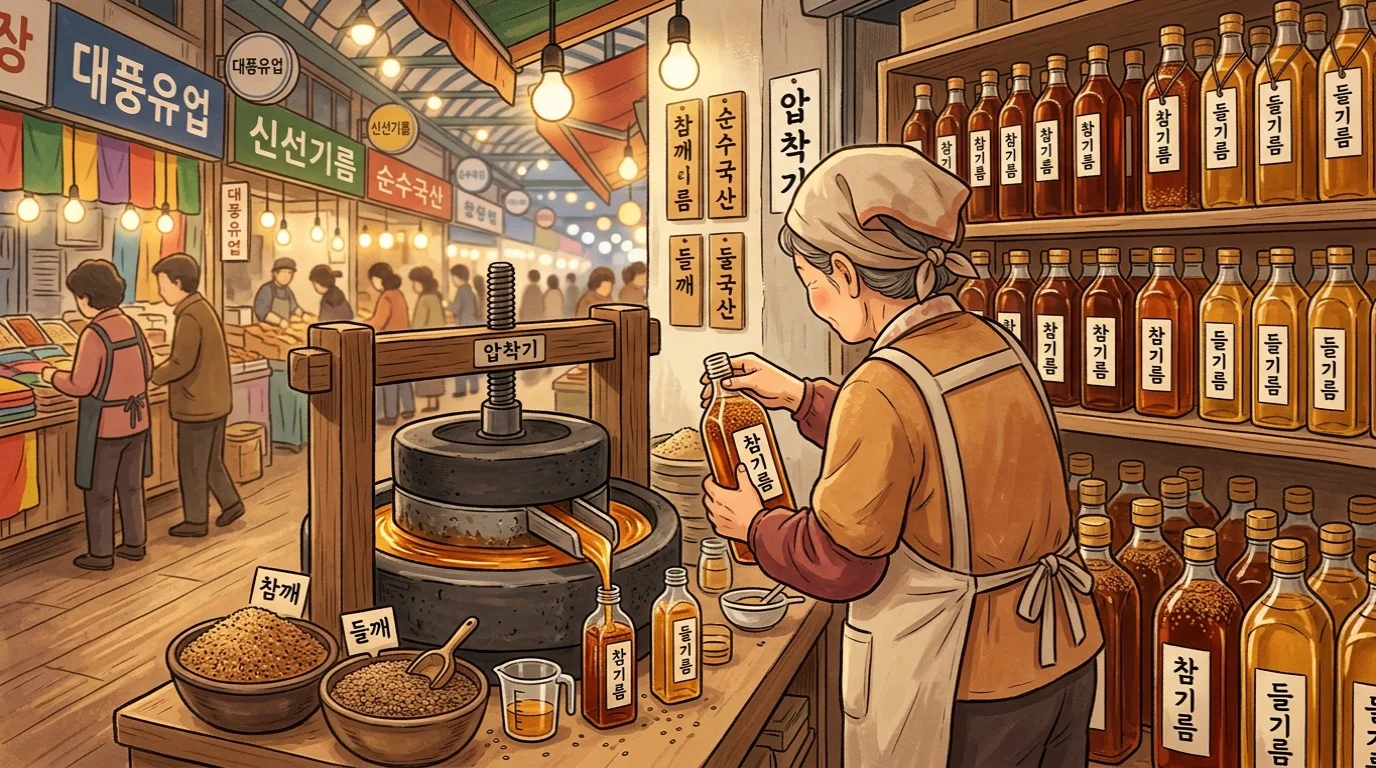
Buying Real Korean Sesame & Perilla Oil at Gwangjang Market — Bottling That Fresh-Pressed Aroma
⚠️ Please Note
Prices, bottle sizes, English support, opening hours, and closing days vary from mill to mill — and even the same shop's prices shift with the season, seed market, and origin. Every number in this guide is for reference only and subject to change, so check whether a shop is open in a map app (Naver Map / KakaoMap) before visiting, and ask about prices on the spot. Gwangjang Market gets very crowded on weekends and at lunchtime (12–2 pm), and popular shops can have lines. There have also been some recent overcharging complaints at markets, so it's a good habit to check the posted price before paying.
⏱️ 30-Second Summary — Just Remember This!
🫗 What it is → Fresh oil pressed on the spot from just-roasted seeds at a mill
🌰 Sesame oil → Nutty, strong aroma · a "finishing" oil for bibimbap, namul, etc.
🌿 Perilla oil → Mild grassy aroma · rich in omega-3 · great for stir-fries and soups
🔥 Method → Roasted-pressed (strong aroma) and cold-pressed (mild, nutrient-preserving)
🇰🇷 Origin → Domestic seeds are more aromatic and pricier · imported are cheaper (do ask!)
💰 Price → Domestic 300ml roughly ₩20,000–30,000; small bottles & imports are cheaper (confirm in person)
✈️ Tip → Ask for a 100ml small bottle + cushioned packing for safe carry-on/checked luggage
📍 Where → Mills cluster around Gwangjang & Jungbu Markets (Jongno 5-ga / Euljiro 4-ga area)
1. 🫗 What Is a Banga-gan? — A Shop That "Presses" Oil
A banga-gan is a traditional shop that roasts sesame or perilla seeds and presses them into oil right there. It doesn't only sell pre-bottled products — many will roast and press to order in front of you, so you can buy oil with the aroma still alive. Watching golden oil flow slowly from an old iron press is a sight in itself. Just follow the warm, nutty smell of the machines and you'll find a mill easily. If you like, you can even bring your own seeds and have them pressed — though that's more of a local regulars' move (more on this later).
2. 🌰🌿 Sesame Oil vs. Perilla Oil — What's the Difference?
These are the two that most beginners to Korean oils mix up. In short:
Sesame oil (chamgireum): Deep and nutty. Rather than being heated for long, it's a "finishing oil" drizzled on at the end to add aroma. A few drops transform bibimbap, seasoned vegetables (namul), noodles, or dumpling dipping sauce.
Perilla oil (deulgireum): Mild, grassy, and full-bodied. It's rich in plant-based omega-3 (ALA), so it's popular with health-conscious shoppers, and it pairs well with stir-fried namul, jeon (pancakes), soups, and grilled seaweed. Because of that high omega-3 content it's a bit more sensitive to oxidation, so refrigerate it after opening.
If it's your first time, buy both in small bottles and try them across different dishes — the flavors really are distinct.
3. 🔥 Roasted-Pressed vs. Cold-Pressed — Aroma or Mildness?
Even for the same sesame oil, the pressing method changes the aroma and nutrients.
Roasted-pressed (roast, then press): The seeds are roasted before pressing. That roasting is what creates the deep, powerful nutty aroma we know so well.
Cold-pressed (raw-pressed, "raw sesame oil"): Pressed without roasting. The aroma is subtler, but with less heat damage it preserves the nutrients relatively well.
One thing to know: an oil's rate of oxidation (going rancid) depends far more on storage conditions (light, oxygen, temperature, bottle state) than on the pressing method. Whichever method, after opening keep it somewhere cool and dark (refrigerate perilla oil) and use it up quickly. Traditional market mills mostly use the strong-aroma roasted-press method. For gifts or aroma, go roasted; for a milder taste and better nutrient retention, ask for cold-pressed.
4. 🇰🇷 Domestic vs. Imported — Always Ask About the Origin
The key to price differences is the seed's origin.
Domestic seeds: The most aromatic and full-flavored — but pricier.
Imported seeds: From Africa (Tanzania, Sudan, Ethiopia, etc.), China, India, and so on. Much cheaper, though generally milder in aroma and flavor. (Indian seed is said to carry a slight bitterness.)
Ask "Is this domestic?" and most shops will tell you. Domestic seed generally costs more than imported, so if a "domestic" oil is suspiciously cheap, double-check. A shop where you can watch the on-the-spot pressing makes it easier to judge freshness.
5. 💰 Price and Size — How Much Will It Cost?
Prices vary a lot by origin (domestic/imported), size, and pressing method. A rough feel (reference only, subject to change):
Travel-size small bottle (~100ml): An easy size to buy several of — popular for handing out as gifts
Gift-size 300–500ml bottle: Freshly pressed domestic sesame oil is roughly ₩20,000–30,000; imported/standard grades run cheaper
Sesame + perilla sets: Two- or three-bottle gift sets are common
Because the same volume is generally sold at higher prices overseas, including Japan, Korean mill prices can feel attractive by comparison. Still, the exact amount differs by shop and season, so always confirm in person and check the posted price before paying.
6. 📍 Where to Go — Gwangjang Market and Around
Gwangjang Market is right by Jongno 5-ga Station (Line 1, Exits 8 & 9), and close to Euljiro 4-ga Station (Lines 2 & 5). Inside the market and along the alleys running toward Euljiro 4-ga, Bangsan Market, and Jungbu Market, you'll find many mills and oil/dried-goods shops.
Rather than the tourist-packed food lanes (the mayak gimbap / bindaetteok streets), look toward the market edges and the areas where oil and dried-goods shops cluster — that's where the mills are. Instead of fixating on one place, it's better to compare the aroma at a few shops and buy from the one you like best.
Hours: The market overall runs roughly 8:30 am–6 pm (varies by shop). Some mills finish pressing early in the afternoon, so a morning-to-early-afternoon visit is safest.
Quieter times: Mondays tend to have fewer shops open; lunchtime (12–2 pm) and weekends are very busy. Weekday mornings are the most relaxed.
7. 🏪 Well-Known Mills / Oil Shops Nearby
We don't endorse any specific shop, but here are a couple often mentioned by travelers and locals for reference. (Prices, hours, and closing days can change, so please confirm via a map app or by phone before visiting.)
Chungbuk Jeyuso (inside Jungbu Market): Located inside Jungbu Market (Jung-gu), within walking distance of Gwangjang. It's known for gently roasting domestic seeds at low temperature and pressing on the spot. The owner explains that "you have to roast slowly at a low temperature for the aroma to last." Thanks to word of mouth on social media and YouTube, it's known as a popular spot among Japanese tourists, and a great place to experience that fresh-pressed aroma.
Haedong Gireumjip (Jongno · Dongnimmun): A mill with 55 years of tradition that will also wash, roast, and press seeds you bring in. It carries sesame oil, perilla oil, and toasted-sesame salt. It's a bit removed from Gwangjang, over by Dongnimmun Station (Tongil-ro, Jongno-gu) — nice to pair with a Seodaemun / Dongnimmun itinerary.
Beyond these, the alleys of Gwangjang, Jungbu, and Bangsan Markets hold plenty of old mills. The most trustworthy option is always a shop where you can watch the on-the-spot pressing.
💡 Compare the aromas. Each mill roasts to a slightly different degree and presses differently, so the aromas differ subtly too. If you ask whether you can open a bottle cap and smell it before buying, comparing becomes easy — and you can pick the sesame or perilla oil that suits you best.
8. 🎁 Buying as a Gift — Ask for Packing
Oil is a popular Korea souvenir. Most mills offer gift-box packing, and if you ask for sealed plastic wrapping plus cushioning (bubble wrap / newspaper) for the flight, they'll wrap it well. As foreign customers have grown, many shops now post simple English and Japanese notices. If you're sharing among several people, several small bottles are more practical than one large one.
9. 🌾 (Advanced) Bringing Your Own Seeds to Press — The Local Way
If you have friends in Korea or a longer stay, you can buy seeds and bring them to a mill to press. In that case you pay a pressing fee (labor charge) rather than for the oil itself — and the fee varies by quantity and region (typically somewhere in the ₩15,000–40,000 range). A large batch can take 1–2 hours, and since it's heavy, a suitcase helps. It's best to call ahead to check the wait. For travelers, buying a finished bottle is far simpler — but it's fun to know this option exists.
10. 🧳 Storage & Travel Tips — Getting It Home Safely
Flying: As a liquid, carry-on requires containers of 100ml or less that meet the 1-liter clear zip-top bag rule. Put large bottles in checked luggage, and wrap them once more in a zip bag to prevent leaks.
Storage: Keep sesame oil somewhere cool and dark; refrigerate perilla oil after opening (its high omega-3 content makes it more prone to going off).
Freshness: Fresh-pressed oil smells best while still slightly warm. Perilla oil especially is all about freshness, so many people buy it on their last day of the trip.
Portioning: Fresh oil is better used up quickly than stored for a long time (ideally within 3–6 months of opening).
❓ Frequently Asked by Foreign Visitors (FAQ)
Q. Can I buy without speaking Korean? Yes. Just point at a bottle and convey the type and size with gestures and simple English. Many shops are used to foreign customers, and some post English/Japanese notices.
Q. Should I buy sesame or perilla oil? If it's your first time, get both in small bottles. Sesame oil is a finishing oil for aroma; perilla oil is for stir-fries and health-minded use.
Q. Is domestic really worth the much higher price? Domestic-seed products are generally rated as more full-flavored, but it comes down to personal taste. Many people buy domestic for gifts or special dishes and imported for everyday cooking.
Q. Can I take it on a plane? Put large bottles in checked luggage. To carry on, you'll need containers of 100ml or less that meet the 1-liter clear zip-top bag rule. Re-confirm the rules with your airline and airport.
Q. Do they take cards? Most shops accept cards, though some small ones prefer cash. Keeping a little cash on hand is reassuring.
Q. How long do sesame/perilla oils keep? Rather than long storage, it's best to use fresh oil within 3–6 months of opening. The fresher the oil, the better to use it while the aroma is alive.
Q. Why refrigerate perilla oil? Perilla oil is high in omega-3 (ALA), which makes it more sensitive to oxidation at room temperature. Refrigerating after opening keeps it fresh longer.
Q. Can I use these on a vegan diet? Yes. Both sesame and perilla oil are plant-based, so they fit a vegan diet.
Q. Is Tax Free available? Some stores offer Tax Free, but most traditional-market mills may not. If you need it, ask the shop before buying.
Q. I'm worried about overcharging or fakes. Check the posted price first, and buy from a shop where you can watch the on-the-spot pressing. Ask about the origin, and double-check any "domestic" oil that seems too cheap.
🗣️ Handy English Phrases for the Shop
"Do you press it fresh here?"
"Is this domestic (Korean) sesame?"
"I'll take one small bottle, please."
"Can you wrap it well for a flight?"
✅ Quick Checklist
Did you decide between sesame and perilla oil?
Did you consider your preference — roasted (aroma) vs. cold-pressed (mild)?
Did you confirm the origin (domestic/imported) and price in person?
Did you pick a size (travel small bottle vs. gift large bottle)?
Did you ask for cushioned, sealed packing for the flight?
Did you bring a little cash? (Most take cards, but some prefer cash)
Did you remember perilla oil needs refrigeration?
🟦 This is a guide put together by the JoyStoria team.
📅 Written as of: 2026 · ⚠️ Prices, English support, information, and operations may change by season, business, and branch.
JoyStoria does not endorse any specific business. Before visiting or buying, please confirm the latest information via each mill's / market shop's own notices and a map app. Oil is a liquid subject to air-travel rules, so re-confirm volume and packing requirements with your airline and airport security.