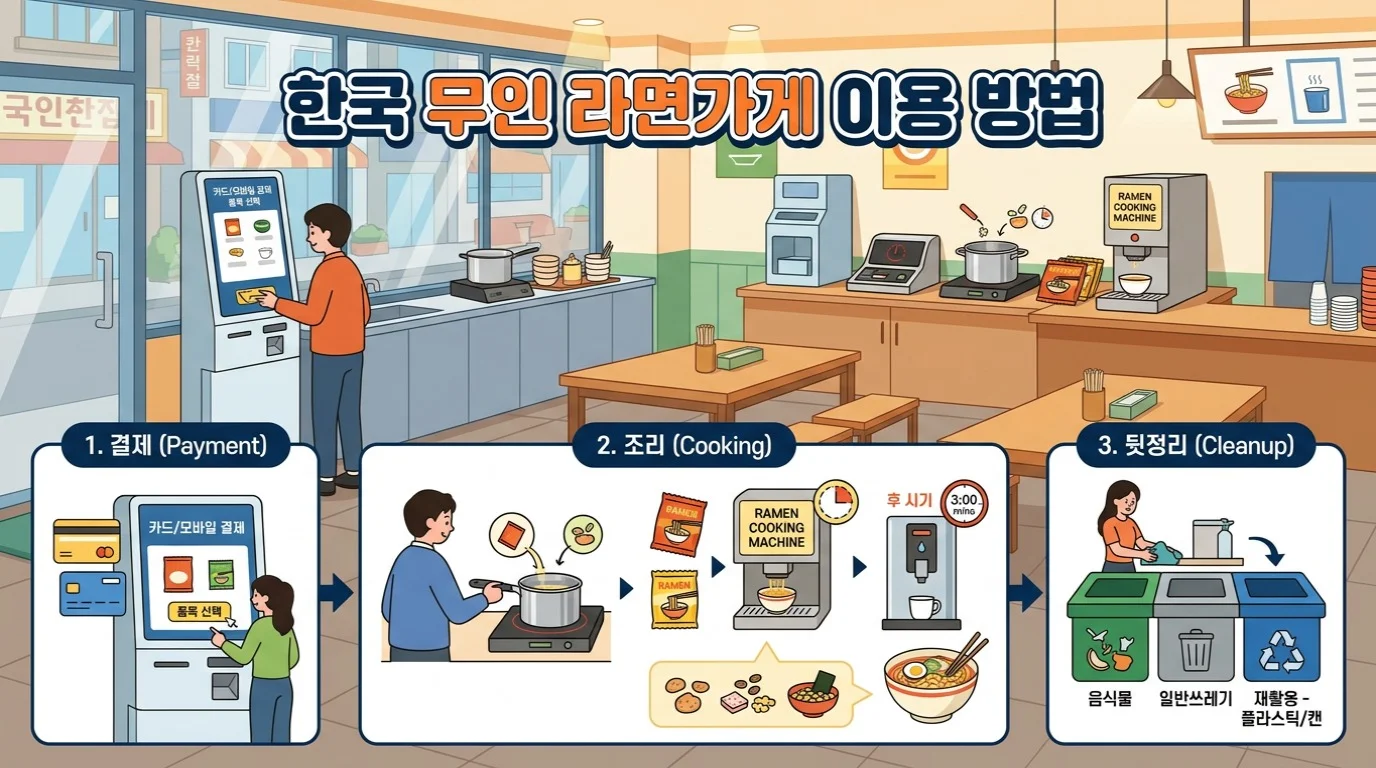
🍜 How to Use Korea's Unmanned Ramyeon (Self-Service Ramen) Stores — From Payment to Self-Cooking and Cleanup
⚠️ Please note
Prices, ramyeon selection, toppings, payment methods, machine types and how they operate, and opening hours all vary by store and change often. This guide is general reference only — always confirm the exact steps, prices, and cooking times on the store's signage and machine screen. In particular, pay before you open any product, and use only the dedicated container the store provides. Most stores run unattended, but some have staff only at certain hours or may be mid-cleaning or restocking, and lines can form at the machine during busy times. Note too that cards issued overseas and non-Korean mobile payments may not be accepted, depending on the device.
⏱️ 30-Second Summary — Just Remember This!
🍜 Concept → A self-service store where you pick ramyeon and toppings and cook them in a dedicated machine
🔁 Order → ①Pick items → ②Pay → ③Open & fill container → ④Cook → ⑤Clean up
💳 Payment → Pay BEFORE opening the product
🥣 Container → Use only the machine's dedicated container provided by the store
🔥 Cooking → Barcode / button / water-setting methods differ, so check the machine's instructions first
🥢 Stirring → Some cook automatically, but others need you to loosen the noodles by hand
🥚 Toppings → Check if they're free or paid; heat frozen items separately per instructions
🌐 Overseas payment → Foreign-issued cards and overseas mobile pay may not work
⚠️ Safety → Don't overfill one container with ramyeon; beware hot water and the cook plate
🧹 Cleanup → Dispose of leftover broth and trash as the store's signs direct
1. 🍜 What is an unmanned ramyeon store?
It's a self-service ramen shop where customers cook their own ramyeon without any staff.
Like a convenience store, it stocks bagged and cup ramyeon, frozen dumplings, tteokbokki, drinks, ice cream, and simple toppings, with a "ramyeon cooker" machine off to one side. You choose your items, pay first, then put your ramyeon in a dedicated container and cook it in the machine. Prices vary depending on whether it's regular or premium ramyeon, whether a dedicated cooking container is included, and whether you add toppings or sides — so it's hard to compare directly to retail ramyeon prices. Check the final amount shown on the shelf and the kiosk screen.
2. 🤖 Every machine works differently — check the instructions first
Broadly, the machines fall into two groups: self-cookers where you cook directly in a dedicated container, and vending-style machines that cook a dedicated product automatically.
But even self-cookers vary a lot. Some read a barcode on the dedicated container to set the water and time automatically; some let you choose the ramyeon type, water amount, or cook time yourself on a screen or buttons; some just need a start button; and some require you to stir the noodles yourself while it cooks. Vending-style machines also differ — some supply hot water to a sealed, dedicated ramyeon container — and cooking method and wait time vary by product.
So whatever machine you're facing, checking the on-site instruction picture and the on-screen sequence first is the key. For vending-style machines, you usually select a product on screen, pay, then insert the dedicated product or collect the finished item as directed. The steps below cover the most common flow, so always defer to the store's instructions for the details.
3. 🛒 Step 1 — Choose your items and dedicated container
First, pick the bagged ramyeon and any drinks or toppings you want from the shelf.
Check whether the dedicated cooking container is a separate product or already included in the ramyeon price. Also check whether toppings are free or paid by looking at the price tags and barcodes. If you're worried about spice, look for labels like "mild," "spicy," or "very spicy" on the packaging. A chili icon or spice-level marker can help, but you can't judge by package color alone (some red packages aren't spicy, and vice versa). If you're sensitive to spice, choose a "mild" product or don't add all of the soup powder.
4. 💳 Step 2 — Pay BEFORE opening the product
Once you've chosen your ramyeon and toppings, pay at the kiosk or self-checkout before opening the package.
Unmanned stores verify products and payment by CCTV, so opening a product before paying can cause misunderstandings. As a rule, pay before opening or cooking anything, and if the store posts a different procedure, follow it. Many kiosks are card-only, though some stores also take cash or Korean mobile payments. Cards issued overseas and overseas mobile payments may be declined, so check the accepted-payment logos first; if payment fails, don't open the product — use another method or contact the manager. Note that some Korean mobile payments like KakaoPay or Samsung Wallet may require a Korean account or a domestically issued card, so they aren't usable by every international traveler.
5. 🥣 Step 3 — Put the ramyeon in the dedicated container
After paying, open the ramyeon and put it in the dedicated container the store provides.
Generally, adding the noodles first and then the powder and dried-vegetable soup packets on top helps them mix well — but if the instructions next to the machine give a different order, follow that. What matters most is using the dedicated container and not exceeding the container's marked fill line (max capacity). Overloading with toppings can make it boil over. Never place outside cups, plastic bowls, or ordinary cup-ramyeon containers on the cook plate.
6. 🔥 Step 4 — Check the machine's instructions and cook
Now it's time to place the container on the cooker. Since operation differs by product, read the screen and instructions first.
If the dedicated container has a barcode, scan it at the machine's scanner; if there's no barcode, select the ramyeon type, water amount, or cook time yourself on the screen or buttons. Place the container squarely in the center of the dedicated cook plate (heating plate) and press start in the order shown on the screen or instruction picture. The machine will then add the set amount of water and begin heating the container. It usually takes a few minutes, but check the machine's display for the exact time.
7. 🥢 Step 5 — Loosen the noodles as instructed
Some machines are fully automatic — "just press the button" — but many are not.
Some machines require you to gently loosen the noodles with chopsticks after the water starts boiling. When you do, don't press hard on the bottom or sides of the container, as it can puncture or tear — stir only the noodles, gently. Hot water can splash, so keep your face and hands away from the cook plate, and follow the machine screen or posted instructions while you wait.
8. 🥚 Step 6 — Add toppings the proper way
If plain ramen feels lacking, you can add toppings — but the method depends on the type.
Add only toppings the store designates for ramyeon — like green onion, cheese, or thin rice cakes — in the recommended amount. Use only eggs the store provides for cooking, and if you want them fully cooked, add them early (cheese melts nicely if added after cooking). On the other hand, foods that need to be heated through to the center — like frozen dumplings, fish cake, or sausage — should not go straight into the ramyeon; heat them separately in the microwave per the packaging and store instructions. Only put them in the cooker if there's a sign saying they can be cooked together. Adding too many toppings can make the broth overflow.
9. 🧹 Step 7 — Sort and dispose after eating
At an unmanned store, cleaning up after yourself for the next customer is basic etiquette.
Pour leftover broth and food waste into the store's designated collection bin first, then put the empty container, chopsticks, cans, and bottles into the marked recycling bins by type. Since each store sorts differently, following the bin pictures and signs is the most reliable approach. If broth splashed on the table, wipe it lightly with the provided tissues so the next customer can use it right away.
10. 💡 Handy tips & common mistakes
Small things that make it much smoother.
Visiting alone is perfectly normal, and plenty of customers also enjoy ramen simply with friends or family. Some stores have heating/cooling, Wi-Fi, charging outlets, or a separate seating area, but facilities vary by store, so check on site. Some places have few seats or time limits, so it's good to free up your seat after eating. Three common mistakes: (1) opening a product before paying, (2) pouring water yourself or skipping the operation steps, and (3) placing a non-dedicated container on the plate. If you're unsure, check the instruction pictures on the wall or machine, and if a problem comes up, contact the manager number posted in the store. Hot broth and the machine pose a burn risk, so children should always be accompanied by an adult.
❓ Frequently Asked Questions (FAQ)
Q. Is there really no staff at all? Many stores are fully unmanned, but some have staff at certain hours or a manager who stops by for cleaning and restocking. Usage instructions and a manager contact are posted on the wall, so you can text if you get stuck.
Q. When do I pay? As a rule, pay before opening or cooking any product. Unmanned stores verify by CCTV, so opening a package before paying can cause misunderstandings. If the store posts a different order, follow it.
Q. Can I use these without reading Korean? Yes. The pictures and buttons are intuitive, so follow them in order. Since operation differs by machine, though, checking the instructions next to the machine first is most important.
Q. What container do I cook in? Can I put a paper-looking cup on the plate? Use only the dedicated container the store provides or sells for that cooker. Don't use ordinary paper cups, cup-ramyeon containers, plastic bowls, or any container from outside. The dedicated container is made for that machine's heat and cooking method; incompatible containers can melt, leak, or break.
Q. Do I need to stir while it cooks? It depends on the machine. Some cook automatically, but others need you to gently loosen the noodles with chopsticks after the water boils. Don't press hard on the container — stir only the noodles, gently.
Q. Can I cook two packs of ramyeon at once? It depends on the machine and dedicated container, but generally it's safest to cook just one pack per container. Putting two in one container can throw off the water amount or make it boil over. If you're in a group, use one empty cook plate each, and only cook two servings together if the store says so.
Q. I'm worried about spicy ramen. Are there mild ones? Yes — look for a "mild" label on the packaging. That said, spice tolerance varies, so a product considered "less spicy" in Korea may still taste hot to you. Not adding all the soup powder is one option.
Q. What if my card doesn't work? Many stores are card-only, and foreign-issued cards or overseas mobile payments may be declined. Check the accepted-payment logos first, and if it fails, don't open the product — use another method or contact the manager.
Q. Can I just help myself to the toppings? No. Check first whether they're free or paid items. Eggs, cheese, dumplings, rice cakes, and the like that have price tags or barcodes must be paid for together with your ramyeon.
🗣️ Handy Korean phrases for the store
"먼저 결제해야 하나요?" (meonjeo gyeoljehaeya hanayo?) — Do I need to pay first?
"이 기계 전용 용기가 어떤 거예요?" (i gigye jeonyong yonggiga eotteon geoyeyo?) — Which is the dedicated container for this machine?
"조리 중에 저어야 하나요?" (jori junge jeoeoya hanayo?) — Do I need to stir while it cooks?
"해외 카드도 되나요?" (haeoe kadeudo doenayo?) — Do you accept foreign cards?
"안 매운 라면은 어떤 거예요?" (an maeun ramyeoneun eotteon geoyeyo?) — Which ramyeon is not spicy?
✅ Quick Checklist
Choose items & dedicated container (check if container/toppings are paid)
Check spice label on packaging (the "mild/spicy" text, not the color)
Pay BEFORE opening the product (check card-only / foreign-card acceptance)
Fill the dedicated container (don't exceed the fill line; no outside containers)
Check machine instructions → operate in order (barcode / button / water setting)
Loosen the noodles during cooking as instructed (don't press hard on the container)
Heat frozen dumplings / sausage separately as directed
Pour out leftover broth first, then sort container, chopsticks, cans & bottles
🟦 A guide put together by the JoyStoria team.
📅 As of: 2026 · ⚠️ Prices, English support, information, and operations may vary by season, business, and branch.
JoyStoria does not endorse any particular business. Before visiting, please confirm the latest information (hours, payment methods, prices, how to operate the cooker) on each store's signage and a map app. The store's on-site instructions always take priority for the operating order and which containers you may use. Hot broth and the cooker carry a risk of burns, so please take care, and children should always be accompanied by an adult.