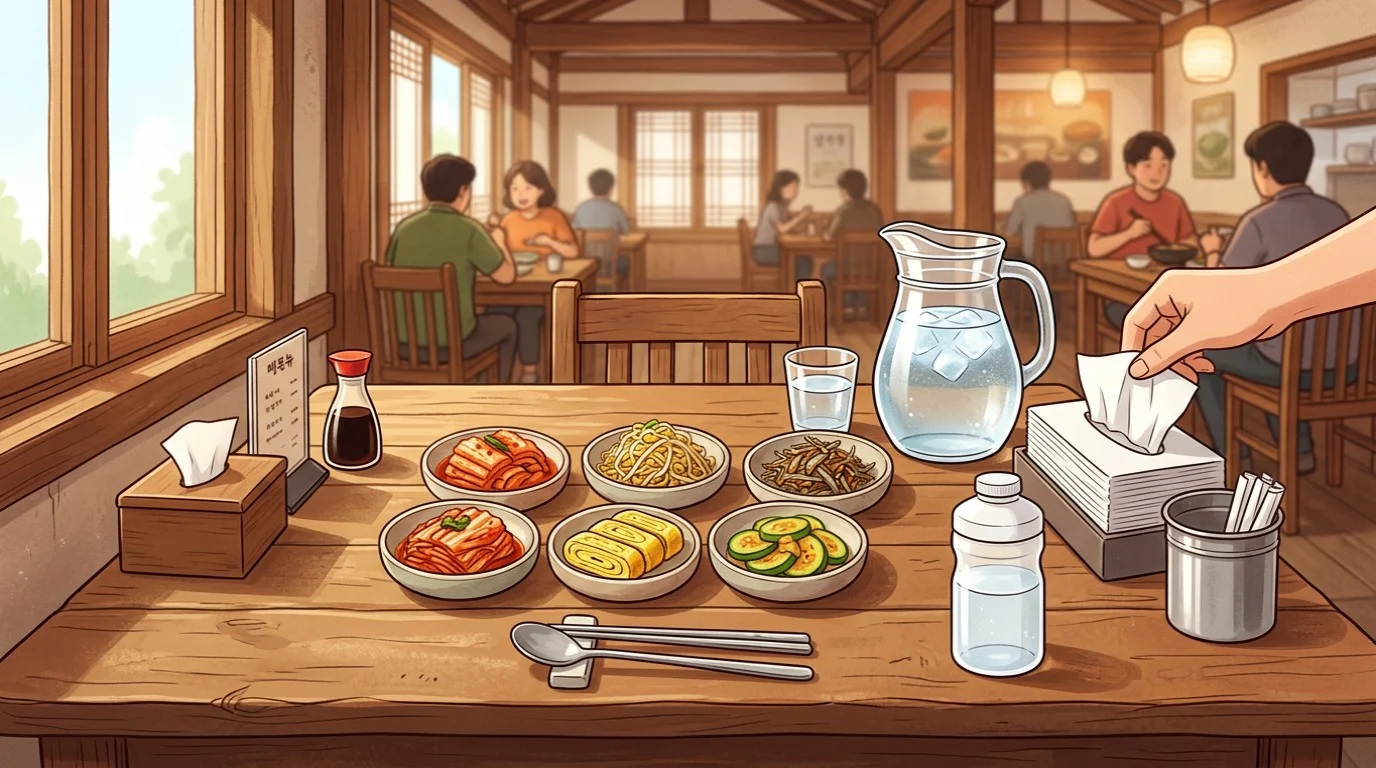
📌 Banchan, Water & Tissues at Korean Restaurants — A Complete Guide for Foreign Visitors
⚠️ Please note
Side-dish selections, refill policies, how water is served, whether wet tissues or a bowl of rice cost extra, self-bar setups, and payment methods all vary by restaurant, region, and type of eatery, and they change often. This is especially true at tourist spots and popular venues, so when in doubt, just ask a staff member. Popular places can have long waits during peak meal times (roughly 12–1 pm and 6–8 pm), so allow extra time.
⏱️ 30-Second Summary — Just Remember This!
🥢 Side dishes → Served with your main; usually no extra charge
🔄 Refills → Basic sides are often refilled free, but not every dish qualifies
💧 Water → Often free; may come by pitcher, from staff, or self-serve dispenser
🧻 Tissues → Napkins and restaurant-provided wet wipes are usually free — check if there's a price tag
🍚 Rice → If not included in your dish, it's usually a paid extra
🍽️ Self-bar → Not everything on it is free, so check for price tags
💳 Payment → Usually pay at the counter after eating, but kiosk/QR prepay is growing
💵 Tips → No need to tip at ordinary restaurants
🙅 Manners → Take only what you'll eat, and use shared tongs/ladles
1. 🥢 What Are Banchan (Side Dishes)?
These are the small dishes that come with your main order by default.
Banchan are part of the Korean way of setting a table, served alongside the main dish you ordered. Most of the time they aren't priced separately and are included in the cost of the meal.
Common ones include kimchi, kkakdugi (radish kimchi), seasoned bean sprouts, namul (seasoned greens), julienned radish, stir-fried fish cake, stir-fried anchovies, and pickled radish. Steamed egg, savory pancakes, or grilled fish may appear as a bonus but can also be separate paid menu items.
The number varies completely by restaurant. Set-menu and home-style places may lay out many dishes, while a snack shop might just bring pickled radish and kimchi.
💡 Banchan aren't a "service extra" — they're a basic part of a Korean meal. Rice, soup, and side dishes together complete the traditional Korean table setting (hansang-charim).
2. 🌍 Side Dishes Vary by Region and Type
Even among "Korean restaurants," the spread differs from place to place.
Home-style and set-menu restaurants in the Jeolla region are well known for a food culture of laying out many side dishes at once. That said, the number and variety depend more on a restaurant's menu, price, and operating style than on region alone.
Barbecue restaurants: lettuce and perilla leaves for wraps, shredded scallions, ssamjang, garlic, and kimchi come as standard.
Gukbap / hangover-soup places: simpler, mostly kkakdugi and kimchi; some have a self-bar.
Snack shops (gimbap/tteokbokki): simple — pickled radish and kimchi.
Set-menu / ssambap places: the side dishes themselves are plentiful and refined, almost like main courses.
💡 Tourist-area restaurants and famous spots also vary in how many sides they serve depending on price and menu, so photos of the menu and reviews are worth checking.
3. 🔄 Can You Really Get Refills?
Many restaurants will happily give you more of the basic sides — kimchi, pickled radish, namul — for free when you ask.
If a side runs out, just tell staff, "Could I get more ○○, please?"
Where there's a self side-dish bar, help yourself.
However, not every side dish is refillable. Higher-cost items like steamed egg, fish, or soy-marinated crab, or one-time bonus dishes, may require a new order.
Lately some places limit the number or type of refills due to ingredient costs. Free refills are a familiar custom, but not an absolute rule.
💡 Asking for a dish that didn't come out initially may be a separate order rather than a "refill." Check whether it's one of the basic sides you were served or an item with a price on the menu.
4. 💧 How Do You Get Water?
At ordinary Korean restaurants, drinking water is often provided free. How it's served falls into three patterns:
Places where a pitcher and cups are already on the table
Places where staff bring water by pitcher or cup
Places with a "water is self-serve" sign, where you help yourself at a dispenser or self-bar
Dispensers usually have cold / hot / room-temperature buttons. Be careful — the hot water is very hot. Some restaurants serve a light chilled tea like barley or corn tea instead of plain water, also free.
💡 If water doesn't arrive right away, check around the table and the self-bar. If there's no self-serve sign, just ask a staff member for water.
Water isn't always free. Dispenser water and the water a restaurant provides by default are usually free, but bottled water, sparkling water, imported water, and other drinks listed on the menu cost extra. At cafés, bars, or some venues even bottled water may be paid, so check.
5. 🧻 Are Napkins and Wet Wipes Free?
Korean restaurant tables often have thin paper napkins, and you can generally use them freely. Many restaurants also provide individually wrapped wet wipes or a wet towel for free to clean your hands or utensils.
That said, not every restaurant provides wet wipes. If there's a price tag or a notice that it's paid — as with a retail product — check before using.
Being on the table doesn't automatically mean you'll be charged for using it; that's not standard Korean restaurant culture.
For foods eaten by hand like fried chicken, jokbal, or crab, plastic gloves may be provided too. The basic quantity is often free, but how extra gloves or other hygiene items are provided can vary by restaurant.
💡 If you're unsure, just ask, "Is this wet tissue paid?" Checking ahead avoids surprises at payment.
6. 🍚 Rice and Soup — Good to Know
Unlike side dishes and water, rice and soup may cost extra.
A bowl of rice (gonggibap): usually a separate paid item. Many restaurants still charge 1,000 won, but depending on region and restaurant it can be 2,000 won or more, so check the menu. (Prices are a rough guide and some places charge more.)
At barbecue places, if you order only meat, rice, naengmyeon, or soybean stew may need to be ordered separately.
Refills of soup/stew or noodle add-ons depend on the restaurant. If soup or noodles aren't set out at a self-bar, don't assume they're free — check with staff first.
Rice refills are usually paid unless it's an all-you-can-eat place.
💡 Even "all-you-can-eat" venues have a set list of unlimited items. Often only some cuts of meat and the basic sides are included, while rice, drinks, naengmyeon, and premium meat may be extra — check the menu. Some venues set a time limit or charge extra for leftover food to reduce waste.
7. 🍽️ Using the Self-Bar
Barbecue places, gukbap spots, cafeterias, and food courts often have a self-bar.
A self-bar has basic side dishes, water, and utensils, and depending on the venue, rice, soup, or coffee may be there too.
Being on the self-bar doesn't mean everything is free. Check price tags and notices. Instant-noodle add-ons, drinks, and packaged products often require separate payment.
Spoons and chopsticks are in the table drawer or at the self-bar. If they're not at your seat, open the drawer first.
Some self-service places have you return your dishes to a return station yourself — look for the signs.
8. 💳 Ordering, Calling Staff, and Paying
Calling staff: if there's no call button, make eye contact or say "Yeogiyo" (excuse me) loud enough to be heard. Avoid shouting or snapping your fingers. Many places now let you order directly via tablet or kiosk.
Paying: ordinary restaurants often have you pay at the counter after eating, but kiosk prepay, table-tablet ordering, and QR payment are becoming more common. Check the method before ordering.
Tips: no need to tip at ordinary Korean restaurants — just pay the final amount shown on the menu. Hotels or special services may include a service charge in the price, but adding a tip on top of the listed amount isn't a common custom.
Splitting the bill: splitting costs among friends is common. Whether the restaurant will split payment across several cards varies by place. Before paying, ask "Can we pay separately?", or one person pays and the rest settle up via a money-transfer app.
9. 🙏 Manners Worth Knowing
Korean meals often involve sharing several side dishes and stews. If there are shared tongs, a ladle, or serving spoons, use them to move food to your own small plate. Avoid dipping your used spoon or chopsticks directly into shared food.
Even with free refills, take only as much as you'll eat to avoid leaving a lot of food.
At family gatherings or formal occasions, it's traditional etiquette to wait for the eldest to pick up their spoon before starting. At casual meals with friends, this often isn't applied strictly.
Unlike in Japan, in Korea it's usual to leave the rice and soup bowls on the table and eat with a spoon. Lifting a bowl isn't a big problem, but if you want to eat the local way, keep it on the table.
Self-serve water and side dishes aren't a sign of poor service — it's a practical culture of "it's easier to do it yourself."
❓ Frequently Asked Questions (FAQ)
Q1. Will I be charged later for side dishes I didn't order? Basic banchan are usually included in the meal price, so they aren't charged separately. But items that might be separate menu dishes, like steamed egg or grilled fish, are worth checking on the menu.
Q2. Do I pay if I ask for more side dishes? Basic sides like kimchi and namul are refilled free at many places. But not every dish qualifies, and higher-cost items may become a new order.
Q3. How do I get water? It's often free. It may be a pitcher on the table, brought by staff, or a self-serve dispenser — look around, and if there's none, ask staff. Note that bottled water and drinks on the menu are paid.
Q4. Do I have to pay for using the wet wipe on the table? Individually wrapped wet wipes or towels provided at ordinary restaurants are often free. But if there's a price shown or a paid notice like a retail product, check before using.
Q5. Why do I pay separately for rice? A bowl of rice is usually a separate paid item, unlike side dishes. It's good to check whether rice is included when you order.
Q6. I can't find the utensils. They're in the table drawer or at the self-bar. Open the drawer first.
Q7. Should I tip? No. Ordinary Korean restaurants have no tipping culture. Just pay the amount shown on the menu.
Q8. I couldn't finish the side dishes. Is that a problem? At ordinary restaurants you almost never pay extra for leaving a little. But all-you-can-eat venues may have an extra charge for leftovers, so check the notice.
🗣️ Handy English Phrases (with Korean)
"Can I get more of this side dish?" — 이 반찬 좀 더 주시겠어요?
"Is the water self-service?" — 물은 셀프인가요?
"Is this wet tissue free or paid?" — 이 물티슈는 무료인가요, 유료인가요?
"Is rice included, or is it extra?" — 밥은 포함인가요, 따로 시켜야 하나요?
"Can we split the bill?" — 나누어 계산할 수 있나요?
✅ Quick Checklist
Basic sides are usually included in the meal — enjoy freely
Refills mainly for basic sides — check higher-cost items
Check how water is served (pitcher/staff/self); bottled water & drinks are paid
Napkins & provided wet wipes are usually free — check if there's a price tag
Rice, rice refills, and noodle add-ons are usually paid — check the menu
Utensils are in the table drawer or at the self-bar
Pay at the counter or via kiosk/QR; no tipping
Even with free refills, take only what you'll eat — don't waste food
🟦 This guide was put together by the JoyStoria team.
📅 As of: 2026 · ⚠️ Prices, English support, information, and operations may vary by season, business, and branch.
JoyStoria does not endorse any specific business. Before visiting or ordering, please confirm the latest details through each restaurant's notices and staff. How banchan, water, wet wipes, and rice are provided — and whether they cost extra — can differ by each venue's policy, so when in doubt, feel free to ask a staff member.