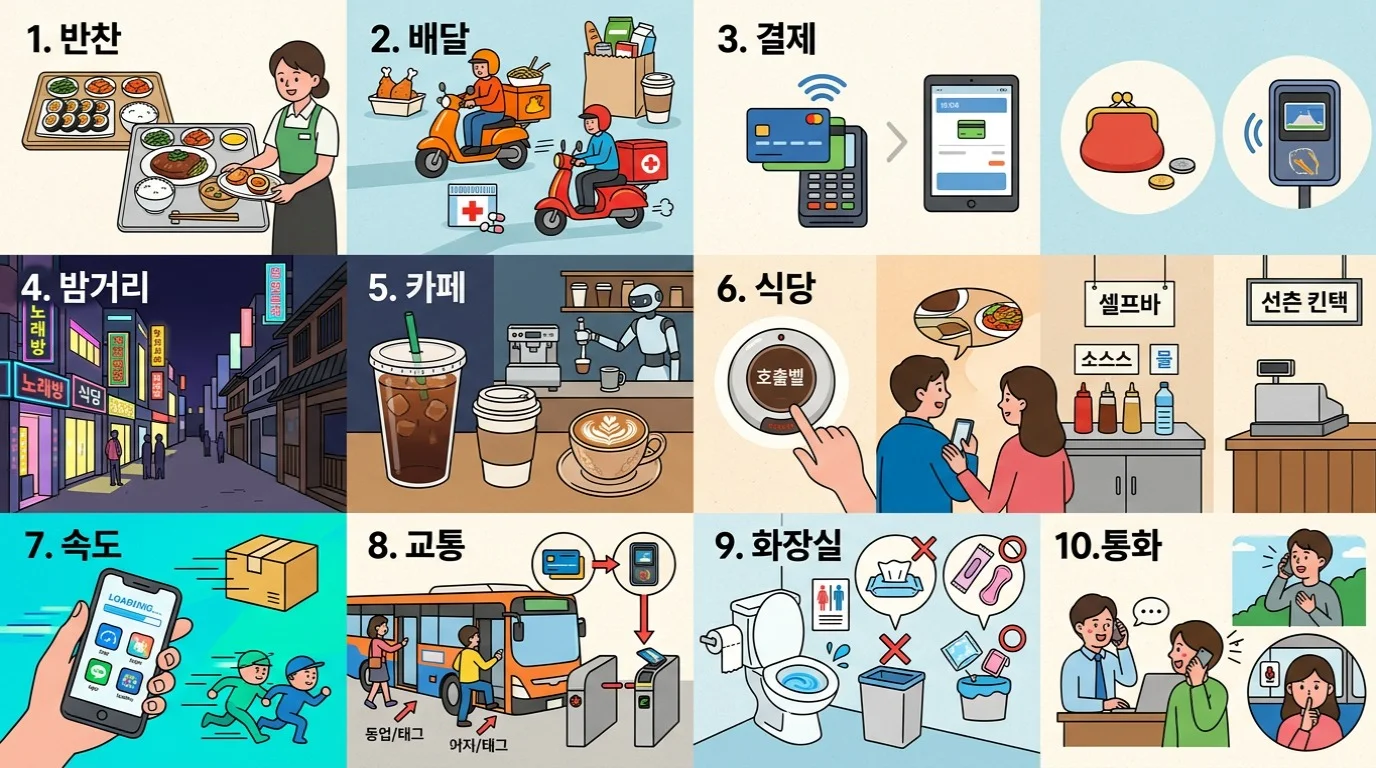
🇯🇵 So Different from Japan — 10 Culture Gaps That Surprise First-Time Travelers in Korea
⚠️ Note — The following describes commonly mentioned tendencies and can differ by store, region, situation, and person. In particular, prices, hours, English/Japanese support, delivery availability, and payment methods vary by store and change often, so always check a map app (Naver Map, KakaoMap, etc.) or each store's official channel before visiting. Popular restaurants and cafés can have long waits on weekends and evenings.
⏱️ 30-Second Summary — Just Remember These!
🍚 Side dishes → Basic banchan come with your meal, often free refills, but not everything is unlimited
🛵 Delivery → Food, drinks, convenience-store items, and daily goods — but medicine is separate
💳 Payment → Cards are very common, but bring some cash for foreign-card errors, street stalls, and topping up transit cards
🌙 Night streets → Busy areas stay bright late, but follow basic safety habits in quiet spots
☕ Cafés → From large cheap coffee to big theme cafés — wide range, but not all are cheap
🔔 Restaurants → Call bells and self-serve bars are common; pre-pay vs. pay-after varies by store
⚡ Speed → Ordering, delivery, and digital services can feel fast
🚇 Transit → Tap your card both boarding and getting off the bus; check transfer-discount rules
🚻 Restrooms → Regular toilet paper goes in the toilet; wet wipes and sanitary items in the bin
📱 Calls → Conversation may feel livelier than in Japan, but keep calls on transit short and quiet
1. 🍚 Basic side dishes come with your meal, and many places refill them
At many Korean restaurants, small side dishes (banchan) like kimchi, seasoned greens, and bean sprouts arrive together before your ordered dish. In typical Japanese restaurants you often order small sides separately, but in Korea these basic side dishes are usually included in the menu price and served alongside your meal. (At Japanese izakaya, a small appetizer called "otoshi" is served automatically and sometimes charged — but that's a bit different in nature from Korea's basic banchan.)
Many restaurants will refill basic side dishes like kimchi and greens at no extra charge if you ask. However, not every side dish is unlimited. Higher-cost items like rolled egg, fish, or soy-marinated crab (ganjang-gejang), one-time "service" dishes, and the fixed portion of vegetables at BBQ places may require an additional (paid) order.
Tip: If there's a self-serve bar, taking only what you'll eat is good manners. Refilling little by little rather than piling up "because it's free" also cuts food waste.
Tip: If you're unsure whether a refill or add-on is paid, just ask a staff member.
2. 🛵 Not just food — convenience-store items and daily goods get delivered too
Korea's delivery culture is something Japanese travelers often admire. Beyond food like fried chicken, jokbal, and tteokbokki, many places deliver café drinks, desserts, ice cream, and convenience-store food and daily goods right to your accommodation via app.
Timing: In city centers it often arrives fairly quickly, but during evening peak hours, weekends, or rain/snow, it can take over an hour or even get canceled.
For foreigners: Domestic apps like Baemin and Coupang Eats may require a Korean phone number or local payment method, and foreign cards may not work. There are multilingual delivery services for foreign travelers, but delivery areas, fees, and supported languages may be limited.
Where you receive it: Some hotels don't allow delivery to your room door, so you may need to pick it up at the lobby or building entrance. Check in advance whether your accommodation can receive deliveries.
⚠️ Medicine is separate: Where and how medicines (cold medicine, painkillers, etc.) are sold is regulated by law, so don't assume you can freely order and receive them through a regular delivery app. If you need medicine, go directly to a pharmacy or a convenience store that sells approved OTC "safety" medicines.
3. 💳 Card payment is very common, but a little cash helps
In Korea, card payment is very common at restaurants, cafés, convenience stores, taxis, and more — convenient for travelers used to relying on cash. Still, it's hard to say cash is never needed. You may need cash in these situations:
Some traditional-market stalls and small street vendors
Topping up a transit card with cash, some unmanned machines / cash-only lockers
When a foreign-issued card isn't approved at the terminal
Small shops that only accept bank transfer
Environments where foreign cards or foreigner prepaid cards work are expanding, but where each payment method is accepted varies. Also, "just your phone is enough" may not apply to Japanese travelers — Korean mobile-pay services often require a Korean phone number, account, and domestic card. Keeping a few small bills (1,000/5,000 won) on hand is reassuring.
Tip: A tipping (service charge) culture isn't common. You don't need to tip at ordinary restaurants, cafés, or taxis. That said, hotels and some premium services may include a service charge in the bill, so just check your receipt.
4. 🌙 Major busy districts stay bright and lively late into the night
Convenience stores often operate late at night, and busy districts have restaurants, cafés, and karaoke open until late, so the streets can feel lively even at night. High urban density, a dining-and-gathering culture that runs late, and convenience-store and transit infrastructure combined to develop the late-night commercial scene in major districts.
Caveat: 24-hour businesses vary greatly by area and industry. Many stores have cut back on late-night hours compared with before, so if you plan to go late, check actual hours on a map app.
Safety: Bright, crowded streets don't mean there's no risk. Use normal caution in nightlife areas with many intoxicated people, quiet alleys, and when taking taxis or heading home. In emergencies you can call police 112, ambulance/fire 119. (Whether Japanese-language support is available depends on the situation, so check separately.)
5. ☕ From large cheap coffee to distinctive big cafés, the options are wide
Korea has many takeout franchises selling large drinks fairly cheaply, so travelers are often surprised by the big sizes of not just coffee but also ades and smoothies. On the other hand, dessert cafés, large cafés, and hotel cafés in famous spots like Seongsu, Hannam, Bukchon, and Jeju can actually feel more expensive than in Japan. Rather than "all Korean cafés are cheap," the point is the wide range of price and scale.
Space: There are many spacious, stylish large cafés, cafés with great views, and cafés with a "study café" culture where people work on laptops. However, crowded popular cafés or small shops may limit time or laptop use, so check the notices, and consider ordering more if you stay a while.
Outlets & Wi-Fi: Many cafés offer free Wi-Fi and power outlets, but not at every seat.
6. 🔔 Call bells, self-serve bars, and counter payment are common
Many Korean restaurants have a call bell on the table. Press it when you want to order or get more side dishes or water, and a staff member comes. If there's no bell, make eye contact when a staff member is near, or call out at an audible volume with "yogiyo" (excuse me) or "jeogiyo." (Shouting loudly or snapping fingers can come across as rude in Korea too, so avoid it.)
Self-serve bar: Many places have you get water, side dishes, utensils, and napkins yourself from a self-serve corner. If you can't find the water, check the self-serve area or ask a staff member.
Water: Ordinary restaurants often provide drinking water for free. However, takeout-only shops and some cafés may handle it differently.
Payment: Ordinary restaurants often have you pay at the counter after eating, but kiosk pre-payment, table payment, and QR ordering are also increasing, so check when you order.
7. ⚡ Ordering, delivery, and digital services can feel fast
In Korea, food ordering, parcel delivery, mobile payment, and administrative services can feel fast to get through. With well-developed internet and app services, many travelers feel things move briskly.
Caveat: Not everything is fast. At popular stores, hospitals, and government offices you may wait a long time.
Manners: People moving quickly may not be trying to rush you personally. Still, in crowded spots (subway, escalators, etc.), it's good to step to one side so you don't block others.
8. 🚇 Tap your card when getting off the bus too, and transfer discounts apply automatically
Japan also has well-established transit cards like Suica and PASMO, so it's often the difference in how they're used — not the card itself — that surprises people. On many Korean city buses you tap your card both when boarding and when getting off, and subway↔bus transfer discounts apply automatically. Some sections also add fare based on distance.
Tapping off: If you don't tap when getting off, you may miss the transfer discount or be charged extra next time. Rules vary by region, so make it a habit to tap when getting off to be safe.
Coverage: Cards like T-money and EZL work on subways and buses in many regions nationwide, and also at taxis and convenience stores that accept transit-card payment. However, they don't work identically in every region, route, or taxi, so check for the card symbol. Some transport like airport limousine buses may require a separate ticket.
Balance refunds: Depending on card type and amount, refunds are possible at convenience stores, subway customer centers, designated service centers, etc., and a fee may apply. The card purchase cost itself often isn't refundable, so check the rules before departure.
Priority seats: The pink pregnancy priority seat is generally kept open so that even early-stage expectant mothers, who may not look pregnant, can use it. Yielding priority seats to passengers who need them is basic courtesy too.
9. 🚻 Free restrooms are plentiful, but how to use them varies by building
Subway stations, parks, and public facilities have relatively well-equipped free restrooms, so you worry less about restrooms while out. That said, cleanliness and opening hours vary by facility, and not every building's restroom is freely open.
Toilet paper: Regular toilet paper can go in the toilet and be flushed. Sanitary items, wet wipes, and paper towels should not go in the toilet. If a very old facility has a separate notice, follow the on-site guidance; if there's no notice, flushing regular toilet paper is the norm.
Access: Some restrooms in shopping complexes or restaurants have a passcode, so you may need to get the number from a receipt or the counter. If you're a customer at a café or restaurant, using their restroom is easiest.
10. 📱 Conversation may sound livelier than in Japan, but keep transit calls short and quiet
Conversation inside Korean subways and buses can feel a bit livelier than on Japanese trains. But you should avoid loud, long calls or using speakerphone on the subway or bus — it can be seen as rude in Korea too.
Manners: For an urgent call, speak quietly and briefly, and always use earphones for videos and music.
Cafés: Conversation and calls are relatively free in cafés, but in study spaces or quiet cafés it's good to read the room.
❓ Frequently Asked Questions (FAQ)
Q. Are the side dishes really all free? A. Basic side dishes are usually included in the menu price and served together, and items like kimchi and greens are sometimes refilled for free. But higher-cost items like soy-marinated crab, fish, or egg may be a paid add-on, and refills aren't unlimited.
Q. Are there Japanese or English menus? A. Tourist spots and popular stores often have them, but local eateries may be Korean-only. A translation app's camera feature or photo menus help.
Q. Do I definitely need cash? A. Card payment is very common, but keeping some small cash for stalls, transit-card top-ups, and foreign-card approval failures is reassuring.
Q. Can foreigners order delivery? A. Domestic apps may require a Korean phone number and payment method. There are multilingual delivery services for foreigners, but areas and languages may be limited — and check whether your accommodation can receive deliveries.
Q. Can medicine be delivered? A. Where and how medicine is sold is regulated by law, so don't assume you can receive it via regular delivery. Go directly to a pharmacy or a convenience store selling approved OTC "safety" medicines.
Q. Is it safe to walk alone at night? A. Busy districts stay bright late, but use normal caution in nightlife areas, quiet alleys, and on your way home. In emergencies: police 112, ambulance/fire 119.
Q. Should I tip? A. Tipping isn't needed at ordinary restaurants, cafés, or taxis. Hotels and some premium services may include a service charge, so check your bill.
Q. How do I dispose of toilet paper? A. Regular toilet paper can be flushed. Put wet wipes and sanitary items in the bin. If an old facility has a separate notice, follow it.
🗣️ Handy Korean Phrases for On the Spot
"반찬 좀 더 주세요 (banchan jom deo juseyo)" — Some more side dishes, please.
"카드 되나요? (kadeu doenayo?)" — Do you accept cards?
"화장실이 어디예요? (hwajangsiri eodiyeyo?)" — Where is the restroom?
"포장돼요? (pojang-dwaeyo?)" — Can I get this to go?
"여기요 / 저기요 (yogiyo / jeogiyo)" — Excuse me (to call a staff member).
✅ Quick Checklist
Get a transit card (T-money, etc.) — handy for subway/bus; tap when getting off the bus too
A payment card + a little small cash (for stalls, transit-card top-ups, foreign-card errors)
Install a translation app — use camera translation for menus and notices
Install a map app (Naver Map, KakaoMap) — for directions, actual hours, and reviews
For delivery, check if your accommodation can receive it; domestic apps may limit payment methods
Restrooms: regular toilet paper in the toilet, wet wipes/sanitary items in the bin
Allow extra time for popular restaurants/cafés (waits and time limits)
Emergency numbers: police 112 · ambulance/fire 119
🟦 A guide compiled by the JoyStoria team.
📅 As of: 2026 · ⚠️ Prices, English (Japanese) support, information, and operations may change by season, store, and branch.
JoyStoria does not endorse any specific business; please verify the latest information through each store's official channels and a map app before visiting or ordering. This article is reference content summarizing commonly mentioned culture gaps, which may feel different depending on region, situation, and person — so enjoy using it as a guide.