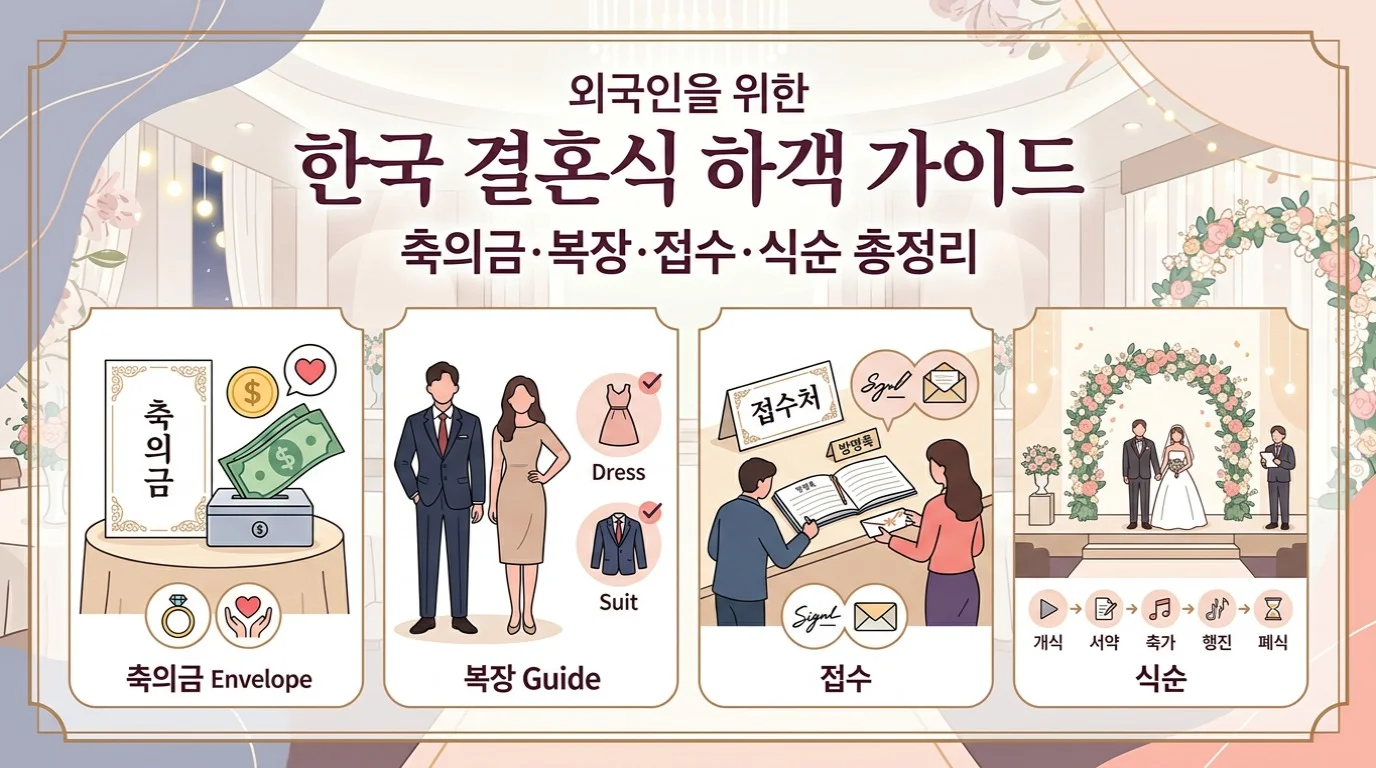
A Foreigner's Guide to Korean Weddings — Gift Money, Dress Code, the Reception Desk & the Ceremony
⚠️ Please Note
Gift amounts, ceremony order, dress formality, and whether a pyebaek takes place can vary a lot depending on the region, venue, family, religion, and your relationship to the couple — and customs shift year to year. The amounts and sequences below are references, not laws or obligations, and figures can change. Popular venues and weekend afternoon slots can get crowded. When in doubt, the most accurate and safest move is to ask the person who invited you, or a friend going with you.
⏱️ 30-Second Summary — Just Remember This!
💰 Gift money → There's no fixed amount; decide based on your relationship, number of guests, venue, and your own budget
💵 Common amounts → ₩50,000–100,000 is often chosen among ordinary acquaintances/colleagues, but it's not an absolute standard
🔢 Amount custom → Easy round units like ₩50,000 / ₩100,000 / ₩200,000 are common; ₩40,000 is usually avoided
✉️ Envelope → Front says '祝結婚' or '축결혼'; write a clear name in the lower-left of the back
🏷️ Reception → Check whether the groom or bride invited you, then go to that reception desk
👗 Dress → Avoid all-white or anything that looks like a wedding dress; dress neatly
⏱️ Ceremony → Entrance, vows, declaration, speeches, songs, recessional — about 30–60 min
📸 Photos → After the ceremony, join your group's photo when the MC or photographer calls you
🍽️ Meal → Use the meal ticket from the reception desk; you normally don't pay again on-site
🎎 Pyebaek → A traditional rite mainly for family/close relatives — regular guests need not attend
1. 🗺️ From Arrival to Departure — A Guest's Day
Let's start with the big picture. When you arrive, you'll generally move in this order. Keep this flow in mind and you'll never be lost. (It varies slightly by venue.)
① Arrive (20–30 min before) — The lobby gets busy, so give yourself time.
② Reception desk — Sign in and hand over your gift envelope at the desk for whoever invited you.
③ Get your meal ticket — After signing in, you often receive a meal voucher. Assigned-seating weddings may skip tickets.
④ Watch the ceremony — Head into the hall, take a seat, and enjoy the ceremony.
⑤ Group photos — After the ceremony, photos are taken with the couple by family, friends, and guests.
⑥ Reception (meal) — Use your ticket at the buffet or banquet hall.
⑦ Leave — After the meal, offer congratulations and feel free to head out.
Lead tip: This flow differs by venue. At some places the buffet opens before the ceremony, so people eat first and just watch the ceremony. When you arrive, check with staff or the signage.
2. 🏷️ What Actually Happens at the Reception Desk
The reception desk is the first hurdle that throws off foreign guests. Here's the usual flow.
Groom's side / Bride's side — At most wedding halls there are two desks, one for the groom's guests and one for the bride's. Go to the desk for whoever invited you. If unsure, tell the staff "I'm a guest of ○○ (the inviter's name)" and they'll point you.
Sign in — Write your name in the guest book so the couple knows who came.
Hand over the envelope — Give your cash envelope to the person at the desk (usually a close friend or relative of the couple).
Get a meal ticket — In return you often receive a meal voucher.
That said, methods vary by venue. Some places have no guest book, use mobile or kiosk check-in, send a mobile meal ticket, don't clearly split the desk by side (small weddings), or serve a plated course meal at assigned seats with no ticket. Following the on-site guidance is always safest.
Small tip: Sign in before the ceremony starts. The line can get long right beforehand.
3. ⏱️ The Ceremony Order — What Happens in the Hall
Once you're seated, the MC leads things along. Guests have nothing special to do — just applaud and enjoy. A typical order looks like this (steps may be reordered or skipped depending on the wedding).
Opening — The MC announces the start.
Mothers light the candles — The mothers of both families step forward to light candles, a traditional segment symbolizing the joining of the two families and a bright future for the couple. It may be skipped, or replaced — parents entering together, or the couple lighting the candles themselves.
Groom enters — The groom walks in first. Everyone applauds! 👏
Bride enters — The bride may enter with her father or parents, alone, or together with the groom — entrance styles are becoming more varied by the couple's choice. When she enters, guests usually stay seated and applaud. Only stand if the MC asks you to for a special ceremony.
Bow & vows — The couple greet each other and exchange vows.
Declaration of marriage — The couple read their vows, and the officiant, MC, or a parent declares them married. Ring (token) exchange happens at some weddings and is skipped at others.
Officiant's address or words of blessing — A blessing from the officiant. Many "no-officiant weddings" today have a father or friend give words of blessing instead.
Congratulatory song / speech — A friend or singer performs; a guest may say a few words.
Greeting the parents — The couple bow in thanks to both families and the guests.
Recessional → Closing — The couple walk out together and the ceremony ends.
Lead tip: During the ceremony, avoid phone calls, loud talking, and flash photography. Especially during the bride's entrance and the recessional, standing up alone (as is common at Western weddings) can block the view of guests behind you — read the room and follow the MC.
4. 💰 How Much Gift Money Is Appropriate? (Reference Range)
This is what people worry about most. The amounts below are a rough range commonly referenced in 2026 — not a law or obligation. There's no set figure; decide based on closeness, number of guests, the venue, and your own budget.
Around ₩50,000 — An acquaintance you contact occasionally, or when you're not attending and just sending your regards
₩50,000–100,000 — Ordinary colleagues and acquaintances
₩100,000+ — A friend or close colleague you're in regular touch with
₩200,000+ — A very close friend or relative you're especially close to
Family / best friends — Consider your relationship and what you've exchanged before, rather than a set standard
A hotel wedding or bringing a plus-one doesn't automatically require a specific amount — decide within your relationship and means.
Background: Over the past few years, rising prices and venue meal costs mean more guests give ₩100,000. One report put the average gift at about ₩117,000, and around ₩134,000 in Seoul. But those are averages tied to how the survey was done — they don't mean ₩100,000 is mandatory for every relationship. More people now factor attendance and plus-ones into their decision, but gift money isn't a payment for the meal — it's a congratulatory gift based on your relationship and means.
5. 🔢 Amount Customs & How to Write the Envelope
There are subtle customs around amounts and envelopes. Not knowing them isn't a serious faux pas, but they help.
Easy round units are common — There's an old idea that odd numbers are auspicious, but today people mostly use easy-to-calculate amounts like ₩50,000 / ₩100,000 / ₩200,000 / ₩300,000. A middle amount like ₩150,000 is also fine, and you don't need to stick to odd numbers.
₩40,000 is usually avoided — The number 4 (四) sounds like the word for "death" (死) and is seen as unlucky. It's not a hard rule, but there's no real reason to pick it.
Front of the envelope — Store-bought envelopes often already print '祝結婚' or '축결혼' on the front. For a blank one, writing "결혼을 축하합니다" (Congratulations on your marriage) in Korean is perfectly fine.
Back of the envelope — Write a name the couple will recognize in the lower-left, and add your affiliation (company, school, group) if helpful — affiliation is optional. It's useful when there are people with the same name or group attendees. Do write your name — otherwise it's hard to tell who it's from.
6. 👗 Guest Dress Code — The Point Is "Don't Look Like the Bride"
The one big principle for Korean wedding attire: the bride is the star, you're the supporting cast. Most tips flow from that.
❌ All-white / bridal-looking outfits — Avoid a head-to-toe white or ivory look, or anything resembling a wedding dress. That said, a bit of white is generally fine — a man's white shirt, or a white blouse under a dark jacket.
🌸 Very pale pastels — be careful — Pastels are okay, but a dress so pale it reads as white in photos or under lights is safer to avoid. If you wear a light top, pair it with a dark bottom or jacket in navy, charcoal, brown, etc.
✅ Safe colors — Navy, charcoal, burgundy, and calm tones are all easy choices.
🖤 All-black? — A neat black suit or dress is generally accepted these days. A slightly brighter accent makes it even better.
Men — A shirt and slacks work well. Dress shoes are safest for hotels or formal weddings; clean, plain sneakers are okay at ordinary halls. Avoid running shoes, slippers, very worn sneakers, ripped jeans, and shorts.
Women — A dress, or a blouse with a skirt/slacks, is a safe bet. Heavy exposure, overly sparkly or flashy patterns, and large accessories can pull attention from the bride, so it's best to avoid them.
Seasonal tips — Spring/fall: a trench or cardigan. Summer: breathable fabrics (but no heavy exposure). Winter: a wool jacket or knit. Indoor AC/heating runs strong, so bring a layer.
7. 📸 Group Photos After the Ceremony — Join In When Called
After the ceremony, the couple stays on the stage for group photos with guests.
The order varies by wedding. Usually family and relatives go first, followed by friends, colleagues, and all guests. Some weddings split the couple's friends into groups; some photograph them together.
When the MC or photographer calls your group, step up front and pose together.
It's quick, so don't be shy — just smile and celebrate.
Once photos are done, head down naturally and move to the meal.
8. 🍽️ The Reception (Meal) & 🎎 Pyebaek
After the ceremony and photos, it's finally time to eat — practically the most important part for guests.
The reception (meal) — Guests generally use the meal ticket from the reception desk at the buffet or banquet hall, and don't pay anything extra there. For reference, gift money is not the meal fee — it's a congratulatory gift to the couple. Buffets are self-serve; course meals are at assigned seats.
What is pyebaek? — Pyebaek began as a rite where the bride greets the groom's elders. Today it's often done with the couple in hanbok bowing to the parents and close relatives of both families.
Jujube and chestnuts — Elders toss jujubes and chestnuts into the bride's skirt, traditionally a wish for many descendants. These days many people see it more as a symbolic way to experience traditional wedding culture.
Who attends pyebaek? — It's usually a private segment centered on family and close relatives. Regular guests need not attend at all, so it's fine to leave after your meal. Many couples now simplify or skip it entirely.
When you leave — No need to linger. If you see the couple or parents, offer a quick word of congratulations; if not, it's fine to slip out quietly.
9. 🙆 Small Tips & Manners Worth Knowing
Little details that go a long way.
Arrive 20–30 minutes early to handle check-in and seating without rushing.
Keep congratulations short and warm — "Congratulations!" or "Be happy!" is plenty.
Wreaths and flowers are usually sent by companies or groups. For an individual guest, gift money is enough.
If you're bringing a child or have dietary needs (vegetarian, allergies), let the inviter know in advance.
During the bride's entrance and recessional, hold your phone up carefully so you don't block others' view.
If you arrive late, don't dash down the aisle — quietly stand at the back to watch.
❓ Frequently Asked (by Foreign Guests)
Q. Can I just send gift money if I can't attend? Yes. You can send it via bank transfer or through a friend who's going. The amount depends on your relationship — not attending doesn't automatically fix it at a set figure. Add a congratulatory message if you can.
Q. I don't have cash. Are cards or transfers okay? A cash envelope is the most common. If you have no cash, you can transfer to the account listed on the mobile invitation — just write your name accurately so the desk can identify whose guest you are, and mention the transfer if needed. Card acceptance varies by venue, so it's safer not to count on it.
Q. Do I need to bring a physical gift? No. In Korea, cash (gift money) is far more usual than a physical present. If you've given gift money, no separate gift is needed.
Q. Can I bring a partner or friend? What about the amount? First check with the couple whether a plus-one is okay. If two of you dine, people often prepare a bit more gift money, but there's no set figure — decide by your relationship with the inviter and your budget. If the invitation didn't mention a plus-one, confirm before bringing someone.
Q. Are seats split by groom's side and bride's side? Traditionally yes, but many places now let guests sit freely. Follow staff if they're directing; otherwise sit wherever's comfortable. Front rows are often for family, so it's best to leave them open.
Q. Can I come in or leave during the ceremony? The ceremony runs about 30–60 minutes, so try to stay seated. If you're late, quietly stand at the back; unless it's urgent, it's polite to stay through the recessional.
Q. Can I write my name in English on the envelope? Yes. Any name the couple will recognize works — Korean or English.
Q. Can I bring my child? Usually fine, but if a child cries during the ceremony, please step out briefly to soothe them. Letting the inviter know in advance helps.
🗣️ Handy Korean Phrases for the Day
"축하해요!" (chuk-ha-hae-yo) — Congratulations!
"신랑측 접수대가 어디예요?" (sillang-cheuk jeopsudae-ga eodi-yeyo) — Where is the groom's reception desk? (Swap 신랑 for 신부 / sinbu = bride)
"식권 어디서 써요?" (sikgwon eodi-seo sseo-yo) — Where do I use the meal ticket?
"연회장이 어디예요?" (yeonhoejang-i eodi-yeyo) — Where is the banquet hall?
(Note: Korean wedding "chugiuim" is best described in English as a cash wedding gift or congratulatory money.)
✅ Quick Checklist
Decided a gift amount based on your relationship and budget? (₩40,000 is usually avoided)
Prepared a cash envelope with a clear name in the lower-left of the back?
Wearing something neat that avoids all-white / bridal looks?
Planned to arrive 20–30 minutes early?
Confirmed whether the groom or bride invited you? (for the right desk)
Know the flow: reception → meal ticket → ceremony → photos → meal?
If you can't attend, decided how to send the gift?
If bringing a plus-one, confirmed they're invited?
🟦 This guide was put together by the JoyStoria team.
📅 As of: 2026 · ⚠️ Prices, amounts, English support, information, and operations can vary by season, venue, region, family, and religion.
JoyStoria does not endorse any specific venue or business. Before attending, we recommend confirming gift money, dress, and the order of events with the person who invited you or a friend going with you. Gift amounts and etiquette vary by region, relationship, and custom and change over time, so when in doubt, asking a local you know is the most accurate. Some segments — candle lighting, ring exchange, pyebaek, an officiant — may be skipped or changed depending on the couple.