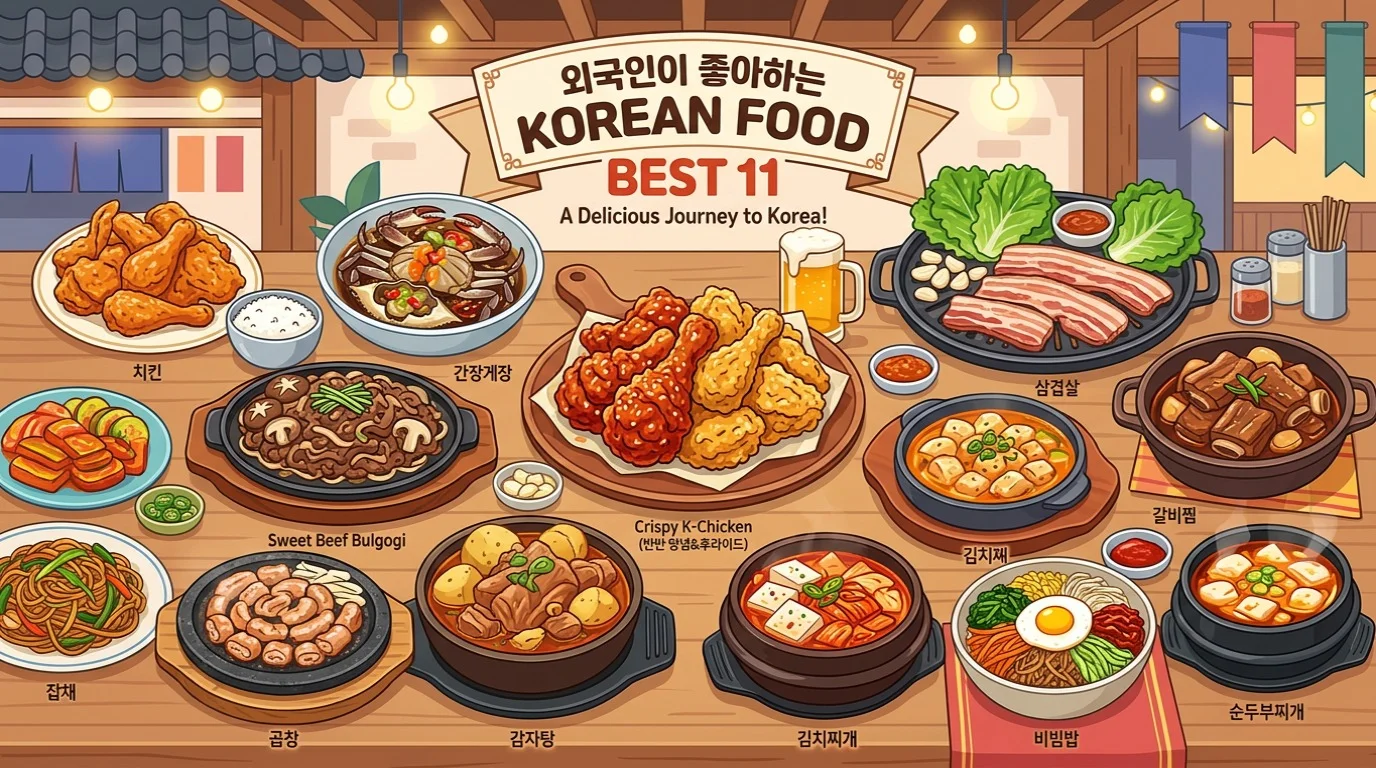
🍗 Korean Foods Foreigners Love — BEST 11
⚠️ Note
The prices, spice levels, vegetarian options, and opening hours here vary by restaurant and branch and by season, and they change often. Popular chicken, crab, gopchang, and gamjatang spots can have long waits in the evening and on weekends, so allow extra time. Dishes with a distinctive aroma and texture, like ganjang-gejang and gopchang, can be hit or miss, so if it's your first time, try a small portion or a single serving. Before visiting, double-check hours, menus, and English support on Naver Map, KakaoMap, or Google Maps, or the restaurant's official channels. All prices are rough references only.
⏱️ 30-Second Summary — Just Remember This!
🍗 K-Chicken → No.1 in tourist bookings; get "half-and-half"
🦀 Ganjang-gejang → Top-rated crab dish on TasteAtlas; a "rice thief"
🥩 Samgyeopsal → Grill it yourself and wrap it in lettuce
🐂 Bulgogi → Mild and sweet; a great first dish
🍖 Galbi-jjim → Fall-off-the-bone ribs; perfect for families
🔥 Gopchang → Chewy K-BBQ favorite on the rise
🍲 Gamjatang → Hot pork-bone soup; pick the meat off the bone
🥘 Kimchi-jjigae → Globally rated; the classic Korean stew
🍜 Sundubu-jjigae → Soft tofu; spice level can be adjusted
🍚 Bibimbap → Often vegetarian-friendly; adjust the gochujang
🍢 Japchae → Mild and chewy; can be made vegetarian
1. 🍗 K-Chicken (Korean Fried Chicken)
The runaway favorite that topped foreign tourists' dining reservations (about 34%). It's crispy outside and juicy inside, and comes in two basics: sweet-and-spicy seasoned (yangnyeom) and plain fried. First-timers can order "half-and-half" (half seasoned, half fried) to try both. Pairing it with cold beer — "chi-maek" — is the Korean way to enjoy it. Delivery is common, so ordering to your accommodation is easy too. Reference price: about 18,000–25,000 won per whole chicken.
2. 🦀 Ganjang-gejang (Soy-Marinated Crab)
Raw crab cured and aged in soy sauce. It earned the top rating in TasteAtlas's crab category and placed 2nd (about 24%) in actual tourist reservations, and its popularity among foreigners has surged recently. The savory, salty flavor makes rice disappear, which is why Koreans call it a "rice thief" (bapdoduk). The raw crab texture may feel unfamiliar, but it has many devoted fans. There's also a spicy version, yangnyeom-gejang. Reference price: about 30,000–50,000 won for a set meal.
3. 🥩 Samgyeopsal (Korean BBQ)
Pork belly you grill yourself on a griddle at the table — Korean-style barbecue. The key is the "ssam": wrapping thick pork belly in lettuce or perilla leaves with a little garlic and ssamjang, eaten in one bite. Many places require a minimum of two servings, and staff sometimes grill the first pieces for you. Plenty of people finish the meal with cold naengmyeon noodles or a doenjang stew. Reference price: about 13,000–19,000 won per serving (roughly 150–200g).
4. 🐂 Bulgogi
Beef marinated in a soy-based sauce, then lightly stir-fried or grilled with a touch of sweetness. It's mild and tender, so it suits people who aren't used to spicy food and families traveling with children especially well. Boneless and easy to eat with little to divide opinion, it's often recommended as a great first dish for Korean food. It goes well with rice or wrapped in lettuce. Reference price: about 12,000–25,000 won per serving.
5. 🍖 Galbi-jjim (Braised Short Ribs)
Beef short ribs braised long in a soy-based sauce until the meat falls tenderly off the bone. It's often ranked among foreigners' preferred Korean dishes in various surveys, and being mild and slightly sweet, it's enjoyed by all ages. It's especially good for families traveling with kids or anyone wary of spice. It also appears often at celebrations and holidays. Reference price: single-serving menus from about 15,000 won, while hot-pot or shared dishes are often 50,000 won or more.
6. 🔥 Gopchang (Grilled Intestines)
Beef or pork intestines grilled on a griddle. Its popularity among foreigners has surged on the K-BBQ wave. It can be hit or miss due to its distinctive aroma and rich fattiness, but grilled well it's savory outside and chewy inside — one bite and many are hooked. It's oily, so it pairs nicely with vegetables and seasoned chives. Gopchang restaurants usually help with the grilling, so it's easy to enjoy. Reference price: about 15,000–22,000 won per serving.
7. 🍲 Gamjatang (Pork-Bone Soup)
A hearty, spicy soup made by simmering pork spine with dried cabbage and perilla seeds. There's a fun ritual of picking the meat off the bones, and the nutty perilla aroma is a signature. There's a single-serving version called "ppyeo-haejangguk" and a "gamjatang" for sharing. Some spots run 24 hours, though more restaurants now keep regular hours. It's savory-spicy but not very hot. Reference price: about 9,000–12,000 won per serving; large (for sharing) around 30,000 won.
8. 🥘 Kimchi-jjigae (Kimchi Stew)
A spicy stew of well-fermented kimchi simmered with pork and tofu — a flagship "soup-and-stew" Korean dish that consistently earns high marks on global food reviews like TasteAtlas. It's the home-style meal Koreans eat most, so you'll find it at almost any restaurant at an easy price. Stirring rice into the broth softens the heat. It's a great entry point for tasting the deep flavor of fermented kimchi. Reference price: about 8,000–11,000 won.
9. 🍜 Sundubu-jjigae (Soft Tofu Stew)
A stew of silky soft tofu in a spicy broth with vegetables, seafood, or meat. It's served bubbling in an earthenware pot, and cracking a raw egg to stir into the broth makes it milder. You can ask for a "milder" spice level, so it's approachable even if you're wary of spicy food. With rice, it makes a filling meal. Reference price: about 8,000–11,000 won.
10. 🍚 Bibimbap
Rice topped with seasoned vegetables, meat, and egg, mixed with gochujang. It's rich in vegetables and popular with vegetarians — it can often be ordered vegetarian, but whether it's fully vegan depends on the broth, gochujang, and vegetable seasonings, so check with the restaurant. If you're worried about spice, ask for the gochujang on the side to control the amount. "Dolsot bibimbap," served in a hot stone bowl, forms a savory crust of scorched rice at the bottom. Reference price: about 9,000–13,000 won.
11. 🍢 Japchae (Glass Noodle Stir-Fry)
Sweet-potato glass noodles stir-fried with vegetables and meat in a soy-based sauce. Mild and slightly sweet, it suits many foreign palates and is a favorite at celebrations. It can be prepared vegetarian at some places, but check the seasonings and cooking process (oyster sauce, stock, etc.) in advance. The chewy noodles are a big draw, and it's easy to enjoy even on a first try. It works as a side dish or as a meal with rice. Reference price: about 8,000–13,000 won.
❓ Frequently Asked Questions (FAQ)
Q. Aren't ganjang-gejang and gopchang too unfamiliar? They can be at first. If you're hesitant, try a small portion or a single serving, or share with your group. Surprisingly, many travelers call these their most memorable meals.
Q. I'm worried about spicy food. Bulgogi, galbi-jjim, and japchae aren't spicy. With bibimbap you can get the gochujang on the side to adjust it. Sundubu-jjigae, kimchi-jjigae, and gamjatang tend to be spicy — you can ask for a "milder" version, but some restaurants can't adjust the heat, so stirring in rice helps soften it.
Q. Are vegetarian (vegan) options possible? Bibimbap and japchae can often be ordered vegetarian, but gochujang, vegetable seasonings, stock, oyster sauce, and the like may contain animal ingredients. Check with the restaurant in advance about whether it's fully vegan.
Q. Can I eat alone? Kimchi-jjigae, sundubu-jjigae, bibimbap, and gamjatang (ppyeo-haejangguk) are great for solo dining. Samgyeopsal, gopchang, and galbi-jjim often require two servings, though solo-friendly spots are growing.
Q. Do I need to tip? Korea has no tipping culture. Just pay the listed price — not leaving a tip is not rude at all.
✅ Quick Checklist
🌶️ Check spice: ask "Is it spicy?" / "Do you have a mild version?" in advance
🍽️ Unfamiliar dishes: try ganjang-gejang and gopchang in small or single servings first
👥 Group size: samgyeopsal, gopchang, and galbi-jjim often need two servings
🥗 Vegetarian: for bibimbap and japchae, confirm options and seasonings with the restaurant
💳 Payment: cards accepted almost everywhere; no tipping needed
⏰ Waits: expect lines at popular spots on evenings and weekends
📱 Map apps: check hours, closing days, and reviews beforehand
🟦 This guide was put together by the JoyStoria team.
📅 Based on: 2026 · ⚠️ Prices, English support, information, and operations may vary by season, restaurant, and branch. JoyStoria does not endorse any specific business. Before visiting or ordering, please confirm the latest information on each restaurant's official channels and map apps. Spice levels, vegetarian options, and allergens (crustaceans, seafood, etc.) mean different things to different people, so if you're sensitive, please check directly with the restaurant before ordering.