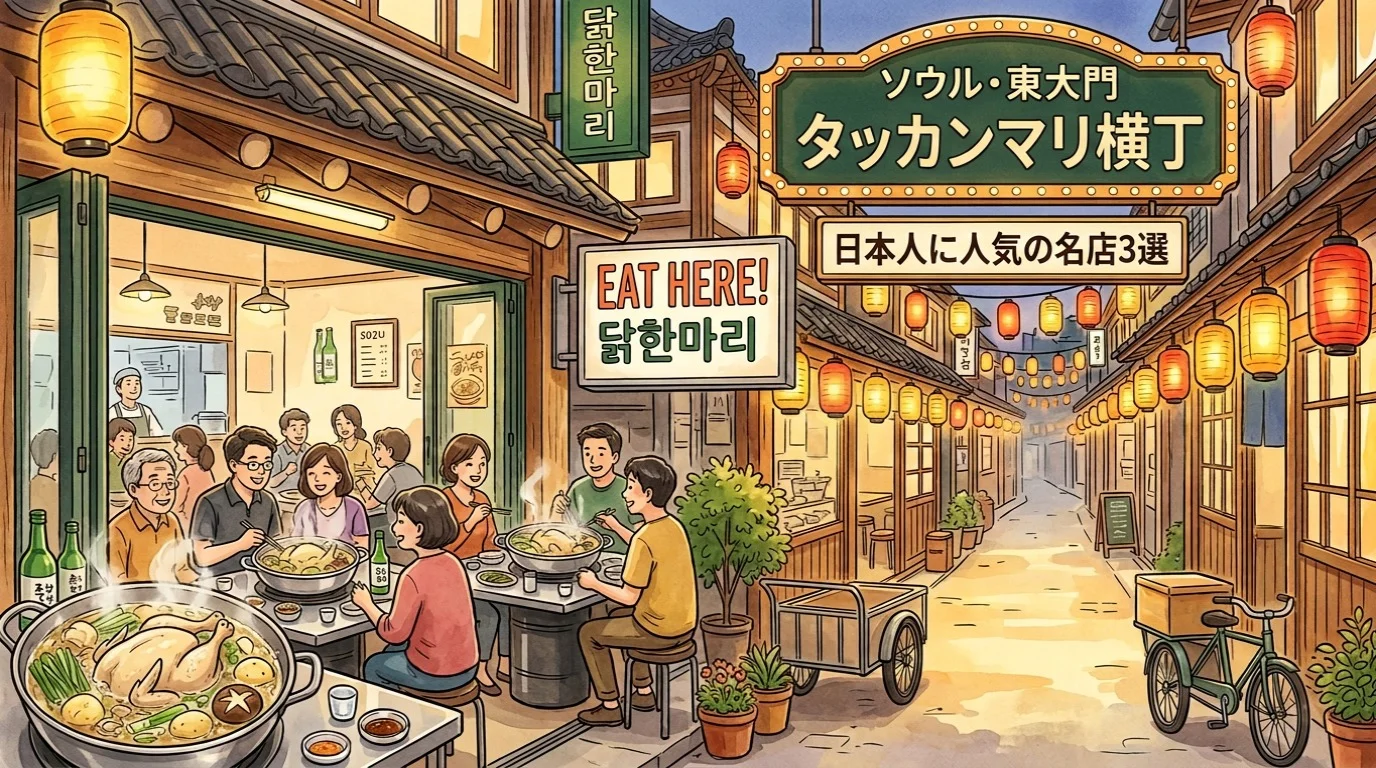
🍲 Dongdaemun Dak-Hanmari Alley in Seoul — A Foreigner's Guide to 3 Beloved Whole-Chicken Hotpot Spots
⚠️ Please Note
Prices, English/Japanese menu availability, hours, and closing days vary by shop and location, and change often. The prices and times here are for reference as of writing and may change, so please confirm the latest details on each shop's official channels or on Naver Map / Google Maps before visiting. In particular, the popular old-school shops in Dongdaemun's Dak-Hanmari Alley can have long waits on weekends and at lunch/dinner rushes. Going a little earlier, or planning around the wait, is a good idea.
⏱️ 30-Second Summary — Just Remember This!
🍲 What it is → A mild Korean hotpot of one cleaned chicken simmered in a pot
🇯🇵 Why Japanese travelers love it → Not spicy; broth resembles mizutaki/nabe
📍 Home base → Dongdaemun "Dak-Hanmari Alley" (near Jongno 5-ga & Dongdaemun Market)
🥢 How to eat → Staff cut the chicken → dip in your own sauce
🍜 Finish → Kalguksu noodles in the leftover broth; porridge/fried rice at shops that offer them
💰 Budget → About ₩30,000+ per chicken (serves ~2 adults) + sides around ₩2,000
🕙 Tip → Waits happen at mealtimes, so go a bit early
1. 🍲 What Is Dak-Hanmari?
True to its name ("one chicken"), dak-hanmari is a Korean hotpot of a single cleaned chicken simmered in a pot with leeks, potato, rice cake, and more. Its hallmark is a plain, mellow broth with no spicy seasoning, so even those who find spicy food hard to handle can enjoy it comfortably. If samgyetang is a rich, single-serving tonic dish made with ginseng and glutinous rice, dak-hanmari is a shared "hotpot" style meal with the pot in the middle — better with two or more than alone. Picture Japan's mizutaki (水炊き) and it clicks quickly. A partly prepared or pre-cooked chicken is brought out in the pot, simmered thoroughly at the table, and eaten; then noodles go into the remaining broth to finish. That said, how each shop preps and cooks the chicken differs a little.
2. 🇯🇵 Why Is It So Popular with Japanese Travelers?
The biggest reason is that it isn't spicy. Many people picture Korean food as red and fiery, but dak-hanmari is the opposite — a clear, gentle broth that's easy even if you're not used to bold seasoning. It also resonates with Japan's love of hot-pot cooking, especially mizutaki, drawing a lot of "familiar yet new" reactions. Another draw is the fun of making your own sauce: mixing soy sauce, vinegar, and mustard to taste is said to appeal especially to Japanese travelers, who come from a rich sauce culture. The sight of staff snipping the chicken with scissors right at the table is striking to visitors, too, and shows up often in travel videos and social media. In recent years, many foreign visitors — Japanese travelers among them — have been coming. Some popular shops get so busy in the evenings or peak seasons that international guests are said to make up more than half the diners, though the actual ratio varies by shop and time of visit. A few well-known shops also stay open until around midnight, making a late dinner after Dongdaemun sightseeing possible (though closing and last-order times differ by shop).
3. 🕰️ A Quick Look at the History
Dak-hanmari is said to have taken root around Dongdaemun Market in the 1960s–1970s. Jin Ok-hwa Halmae Original Dak-Hanmari, one of the alley's landmark old shops today, has been in business since 1978. The dish is believed to have grown out of a quick, hearty meal for Dongdaemun Market merchants, seamstresses, and travelers passing through the nearby bus terminal. There are two stories behind the name: one says busy passersby would call out "one chicken, quick!"; the other says it comes from eating a whole chicken as baeksuk and then boiling noodles in the broth to finish it off "completely." Either way, the rugged old-shop character built up over 40-plus years is itself a draw for travel content these days.
4. 📍 Where Do I Go? — Dongdaemun Dak-Hanmari Alley
If it's your first taste of dak-hanmari, head to the "Dongdaemun Dak-Hanmari Alley" in Jongno-gu, Seoul. It's a narrow lane (around Jongno 40-ga-gil, Jongno-gu) between Jongno 5-ga and Dongdaemun Market where dak-hanmari shops cluster together. The alley sits between Jongno 5-ga Station and Dongdaemun Station, so you can walk from Jongno 5-ga Station (Line 1) Exit 5 or Dongdaemun Station (Lines 1 & 4) Exit 9 — roughly 5–10 minutes depending on where you start. Even within the alley, the broth, seasoning, side options, and atmosphere differ a bit from shop to shop. If a long wait feels like too much, comparing menus and recent reviews and picking another shop is a fine move.
5. 🏠 Three Landmark Shops in the Alley
Jin Ok-hwa Halmae Original Dak-Hanmari — The alley's most renowned "original" old shop. Address: 18 Jongno 40-ga-gil, Jongno-gu, Seoul. Official tourism info lists it as open daily 10:30–01:00 (next day), last order 23:30, open year-round (this can change on holidays or at the shop's discretion, so re-check on the day). A whole chicken is about ₩33,000, with various sides around ₩2,000. When you sit, a pot with the chicken is set up and staff cut the meat for you. As one of the most famous shops in the alley, it can have long waits at mealtimes. There's no dedicated parking, so public transit is recommended.
Myeongdong Dak-Hanmari (labeled "Myeongdong branch" on the official site) — A popular spot in the same alley (14 Jongno 40-ga-gil), loved for its clean, mellow broth. Its eomnamu (castor aralia) dak-hanmari is about ₩33,000, with sides around ₩2,000, and it also offers glutinous-rice porridge and fried rice. Hours are listed as roughly 10:00–00:30 on map apps, but please re-check with the shop before visiting. This one, too, draws many foreign guests, Japanese travelers included.
Wonjo-won Halmae Dak-Hanmari — A third-generation original old shop at 25 Jongno 40-ga-gil. Known for a rich broth and generous portions, it's become familiar through the film "The Himalayas" (used as a filming location) and TV programs like "Baek Jong-won's Top 3 Chef King" and "Delicious Guys." A whole chicken is ₩33,000, with 2/3/4-person sets (about ₩37,000–69,000). Hours are generally listed as 11:00–23:00, but closing times may differ by day of week, so check before you go. (For all three, prices, hours, and closing days can change — please confirm before visiting.)
6. 🥢 How to Order — Just This Much
There's little to agonize over. Most shops center on a single item — dak-hanmari — so you just decide how many chickens to order for your group. Two adults often share one chicken plus a side or so, but it depends on the chicken's size and your appetite; if it's not enough, add sides or another chicken. When you sit, the pot with the chicken goes on the burner, and once it's simmered a bit, staff cut the chicken into bite-size pieces with scissors. From there, add sides like rice cake, potato, or mushroom to taste. Gestures and the menu are usually enough to order, so no need to be nervous. Note that a whole chicken now runs in the ₩30,000s (about ₩33,000), so budget a little generously.
7. 🧂 How to Make the Dipping Sauce (The Key Part!)
The real fun of dak-hanmari is making "your own sauce." The table usually has soy sauce, vinegar, mustard, plus a spicy dadaegi (chili-pepper paste) and chives. You mix these to taste — there's no single right answer. Start with a generous pour of soy sauce, add a little vinegar, then just a small amount of mustard and dadaegi (for example, 2–3 spoons of soy sauce to 1 spoon of vinegar, with mustard and dadaegi added a chopstick-tip at a time). Taste, then add more bit by bit — that's the safe way. If minced garlic is on the table, a little in the sauce or the broth is nice too. Dip the boiled chicken into this sauce and the mellow meat suddenly comes alive with savory flavor.
8. 🍜 The Eating Order — Broth → Chicken → Kalguksu, Porridge Varies by Shop
Dak-hanmari is a course with an order — but first, one must-remember point. ① Only eat once the pot has simmered enough and the staff say it's ready. If the chicken is red or cold inside, cook it more. ② Dip the well-cooked chicken in your sauce, and enjoy the hot broth alongside. ③ Potato takes time to cook, so add it early; rice cake can cook fast, so follow the staff's cue (at some shops, rice cake and potato are already in the pot from the start). ④ Once you've eaten some chicken and the broth has deepened, add kalguksu noodles and let them cook — the highlight for many. Noodles soak up a lot of broth, so don't add too much at once; order based on your group size and how much broth is left. ⑤ At shops that sell porridge or fried rice, you can round things off once more with the leftover broth — but not every shop offers it, so check the menu. It's a hearty, warming meal that leaves you full yet reaching for your chopsticks.
9. 💡 Good-to-Know Tips & Etiquette
Popular old shops can have long waits on weekends and at lunch/dinner rushes. Weekdays or off-peak times can be relatively easy, and since turnover is quick, even a long line often moves faster than expected. Tables are close together and it gets crowded, so keep large bags to a minimum. The broth is hot, so be careful at first, and add sides in batches rather than all at once so they don't get soggy. Major shops generally accept cards, but approval for foreign-issued cards and support for mobile payments can vary, so having a little cash on hand helps. Side dishes (kimchi, fresh salad, etc.), water, and garlic are usually provided by default.
❓ FAQ for Foreign Visitors
Q. Is it spicy? No. The base broth isn't spicy at all — very mild. Spiciness is adjusted only by how much dadaegi you add, so it's perfect if you find spicy food difficult.
Q. Can I go alone? Some places allow solo diners, but since the base order is often a whole chicken, the portion and cost can be a lot for one. If dining alone, check first whether solo entry is allowed and what the minimum order is.
Q. Are there English or Japanese menus? Many popular shops that draw foreign guests have English/Japanese or photo menus. It varies by shop, though, so pointing at photos works well too.
Q. Do I have to make the sauce? Yes, it's recommended. Boiled chicken is mild, so dipping it in a soy–vinegar–mustard sauce with dadaegi makes it much tastier. If it feels tricky, feel free to ask the staff for help.
Q. Can I make a reservation? Most rely on walk-in waiting rather than reservations. Popular times have queues, so allow extra time.
Q. About how much does it cost? A whole chicken is roughly in the ₩30,000s (usually for two), with sides around ₩2,000. Prices can change, so treat this as a reference.
✅ Quick Checklist
📍 Did you check your route from Jongno 5-ga Station Exit 5 or Dongdaemun Station Exit 9?
👥 Did you set the number of chickens for your group? (2 adults ≈ 1 chicken + a side)
🕙 Are you going a bit early to allow for mealtime waits?
🧂 Ready to make your sauce with soy sauce, vinegar, mustard, and dadaegi?
🍜 Did you save room for kalguksu? (Check the menu for porridge/fried rice)
🌾 If you have allergies, did you confirm sauce/side ingredients with the shop?
💳 Did you bring a payment method (card / a little cash)?
🟦 A guide put together by the JoyStoria team.
📅 As of: 2026 · ⚠️ Prices, English/Japanese support, information, and hours may vary by season, business, and branch.
JoyStoria does not endorse any specific business; please confirm the latest details on each shop's official channels and map apps before visiting or booking. Beyond the chicken, the dipping sauce contains soy sauce, mustard, chili powder, and more, and kalguksu and rice cake may contain allergens such as wheat and buckwheat — if you have allergies, check the ingredients before ordering. (Handy Korean phrases: "알레르기가 있어요" = I have allergies; "겨자 빼 주세요" = Please leave out the mustard; "맵지 않게 해 주세요" = Please make it not spicy.)