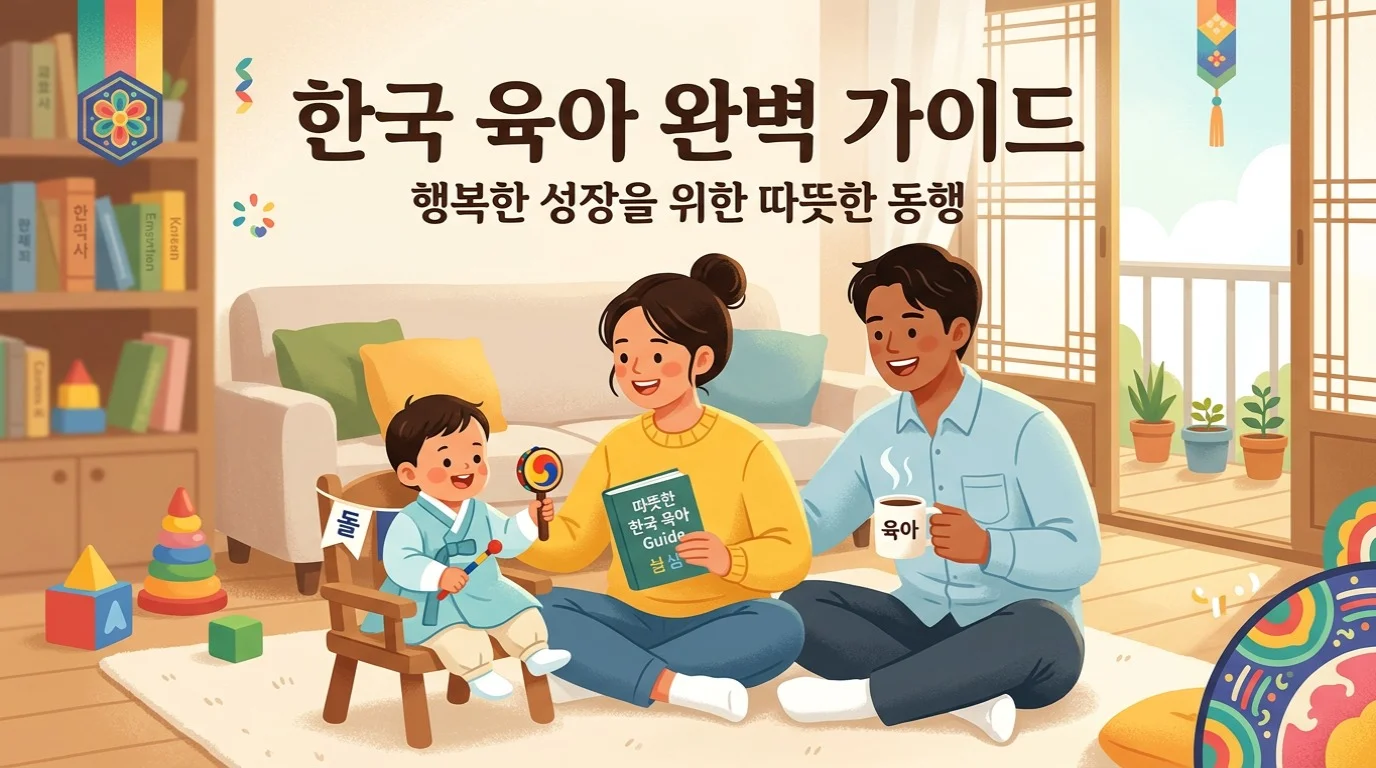
👶 Korean Parenting Culture for Foreigners — Sanhujori to Doljanchi
⚠️ Please Note
The costs, benefits, systems, and procedures in this guide vary by region, timing, family, and institution, and they change often. Postpartum center fees, government cash support like parental benefit and the first-meeting voucher, postpartum helper vouchers, and daycare admission rules are revised year to year — so before using or applying for anything, always confirm the latest details through your local public health center, community service center (jumin-center), the relevant institution, or government portals (Gov24, Bokjiro, the integrated early-childhood portal). The benefit amounts below are as of 2026 and may change. This is a general cultural overview, does not endorse any specific business or institution, and there's no single "right" way to parent — read the below as "what you'll commonly see in Korea." For anything health-related, please consult a medical professional.
⏱️ 30-Second Summary — Just Remember These!
🍲 Sanhujori → Korean-style postpartum recovery care for new moms
🏨 Care center → New mom & newborn stay ~2 weeks (costs vary widely)
🤱 Postpartum helper → Gov't voucher for home care; foreign families may qualify by registration, visa & income
🌊 Seaweed soup → Eaten by new moms & on birthdays; a food of deep cultural meaning
👕 Baby gear → Traditional items + very active online "mom-cafe" culture
🎉 100 days & 1st b-day → Big celebrations; Doljabi predicts the future
💵 Support → Parental benefit, first-meeting voucher, child allowance (2026: under age 9, ₩100k–130k/mo)
👵 Grandparent care → Grandparents often help raise grandkids
🏫 Daycare → Widely used by dual-income families
1. 🍲 Sanhujori — Korea's Postpartum Recovery Culture
The first concept to know is Sanhujori (産後調理) — the cultural practice of managing a new mom's rest, meals, and living environment so she can recover after birth. Traditionally the first 21 days (Samchilil) were considered especially important, but the actual recovery period and methods vary with the delivery and the mother's health. Koreans take this recovery seriously; there's even a saying that "poor postpartum care haunts you for life."
🌡️ Stay warm: Avoiding cold is emphasized — cold water, cold food, and drafts are avoided, and many moms won't sit directly under air conditioning even in summer. (Modern medicine doesn't consider every custom essential, but it's widely followed culturally.)
🛌 Full rest: Heavy chores and overexertion are avoided so mom can focus on recovery and feeding, with family helping out.
🍜 Samchilil (the first 21 days): The first 21 days (3×7) after birth are treated as a special recovery-and-protection period. In the past, a "geumjul" straw rope was hung on the gate to discourage visitors and shield mom and baby from infection and fatigue.
🙏 Samshin Grandmother: Traditionally the household spirit believed to grant, deliver, and protect babies. Families once set a small table of seaweed soup, rice, and fresh water to pray for the baby's health and long life. Few young families do this literally today, but the phrase "a child sent by Samshin Grandmother" lives on.
😊 Baenetjit: The way newborns smile in their sleep is fondly called baenetjit — said to be Samshin Grandmother "teaching the baby how to smile."
2. 🏨 Postpartum Care Centers — A Facility Especially Popular in Korea
A facility foreigners find especially interesting is the postpartum care center (sanhujoriwon) — where mom and newborn stay together, usually for about two weeks, receiving professional care. Mom focuses on recovery while nursing staff help look after the baby, and many centers offer massage, feeding education, sitz baths, and postpartum yoga. This culture is very widespread in Korea, though similar postpartum care and nursing facilities also exist in places like Taiwan.
💰 Cost: Centers are usually contracted in two-week blocks, and prices vary widely by region, room type, number of newborns, and add-ons like massage. Even a standard room can run into the millions of won, and some premium facilities cost far more; the eye-popping figures in the news are a tiny minority of premium suites, not a typical benchmark. Before signing, always confirm the total price, extra fees, the refund policy, and exactly which services are included.
🏥 Public vs. private: Some local governments run relatively affordable public postpartum centers — check your district health center or city website.
👭 "Joriwon buddies": Moms who stay at the same center at the same time often become friends — called joriwon donggi — and stay a trusted circle for sharing parenting tips as the kids grow. It's Korean parenting's first "community."
🌐 For foreigners: Some centers offer English or other language support, but not all. Confirm interpretation, contracts, and medical coordination before booking.
3. 🤱 Postpartum Helpers & Government Support — Care at Home
Instead of (or after) a care center, many families get help at home from a postpartum helper. The maternal & newborn health manager helps with the mom's meal prep and recovery, the newborn's bath, feeding, and hygiene, and laundry for mom and baby. Note that meals, laundry, or care for other family members, or general cleaning of the whole home, may not be part of the standard service (they can be paid add-ons).
🏛️ Maternal & Newborn Health Support Program (the government-subsidized "postpartum helper"): subsidizes part of the helper cost via voucher. A health manager visits to provide standard services — the mom's exercises and recovery care, and the newborn's hygiene, bath, and feeding support.
🌏 Foreign families may qualify, with conditions: The program covers birth families with resident or foreigner registration in Korea. However, if both parents are foreign nationals, both must hold one of the F-2 (residence), F-5 (permanent residence), or F-6 (marriage migrant) statuses. It generally targets households at or below 150% of median income; check your district health center for income criteria and any local exceptions.
📝 When to apply: Generally from 40 days before the due date to 60 days after birth, through your district health center or Bokjiro. Voucher validity and days of service vary by region and tier, so check in advance.
💡 Tip: Popular slots book up fast, so it's smart to look into it in late pregnancy.
4. 🌊 Seaweed Soup (Miyeok-guk) — Food for Moms and Birthdays
In Korea, there's a culture of making seaweed soup (miyeok-guk) for a new mom after birth. Seaweed contains iodine and other nutrients, but rather than eating only seaweed soup over and over, a balanced diet of protein, vegetables, and grains matters. Because too little or too much iodine can be a problem, anyone with a thyroid condition or special dietary needs should consult a doctor. Still, seaweed soup carries deep cultural meaning as a food long associated with new mothers.
🎂 Birthdays too: That's why Koreans eat seaweed soup on the morning of their birthday — a warm nod to "remembering the mother who gave birth to me." If your Korean friend eats it on their birthday, now you know why.
📌 A fun superstition: Some avoid seaweed soup before an exam because the slippery seaweed evokes "slipping up" (failing). It's more playful than seriously believed.
🥣 Many versions: It's made with beef, flatfish, mussels, abalone, and more; the version for new moms is often kept light.
5. 👕 Korean Baby-Gear Culture — From Traditional to Practical
Korea has traditional baby items you won't see elsewhere, famously practical parenting products, and a very active online information culture.
👶 Baenet-jeogori: A soft jeogori traditionally put on a just-born baby — protecting delicate skin and, by old custom, carrying a wish for a long life.
🎀 Dol hanbok & dol-tti: For the first birthday, babies wear a colorful saekdong hanbok, sometimes with a long dol-tti sash symbolizing longevity. Colors and details differ slightly for boys and girls.
🧧 Geumjul: Traditionally a straw rope hung on the gate to announce a birth and keep visitors away. Depending on the region and household, red peppers and charcoal for a boy, or pine branches and charcoal for a girl, were tucked into it. Rare today, but a lasting cultural symbol.
👝 Podaegi & baby carriers: Korea long had a podaegi (back-wrap) tradition. Modern carriers and hip seats are common now, but grandparents still wrap and carry babies to sleep.
🍚 Baby-food culture: Great care goes into baby food, split into early, middle, late, and finishing stages with ingredients and textures adjusted carefully. Some families cook it themselves; others use specialized delivery services.
💬 Mom-cafes & group buys: Korea's online parenting communities ("mom-cafes") and group-buying culture are extremely active — parents swap product reviews, hospital info, secondhand deals, and tips in real time, so trends spread fast. Useful for foreign parents too, but double-check accuracy yourself.
6. 🎉 Baek-il & Doljanchi — Big Celebrations of a Baby's Growth
Korea celebrates a baby's milestones as a family, most notably at 100 days and the first birthday.
💯 Baek-il (100 days): A celebration of the baby's 100th day. In an era of higher infant mortality, surviving 100 days was a real milestone worth celebrating. The baek-il table features white baekseolgi rice cake (symbolizing purity), susu-patteok (red-bean cake said to ward off bad luck), seaweed soup, and fruit — and sharing rice cake with 100 people is said to bring the baby health and long life.
🎂 Doljanchi (first birthday): A big celebration of the first birthday, with family and friends invited to share a meal and photos of the baby in hanbok. Today many rent a buffet or dedicated dol venue, or keep it small with just family. The dol table holds rice cakes, fruit, and the Doljabi objects.
🔮 Doljabi: The highlight. Objects are placed before the baby, and whatever they grab is said to hint at their future:
✏️ Pencil/brush → scholar, good at studying
💰 Money/rice → wealth
🧵 Thread → long life
🩺 Stethoscope → doctor
⚖️ Gavel → legal profession
🎤 Microphone → entertainer, 🖱️ Mouse → developer/IT (modern additions)
🧧 Gift customs: Guests typically bring congratulatory money or a gold ring (dol-banji). Of course, Doljabi is a fun family event, not a serious prophecy.
7. 💵 Key Government Birth & Parenting Support (as of 2026)
To address low birth rates, Korea offers various cash and voucher support to families. Amounts and rules change yearly, and eligibility for foreigners depends on visa and residency, so the below is a 2026 reference — always confirm your own eligibility via Bokjiro, Gov24, or your community center.
🎁 First-meeting voucher (Cheotmannam): A one-time birth voucher — as of 2026, ₩2 million for a first child and ₩3 million for a second or later. Usable at most types of merchants.
👶 Parental benefit (Bumo-geup-yeo): If you care for the child at home, you receive ₩1 million/month for age 0 (0–11 months) and ₩500,000/month for age 1 (12–23 months) in cash. If you use daycare or a full-time childcare service, it's paid instead as a childcare voucher or childcare-service subsidy, and depending on age and type of use a cash difference may still be paid.
🧒 Child allowance (Adong-sudang): As of 2026, paid to children under age 9. The amount is ₩100,000–130,000/month depending on your region and payment method (the greater-metro area is a base ₩100,000; non-metro and population-declining areas may receive extra), and payment can be suspended if the child stays abroad for 90+ days, for example.
🩺 Other key support: national health-insurance pregnancy/childbirth expense vouchers, home-care allowance after 24 months, childcare and Nuri-curriculum support for ages 0–5, the idolbom childcare service, infant health checkups and national immunizations, parental leave and spousal maternity leave, and more. Criteria and amounts differ by program — check Bokjiro and Gov24.
🏙️ Local add-ons: Birth grants and postpartum-cost support vary by district — be sure to check your local government's policy.
8. 👵 Grandparent Care & 🏫 Daycare — Who Looks After the Child
With many dual-income households, who cares for the child during the day is a real question in Korea — split mainly between grandparents and daycare/kindergarten.
👵 Grandparent care ("twilight parenting"): Grandparents often care for grandkids while parents work — trusted family care with the bonus of cross-generational bonding. Many families give the grandparents some money in thanks, and some districts offer a "grandchild-care allowance." Generational differences over parenting style can arise, so mutual respect matters.
🍼 Daycare (eorinijip, ages ~0–5): Full-day care for younger children. Types range from national/public to private and home daycare; popular public ones can have long waitlists.
🎨 Kindergarten (yuchiwon, ages 3–5): More education-focused, before elementary school.
🖥️ Admissions: You can check daycare and kindergarten information and apply for admission through the integrated early-childhood portal (Yubo Tonghap). Daycare uses a rolling waitlist, while kindergartens have their own recruitment schedules and selection methods, so check ahead.
🧸 Idolbom childcare service: A government-supported visiting/hourly care service for when you suddenly need care.
🌏 For foreign parents: Procedures and documents differ by institution and region — check whether English support is available, what documents you need, and how waitlists work. Your community center or a childcare support center can help.
9. 💡 Tips & Etiquette for Foreign Parents
🗣️ Language: English support varies by hospital, center, and daycare. Keep a translation app handy and request interpretation for important consultations in advance.
🏛️ Claim your benefits: Much support must be applied for. Around the birth, map out what you're eligible for via Bokjiro, Gov24, or your community center.
🤗 Respect the culture: When elders say "keep the baby warm" or "don't eat cold things," it's usually affection. If it feels like too much, gently explain your own approach.
👐 Attention to babies: In Korea even strangers often show warm, friendly interest in babies. It's usually pure goodwill, so don't be startled.
🏥 Health first: Traditional customs and modern medicine can differ on recovery, feeding, and baby health. For anything requiring medical judgment, consult a professional.
❓ FAQ from Foreigners
Q. Do I have to use a postpartum care center? A. No — it's a choice. Many families recover at home with a postpartum helper. Pick what fits your budget and situation.
Q. Can foreigners use care centers and postpartum helpers? A. Yes. Care centers are open to you (confirm language support), and the government-subsidized helper program can cover birth families with resident or foreigner registration in Korea. Note that if both parents are foreign nationals, both must hold F-2, F-5, or F-6 status, and income criteria apply — check via your health center or Bokjiro.
Q. Can foreign parents receive birth/parenting support? A. It depends on the program. It's not just the parents' nationality — programs also look at the child's Korean nationality and resident-registration number, and the parents' foreigner registration and residency status. Foreign parents raising a child with Korean nationality qualify for many programs, while support for a foreign-national child may be limited or subject to special conditions. After birth registration, confirm each program's eligibility at your community center.
Q. Does the object my baby grabs at Doljabi really decide their future? A. No — it's a fun family tradition, not a real prophecy. Just enjoy it.
Q. Why eat seaweed soup on birthdays? A. It carries over from new moms eating it after birth, with the warm meaning of "remembering the mother who gave birth to me."
Q. Which is bigger — 100 days or the first birthday? A. Usually the Doljanchi (first birthday). Baek-il is often small and family-only, while the first birthday may include guests — but it varies by family.
Q. Are grandparents really a common childcare option? A. Quite common. With many dual-income families, grandparents often help — though daycare and idolbom services are also popular options.
Q. Is cold water really off-limits during Sanhujori? A. Traditionally, yes. But modern medicine doesn't consider every custom essential, so choose based on your own health in consultation with a doctor.
✅ Quick Checklist
🍲 Decided your recovery route (care center vs. home helper vs. home care)?
💰 Confirmed center cost, room type, and language support by direct inquiry?
🤱 Checked the timing/eligibility for the government postpartum-helper program?
💵 Checked which benefits you qualify for (first-meeting voucher, parental benefit, child allowance)?
🎉 Planned the Baek-il / Doljanchi date and format (home, buffet, venue)?
🏫 Checked daycare/kindergarten admission steps on the integrated early-childhood portal, and documents?
🗣️ Requested language/interpretation support at hospitals and institutions?
🏥 Agreed to consult a doctor when tradition and medical advice seem to conflict?
🟦 A guide put together by the JoyStoria team.
📅 As of 2026 · ⚠️ Costs, benefits, systems, and procedures may differ by season, region, institution, and family.
JoyStoria does not endorse any specific business or institution; before using or applying for a service, always confirm the latest details through each institution's official channels and government portals (Gov24, Bokjiro, the integrated early-childhood portal). There's no single right way to recover or parent, and health varies from person to person, so please consult a medical professional for anything requiring medical judgment.