🪷 Jogyesa Temple Guide — Seoul's Temple Among Skyscrapers, Made Easy
⚠️ Please note The temple grounds are open around the clock and free of charge, but access to the main hall and other buildings, festival periods and Templestay fees all change with services, the temple's schedule and the season. During major ceremonies and holidays (Seollal, Chuseok, Buddha's Birthday) the temple gets extremely crowded and some areas may be closed off. Check the official website (jogyesa.kr) and a map app before you go. Figures and details in this guide are for reference and may change.
⏱️ 30-Second Summary — Just Remember This
🏯 What → Head temple of the Jogye Order of Korean Buddhism, the landmark temple of downtown Seoul
📍 Where → 55 Ujeongguk-ro, Jongno-gu, Seoul, about 5–7 minutes on foot from Jonggak Station
🎫 Admission → Free, no reservation needed
🕐 Hours → Grounds open 24 hours; access to halls and facilities depends on services and the temple schedule
🌳 Highlights → Three Buddhas in the main hall, the Natural Monument white pine, a 450+ year-old pagoda tree, the octagonal 10-story relic pagoda
🪷 Summer 2026 → Lotus Festival themed "Lotus, Bringing Peace of Mind", running until mid-September
🏮 Spring → Lanterns around Buddha's Birthday and Yeondeunghoe, a UNESCO Intangible Cultural Heritage
🌙 Night → Grounds open at night; lanterns and special lighting depend on the season and events
🙏 Manners → Shoes off and quiet inside the halls, use the side doors, no photos, flash or close-ups of worshippers during services
1. 🏙️ Why Is There a Temple in the Middle of Downtown?
Most of Korea's famous temples are in the mountains. During the Joseon Dynasty (1392–1910), Buddhism was greatly suppressed under Confucian state policy, and for a long time monks were even barred from entering the capital. That is why simply having a temple inside Seoul's old city walls is historically remarkable.
When those restrictions were lifted in the modern era, monks came together in 1910 to build a temple called Gakhwangsa inside the four main gates. That is where today's Jogyesa began.
In 1937 work began on moving to the present site, and the Sibiljeon, a building belonging to the Bocheongyo religious movement in Jeongeup, North Jeolla Province, was relocated to complete today's main hall (Daeungjeon) in 1938.
The temple then went by the name Taegosa, and through the Buddhist Purification Movement that began in 1954 and the launch of the unified Jogye Order in 1962, today's "Jogyesa" and its role as head temple took shape.
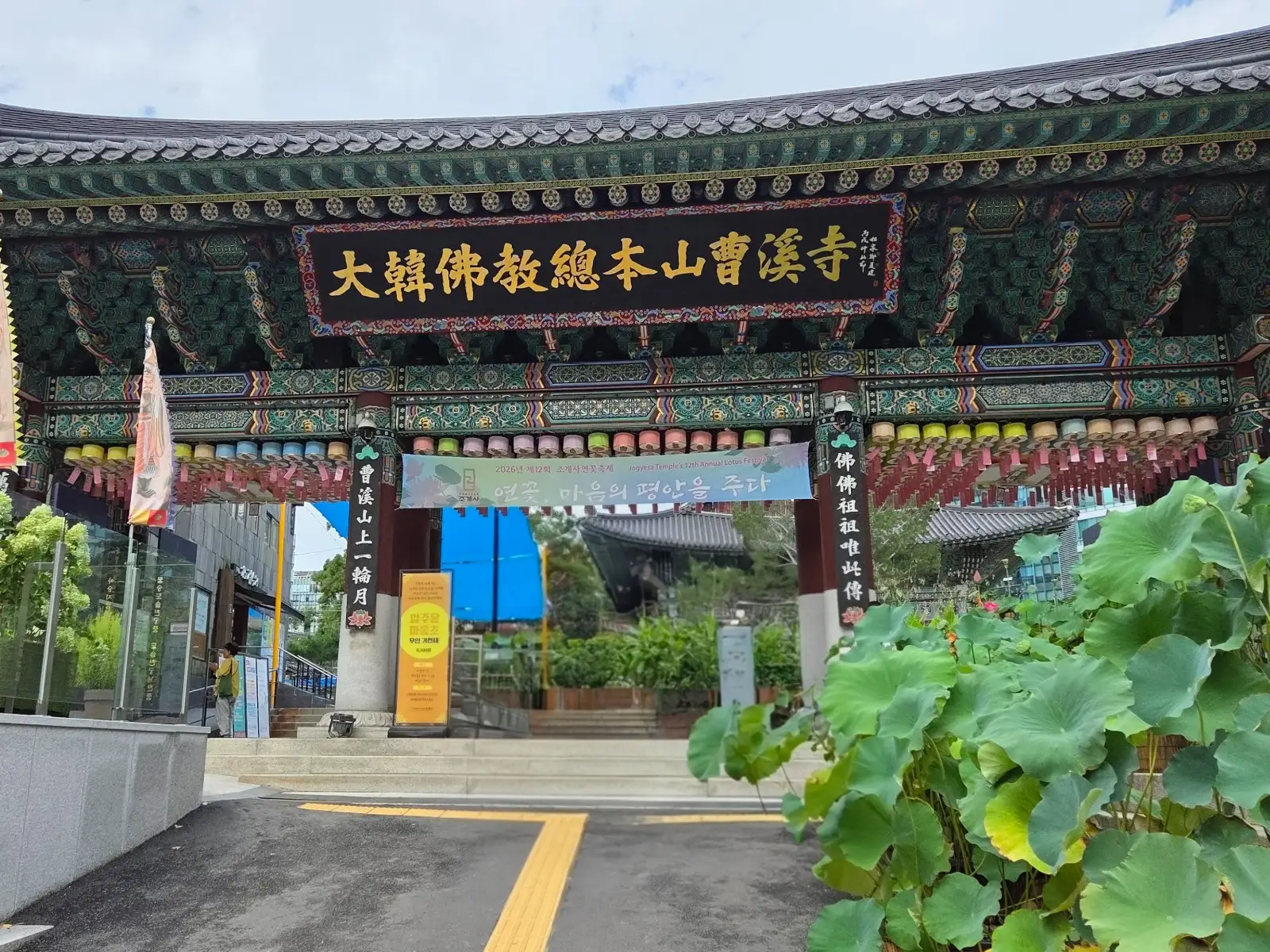
It is now the head temple (headquarters) of the Jogye Order of Korean Buddhism, the country's largest Buddhist order. The Chinese characters on the gate's signboard, 大韓佛敎總本山曹溪寺, mean exactly that.
So Jogyesa is less a "quiet mountain temple" than a "living center of religion". Monks come and go, worshippers pray and events run all year, so you feel the atmosphere of a working temple.
2. 🚇 Getting There and Admission
About 5–7 minutes on foot from Exit 2 of Jonggak Station (Line 1) or Exit 6 of Anguk Station (Line 3). It's also a short walk from the southern end of Insadong.
Address: 55 Ujeongguk-ro, Jongno-gu, Seoul. Search "Jogyesa Temple" in your map app.
Admission is free and no reservation is needed. The grounds are open 24 hours, but access to individual halls such as the main hall depends on services and the temple schedule, so check official channels.
Restrooms, bilingual (Korean/English) signs and shaded rest areas make it comfortable even in summer.
A walking route of Gyeongbokgung → Insadong → Jogyesa → Jonggak (Cheonggyecheon) flows naturally.
3. 🏯 Daeungjeon — A Giant Hall Against a Backdrop of Towers
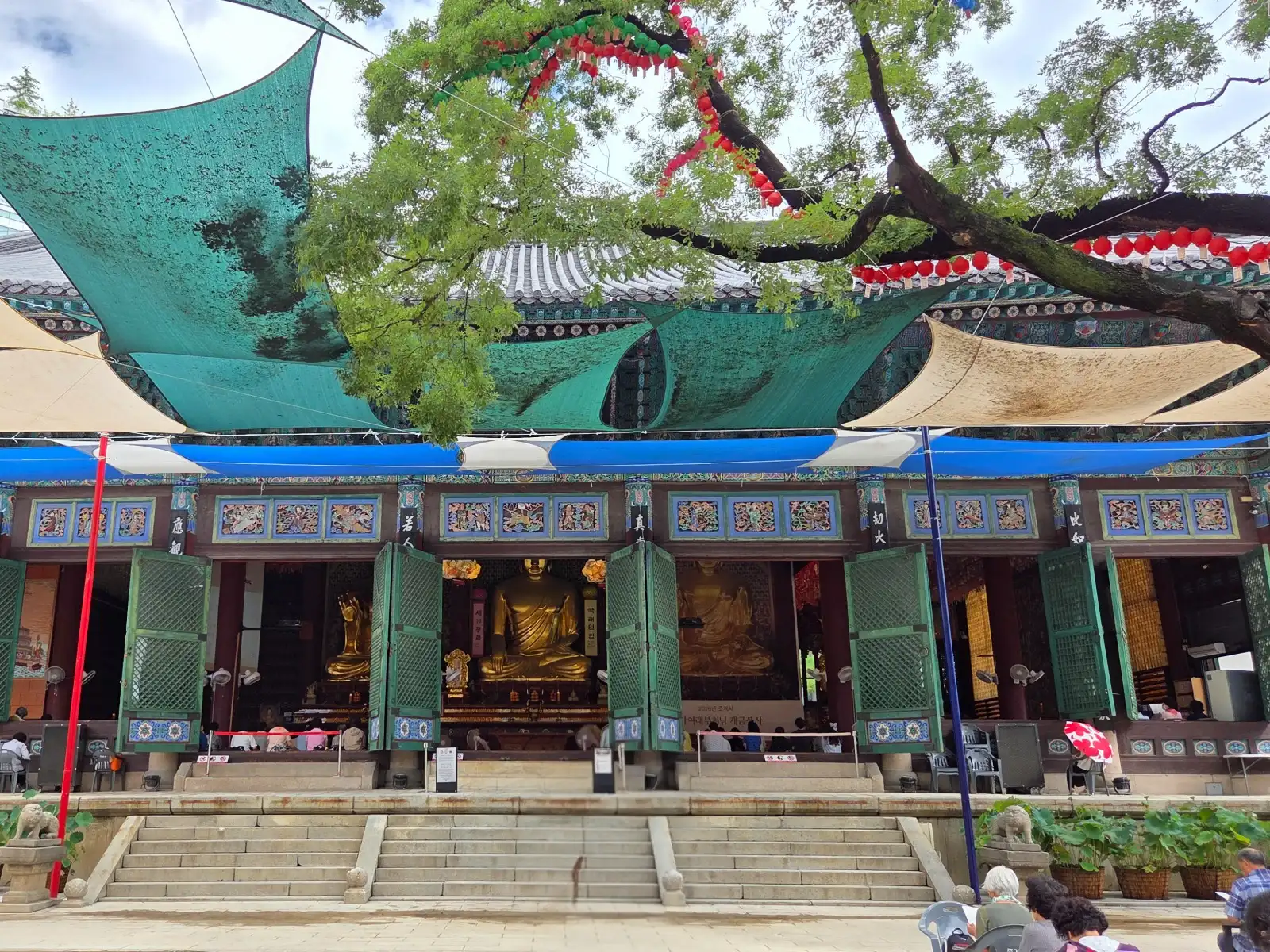
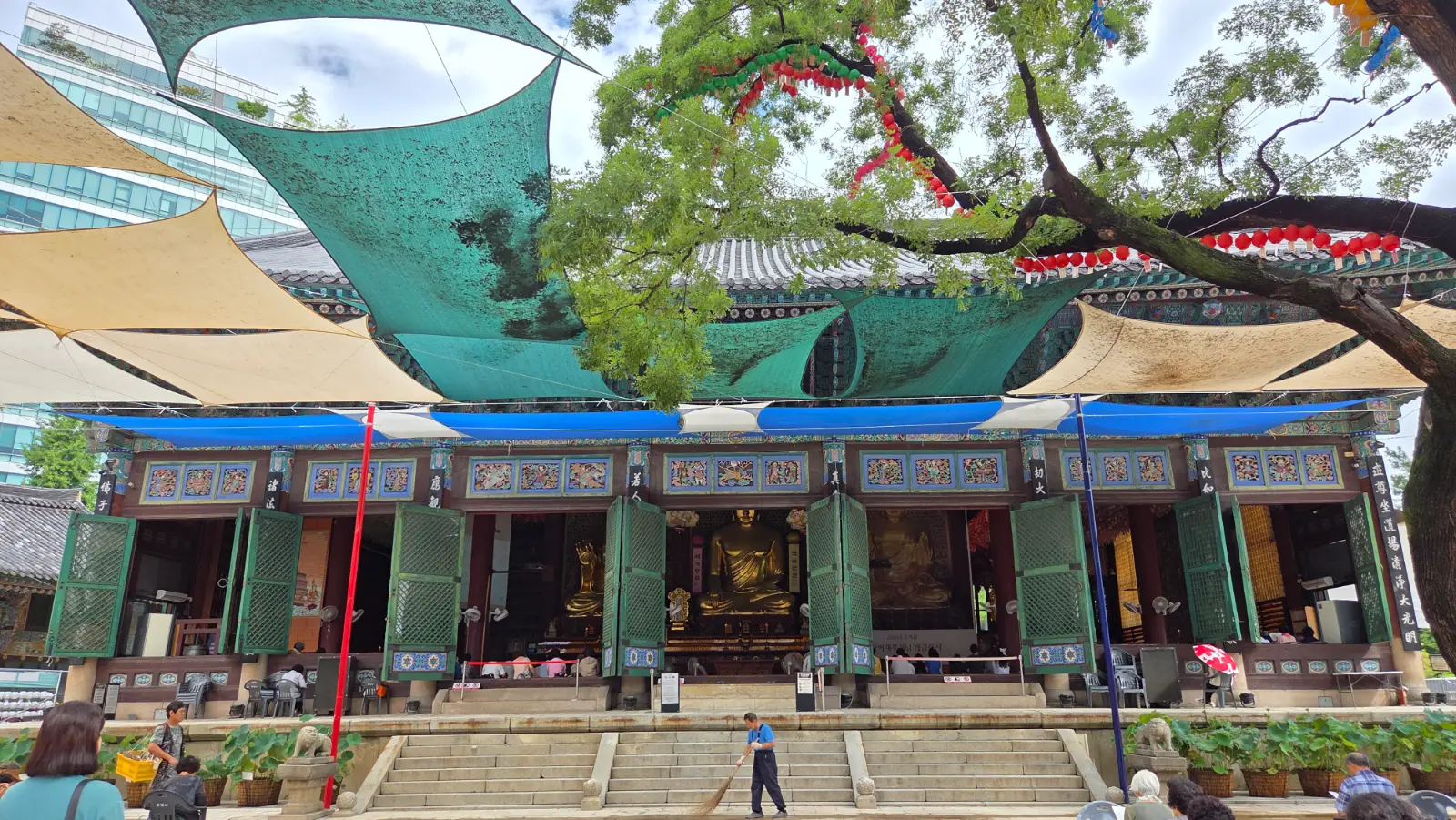
The first thing you notice on entering is the large building, Daeungjeon, the main hall. "Daeung" means "Great Hero", a title for Shakyamuni Buddha.
Seven bays wide, it's an imposing building designated a Seoul Tangible Cultural Heritage. It has an unusual history: the Sibiljeon, a building erected in the 1920s in Jeongeup, North Jeolla Province, by the Bocheongyo movement, was dismantled, moved to Seoul and rebuilt as Jogyesa's main hall.
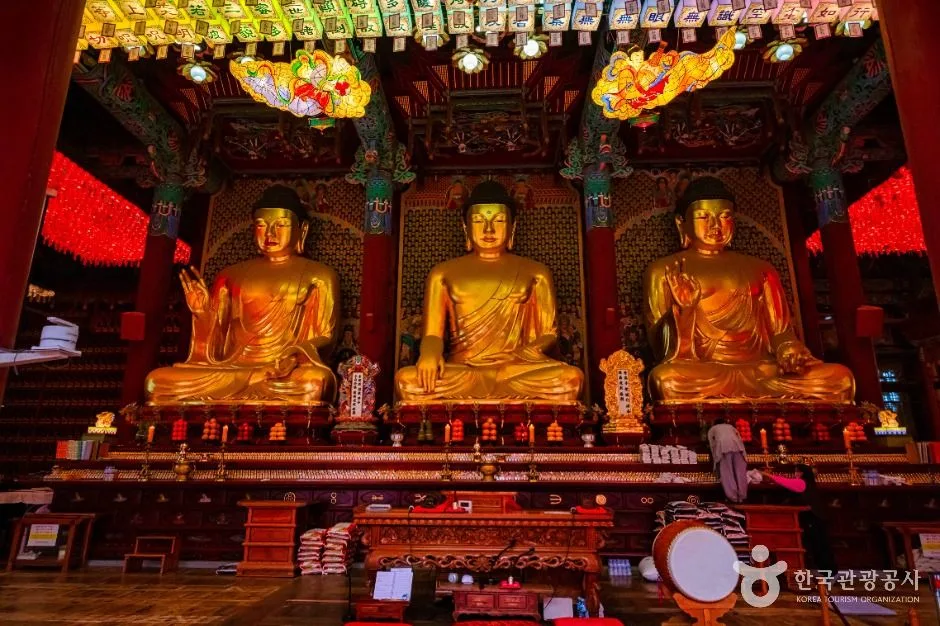
Inside are three huge Buddha statues enshrined in 2006. Shakyamuni Buddha sits in the center, with the Medicine Buddha (Bhaisajyaguru) on the left and Amitabha Buddha on the right. In seasons when the doors are wide open, you can see the golden triad from outside.
Separately, Jogyesa also holds the "Wooden Seated Buddha of Jogyesa, Seoul", believed to date from the 15th century (Joseon Dynasty). Originally at Dogapsa Temple in Yeongam, South Jeolla Province, it was moved to Jogyesa in 1938, is still enshrined inside the main hall, and was designated a Treasure in 2022. It's a different statue from the triad enshrined in 2006, so don't mix them up.
Look closely at the doors. The lattice is carved and painted with flower patterns, and it's the detail foreign visitors photograph most.
In front of the hall stands the octagonal 10-story pagoda holding relics of the Buddha (sarira). You'll see worshippers walking around it in prayer.
You may enter the hall quietly with your shoes off. Don't cross in front of people who are praying, and check the signs on site before taking photos inside.
4. 🌳 Trees Over 450 Years Old — The White Pine and the Pagoda Tree
Meeting these trees between office buildings makes you realize how old this site is. Both were standing here long before Jogyesa settled on this spot.
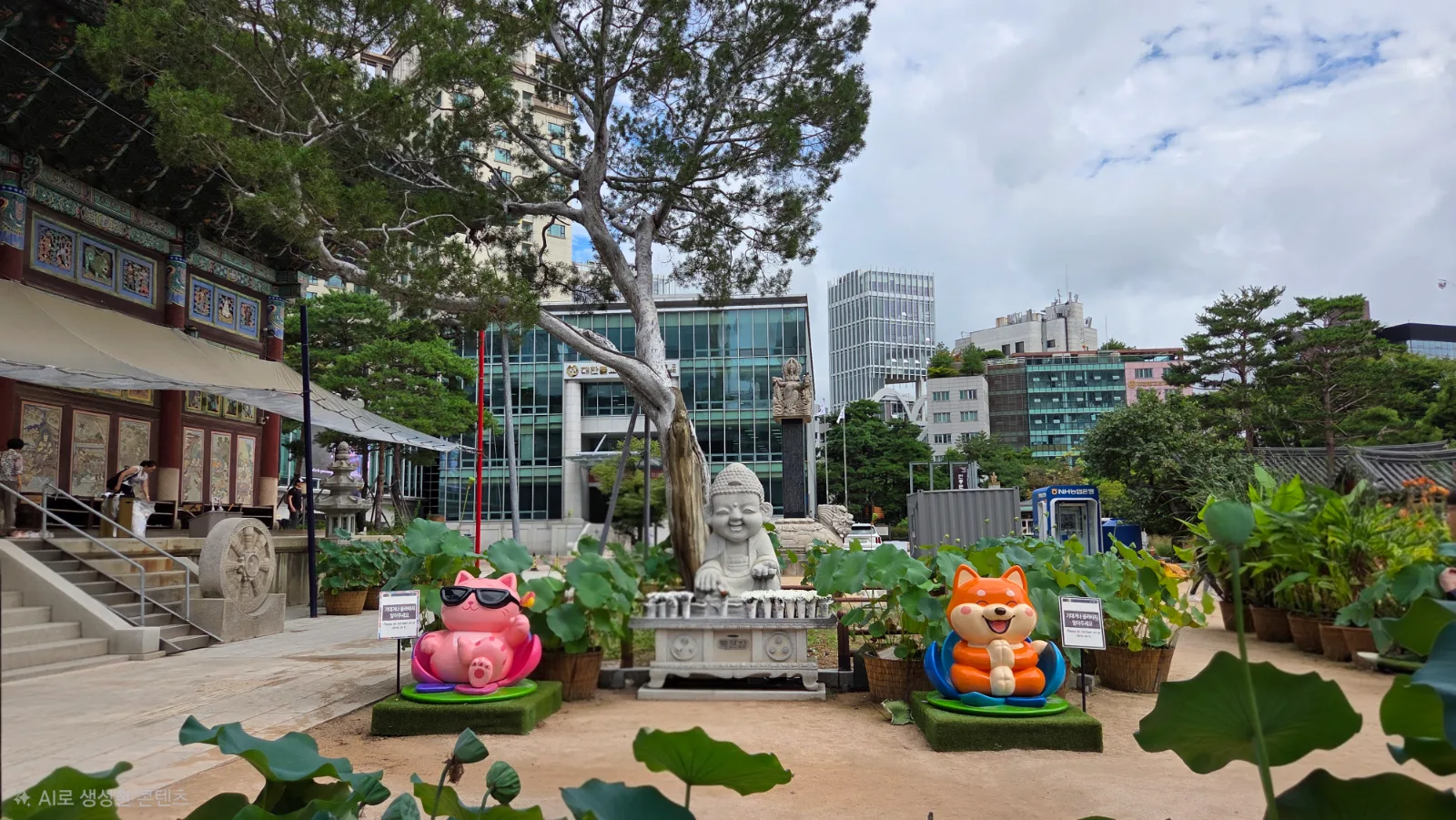
White pine (Lacebark Pine): a rare pine whose bark peels to reveal white patches, designated a Natural Monument. Its age is estimated at around 500 years (450-plus by some sources). It stands right beside the main hall.
Pagoda tree (Chinese scholar tree): the big tree in the front courtyard, also said to be over 450 years old. In summer it shades the whole courtyard together with the sunshades. During exam season, parents of students come here to pray for good results.
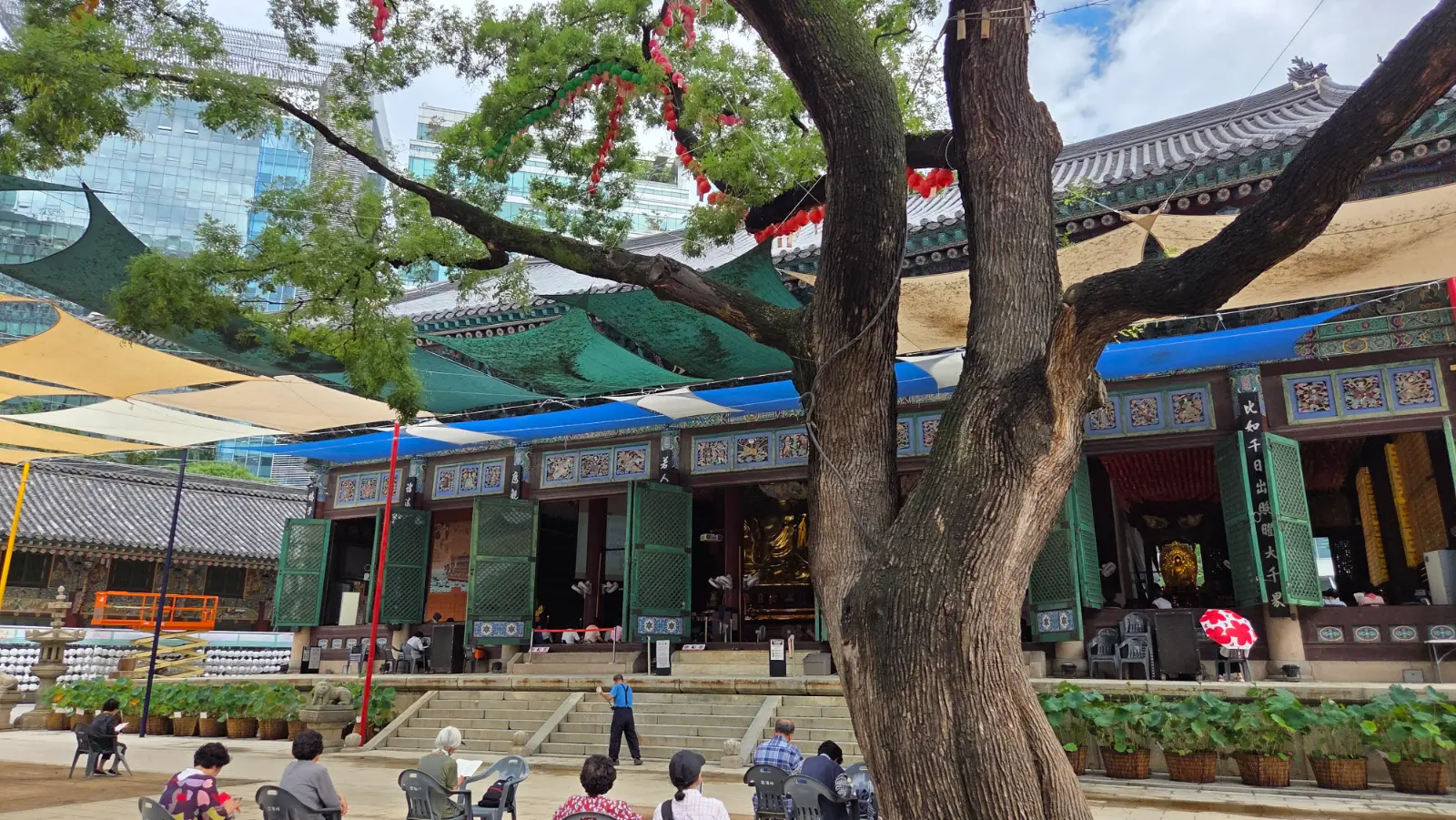
Sitting on a bench under the pagoda tree and looking at the main hall is the most peaceful moment at Jogyesa. Office workers rest here at lunchtime too.
5. 🪷 Summer Highlight — The Lotus Festival and the Wish Drum
From summer until around mid-September, the courtyard fills with pots of lotus. The theme of the 2026 Jogyesa Lotus Festival was "Lotus, Bringing Peace of Mind".
Lotus flowers and leaves in large pots are placed all over the grounds. Because the lotus blooms clean out of the mud, it symbolizes enlightenment in Buddhism.
Lotus Lantern of Auspicious Connections: hundreds of lotus-shaped lanterns hang above a green bridge between the lotus beds. You can write a wish on paper and hang it on a lantern. It's a space for wishing for good relationships and happiness, and the best photo spot.
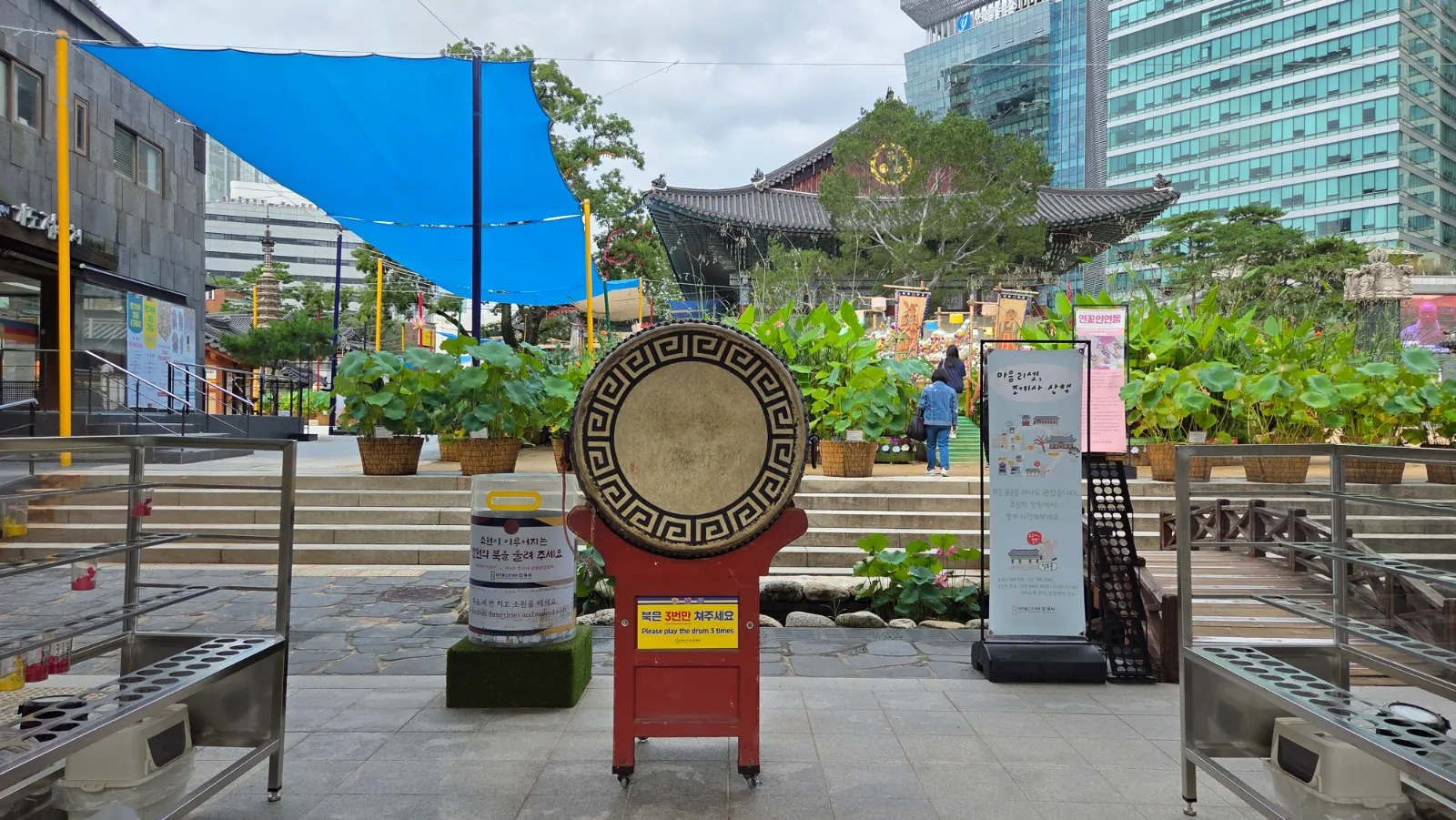
Wish Drum: a large drum near the entrance. When we visited in 2026, a sign in English read "Please play the drum 3 times" and invited visitors to make a wish. Installations like this and how to use them can change with the festival or season, so follow the signs on site.
Cute character figures: beside the baby Buddha statue are figures like a cat in sunglasses and a dog with its paws pressed together. They show how playful a temple can be, a charm unique to Jogyesa. (Signs ask you not to climb on or lean against them, so photos only!)
Festival dates and displays change every year, so check the official website before visiting.
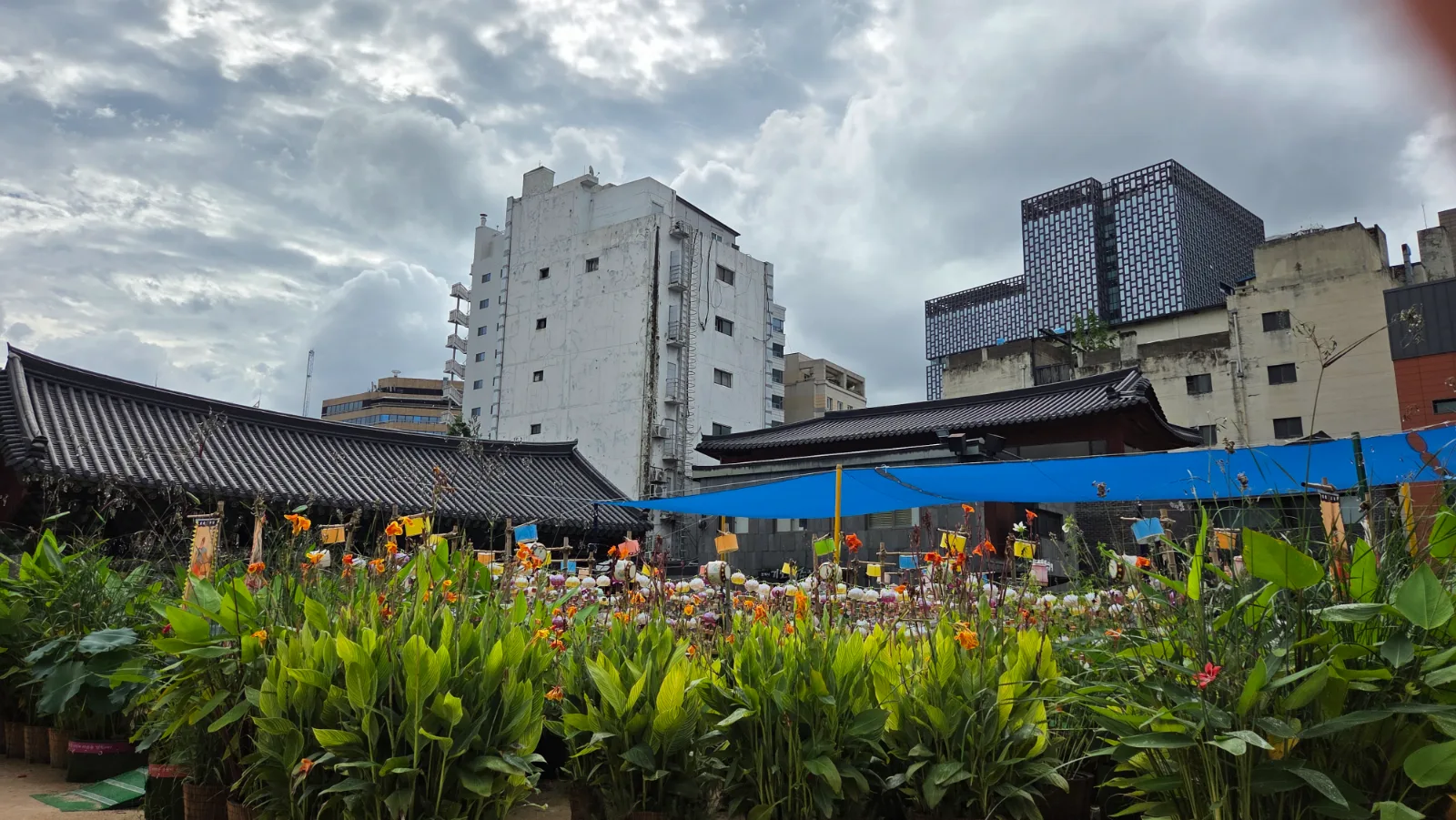
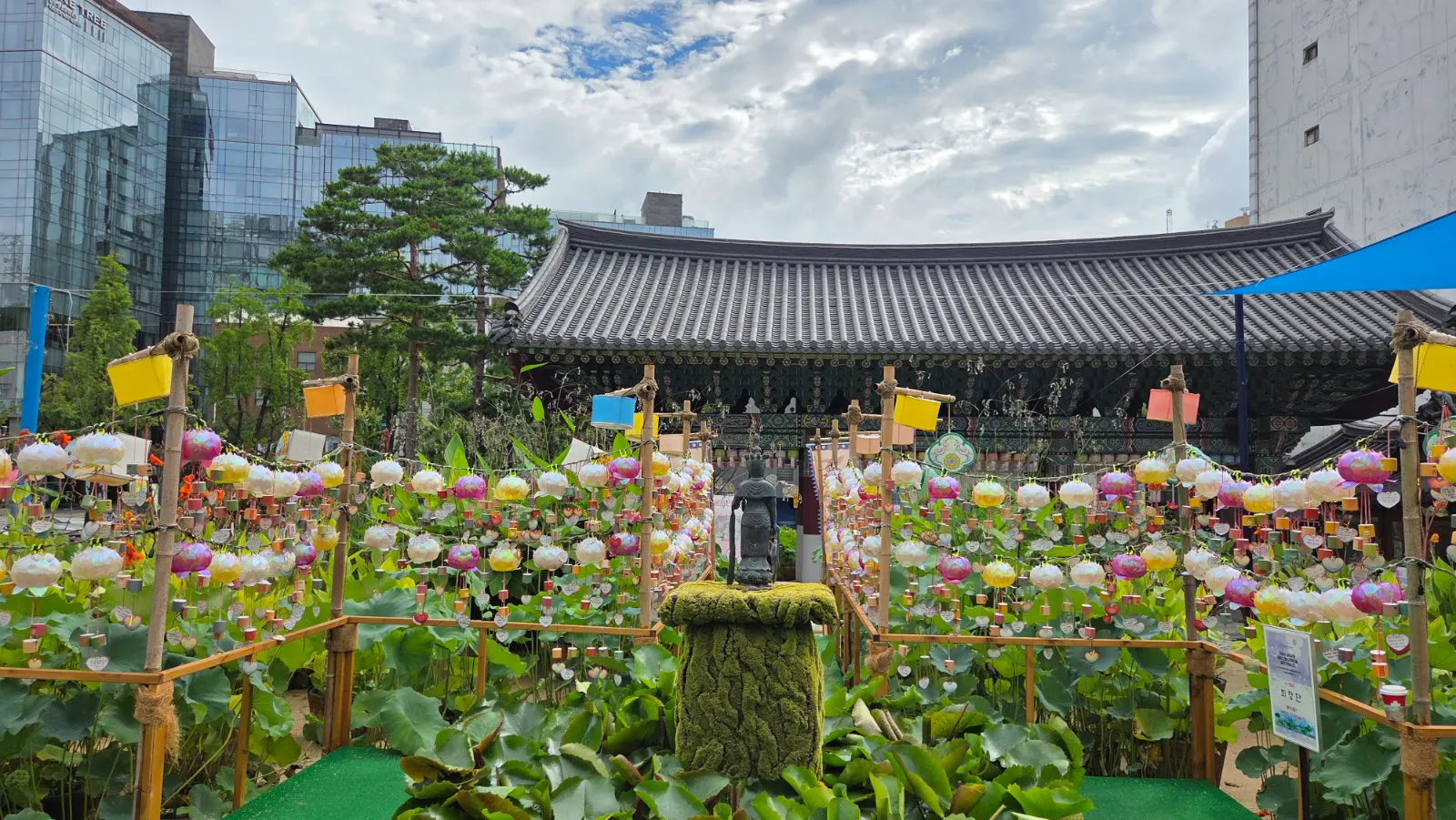
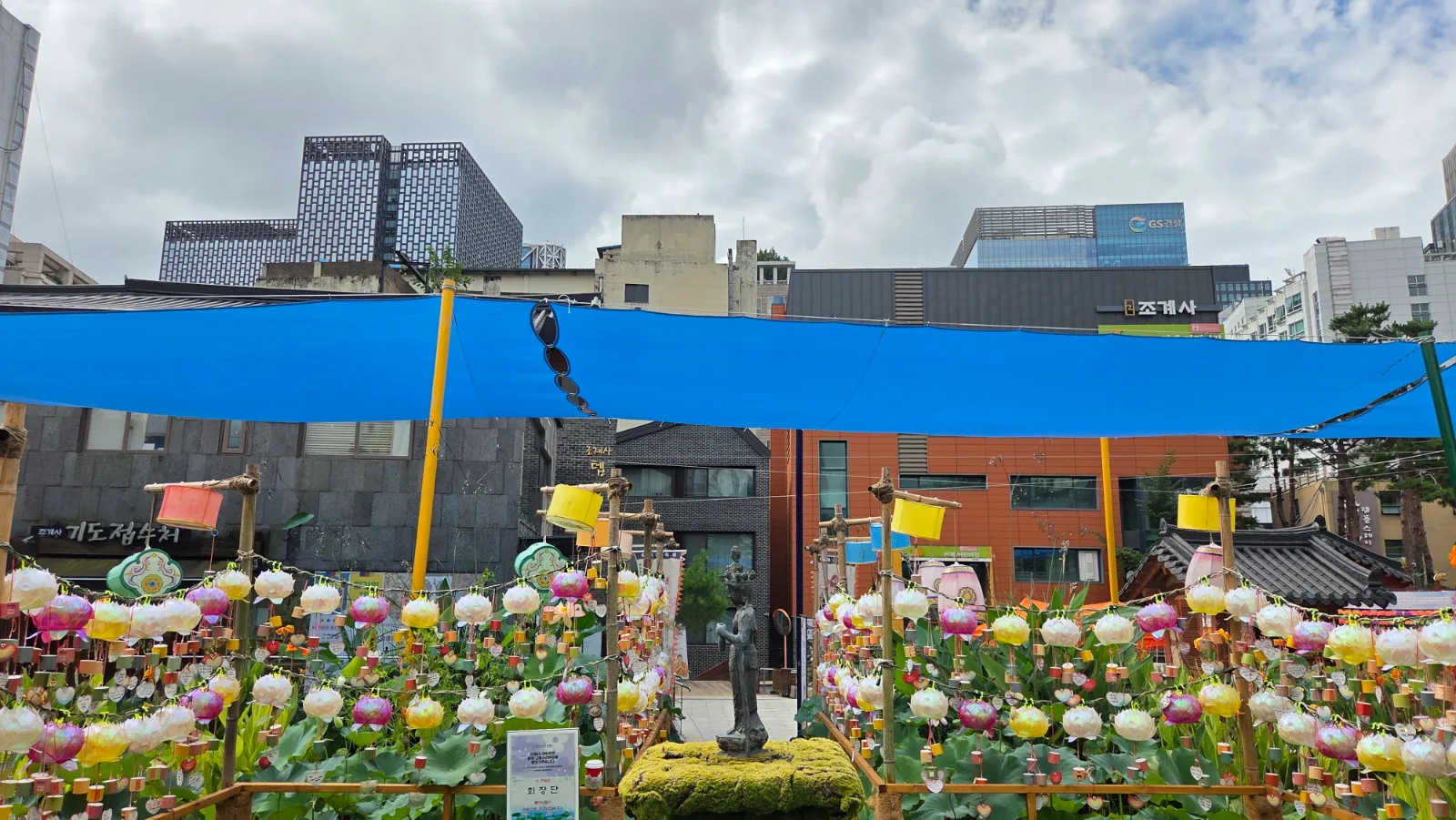
6. 🏮 A Different Face Each Season — Spring Lanterns, Autumn Chrysanthemums
Jogyesa looks different whenever you visit.
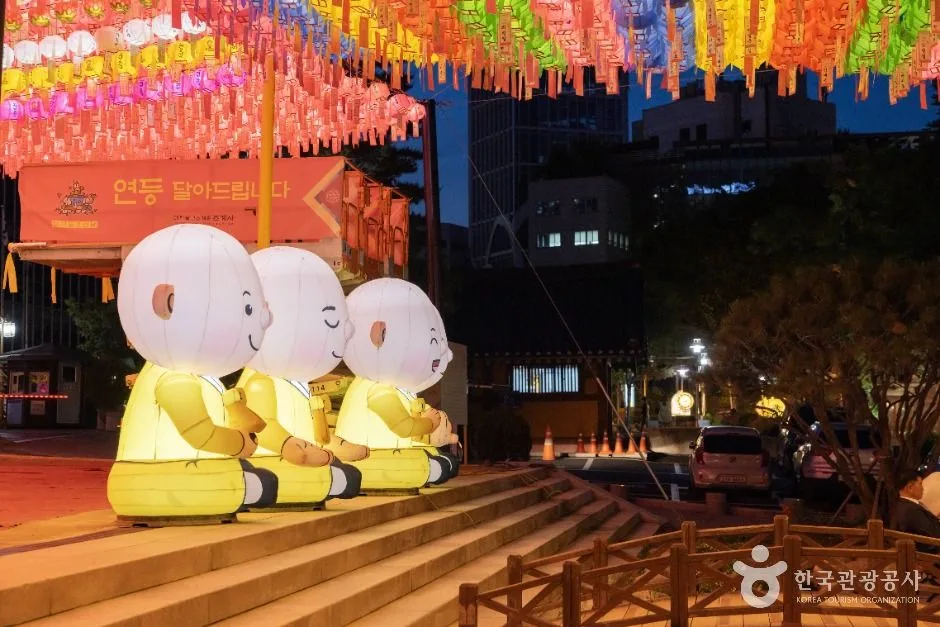
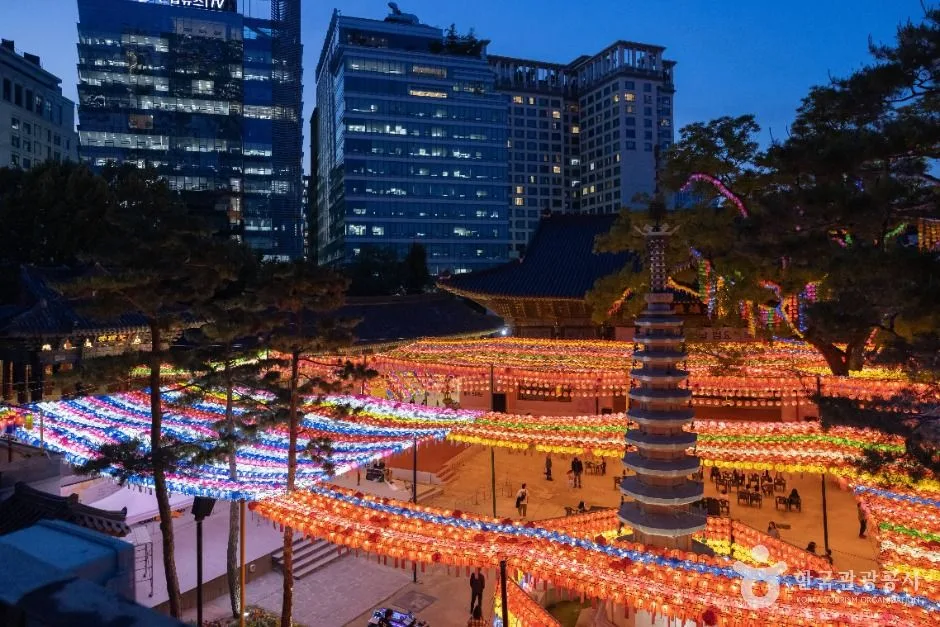
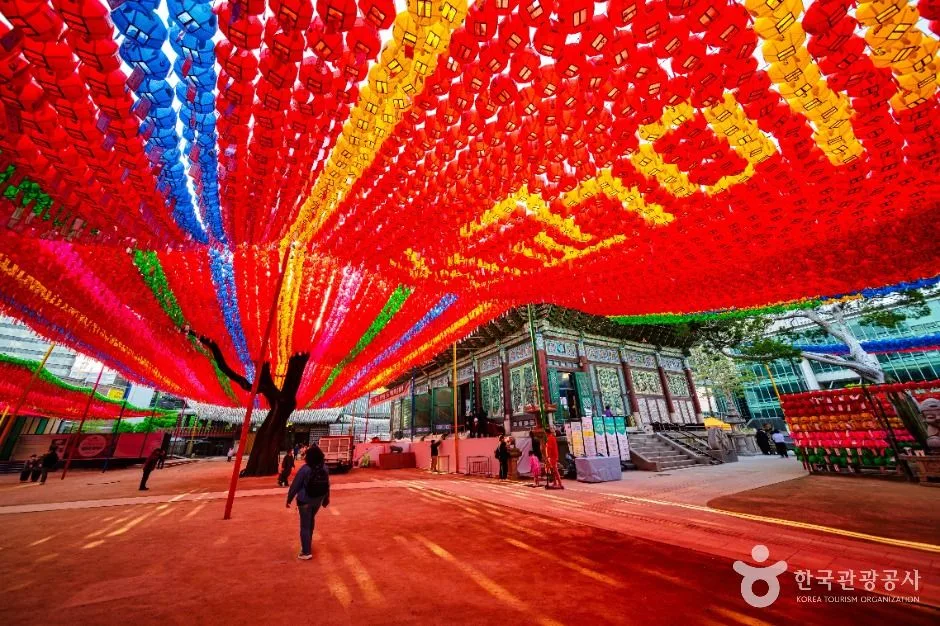
Spring (April–May): ahead of Buddha's Birthday (the 8th day of the 4th lunar month, usually in May), the grounds and the sky above are covered in colorful lanterns. Lit up at night, it becomes one of Seoul's best-known night views. Seoul's lantern festival at this time, Yeondeunghoe, is a UNESCO Intangible Cultural Heritage of Humanity.
Summer (to mid-September): the Lotus Festival, sunshades and the shade of the pagoda tree.
Autumn (October–November): the "Chrysanthemum Fragrance Sharing Exhibition" (chrysanthemum festival) fills the courtyard with yellow and white blooms. Chrysanthemum sculptures and photo zones are popular.
Winter: quiet, and in a way the best time to feel a real temple atmosphere. On New Year's Day morning there is a New Year prayer service and bell ringing (the program can vary from year to year).
Night: the grounds are open 24 hours, so a night stroll is possible. But lanterns, special lighting and decorations depend on the season and events such as Buddha's Birthday or festivals. Time your visit with an event and you'll see why many foreign visitors say "it was more beautiful at night than in the day". Evenings are also less crowded and good for photos.
7. 🔍 What Foreign Visitors Ask Most — 卍, the Three Buddhas, Gray Robes, How to Bow
While looking around a temple, there's always a "what is this?" moment. Knowing in advance makes it much more fun.
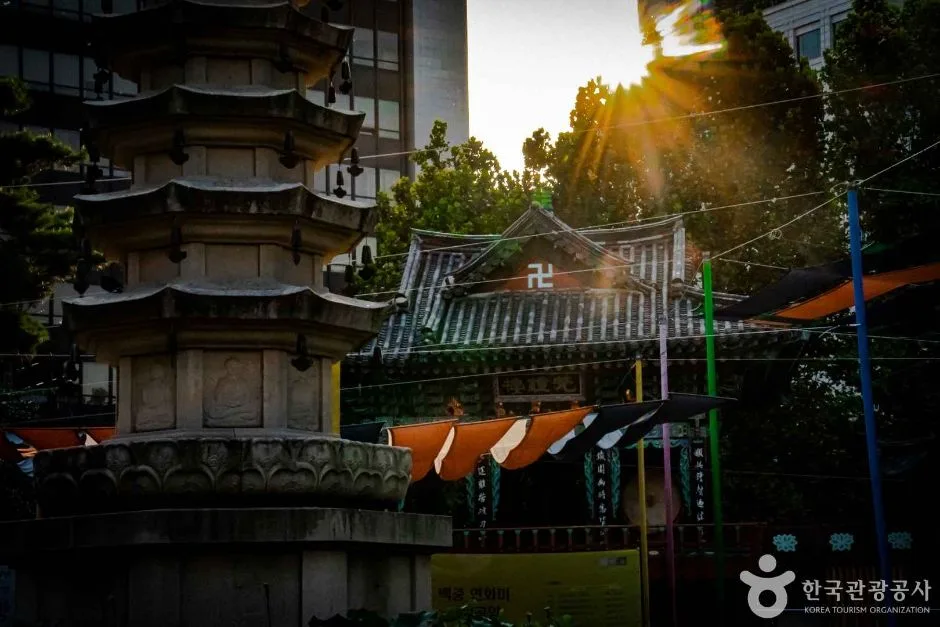
Why is there a 卍 here? To Western visitors it may look unfamiliar or even bring the Nazi symbol to mind, but the Buddhist manja (卍) is a symbol of good fortune and of Buddhism that was in use long before that. In Buddhist cultures both left- and right-facing forms appear depending on the era and region, so it isn't accurate to say "it's a different symbol because it faces the other way". Korean map apps also use it as the icon for temples, so don't be alarmed!
Why three golden Buddhas? The central Shakyamuni Buddha represents the historical Buddha who attained enlightenment; the Medicine Buddha (left) is associated with healing and health, and Amitabha Buddha (right) with the Western Pure Land. Just understand that each statue carries a slightly different meaning.
Why do monks wear gray? People used to the saffron robes of Thai or Burmese monks often ask. Korean monks mostly wear gray or charcoal-colored robes in daily life, and at services and important ceremonies they wear a ceremonial robe (gasa, 袈裟) over them. If you know Southeast Asian Buddhism, it can feel quite different. Both monks and nuns shave their heads.
The sounds of the service: several times a day (usually early morning, late morning and evening) monks and worshippers chant together in a service called yebul. At large temples, before the morning and evening services, four ritual instruments in the bell pavilion are sounded: the dharma drum, the wooden fish, the cloud-shaped gong and the bronze bell. Traditionally the drum is for creatures on land, the wooden fish for those in water, the cloud gong for those in the sky and the bell for those in hell, a wish that all beings be freed from suffering. Visitors may sit quietly at the back of the hall and watch. Check the schedule on the official website for exact times.
How to bow (full prostration): worshippers kneel and touch their foreheads to the floor, which expresses humbling oneself. If you'd like to try: press your palms together → kneel → touch your forehead and both elbows to the floor → lift your palms slightly upward → stand. It isn't required; pressing your palms together and bowing your head lightly is enough.
What are 108 bows? A practice of bowing 108 times to cleanse the 108 worldly afflictions. You can try it in Jogyesa's Templestay and experience programs. Repeating the bow 108 times is harder than it sounds the first time.
Can I hang a lantern? Yes. Even non-Buddhists can pay a small fee (for reference, subject to change) at the temple office and hang a lantern with their name and wish. Many foreigners join in around Buddha's Birthday.
Incense and candles: you're free to place incense in the burner or offer a candle in front of the hall. If incense is already burning, there's no need to add more. After lighting, don't blow out the flame with your mouth; wave it out with your hand.
Lunchtime prayers: on weekdays around noon you'll see people in business suits drop in, bow and leave. It's a scene unique to a downtown temple like Jogyesa.
8. 🙏 Temple Etiquette — Mistakes Foreign Visitors Often Make
Take off your shoes when entering a hall. Wearing socks is neater.
Traditional etiquette is to use the side doors rather than the central front door (eogan-mun). But event rules and on-site signs always take priority.
Keep quiet inside. No phone calls, loud voices or food.
Check the signs first about whether photos are allowed inside the hall. Even where they are, keep camera use to a minimum during services, and avoid flash and close-ups of people praying. The key point is not the statues themselves but not disturbing people's worship. Outdoor photography on the grounds is free.
There's no dress code, but it's best to avoid very short or revealing clothing.
Non-Buddhists can offer incense and candles or hang lanterns, and donations are voluntary. No one will pressure you.
If you pass a monk, pressing your palms together and bowing your head lightly makes a good impression.
9. 📸 Photo Spots & Nearby Route
In front of the gate (Iljumun): the colorful painted signboard, lanterns and lotus pots in one frame.
The Lotus Lantern bridge: a tunnel of colorful lotus lanterns, the best photo spot and summer only.
Under the pagoda tree: the contrast of the main hall and glass towers seen past the trunk.
Below the front steps of the main hall: the golden Buddhas glimpsed through the open doors (check the signs before shooting inside).
Nearby: Insadong (traditional crafts, tea houses) 3 minutes on foot, Gyeongbokgung and Bukchon 15–20 minutes, Cheonggyecheon and Gwanghwamun 10 minutes. The alley beside the temple is lined with Buddhist supply shops, temple-food restaurants and traditional tea houses, and across the street at 56 Ujeongguk-ro is the Templestay Information Center.
❓ Questions Foreign Visitors Often Ask (FAQ)
Q. Can I go in if I'm not Buddhist? A. Of course. Jogyesa is open to everyone, and there are lots of tourists. You're welcome to go into the hall and sit.
Q. Do I need a ticket or reservation? A. The grounds are free and no reservation is needed. Only Templestay and some experience programs have separate fees and bookings. Programs and fees change often, so check the official Templestay website (English available).
Q. Is there English signage? A. The main signs on the grounds are in Korean and English, and the Lotus Festival and Wish Drum signs have English too. You can ask questions in English at the Templestay Information Center across the street.
Q. How long should I stay? A. A quick look takes 20–30 minutes; sitting in the hall and taking photos, about an hour.
Q. When is it prettiest? A. Around Buddha's Birthday (lanterns) and during the summer Lotus Festival it's most colorful. For a quiet atmosphere, weekday mornings are best.
Q. Can't I go in during a service or event? A. During major services, entry to the main hall may be restricted for a while. Then you can look in through the open doors from outside, or visit other halls first, such as Geungnakjeon and Gwaneumjeon.
Q. What should I look out for at a Korean temple? A. Notice the colorful dancheong painting on the wooden buildings, the tiled roofs, the layout of halls and pagodas, and the culture of pressed palms and chanted services. What makes Jogyesa special is that it isn't a mountain temple: it's a downtown temple where real worship and the order's work carry on in the middle of modern Seoul.
Q. Can I photograph monks? A. Taking close-up photos without permission is rude. Including them from a distance as part of the scenery is about right.
✅ Quick Checklist
Did you come out of Exit 2 at Jonggak Station or Exit 6 at Anguk Station?
Did you bring easy-to-remove shoes and socks for entering the halls?
Did you check the official website for events during your visit (lanterns, lotus, chrysanthemums)?
Did you check the on-site signs for how to use the Wish Drum and other installations?
Remember not to climb on the figures?
Did you read up on the meaning of the 卍 and the gray robes?
Did you check on site or via official channels whether photos are allowed in the hall and when services are held?
If visiting at night, did you check whether lantern or lighting events are on this season?
Did you plan a walking route combining Insadong and Gyeongbokgung?
📷 Image: "Seoul_Jogyesa Temple (Seoul)", provided by the Korea Tourism Organization through its Tourism Content Lab, used under the Korea Open Government License (KOGL) Type 1 (attribution). The lanterns and decorations in the photo reflect the time it was taken and may differ from what you see on your visit.
🟦 This guide was put together by the JoyStoria team.
📅 Written as of 2026 · ⚠️ Events, opening hours, programs and fees may change with the season and the temple's circumstances.
JoyStoria does not endorse any particular business. Before visiting or booking, please confirm the latest information on the official Jogyesa website, the official Templestay website and map apps. As this is a place of worship, please be considerate of people praying or attending services and look around quietly.