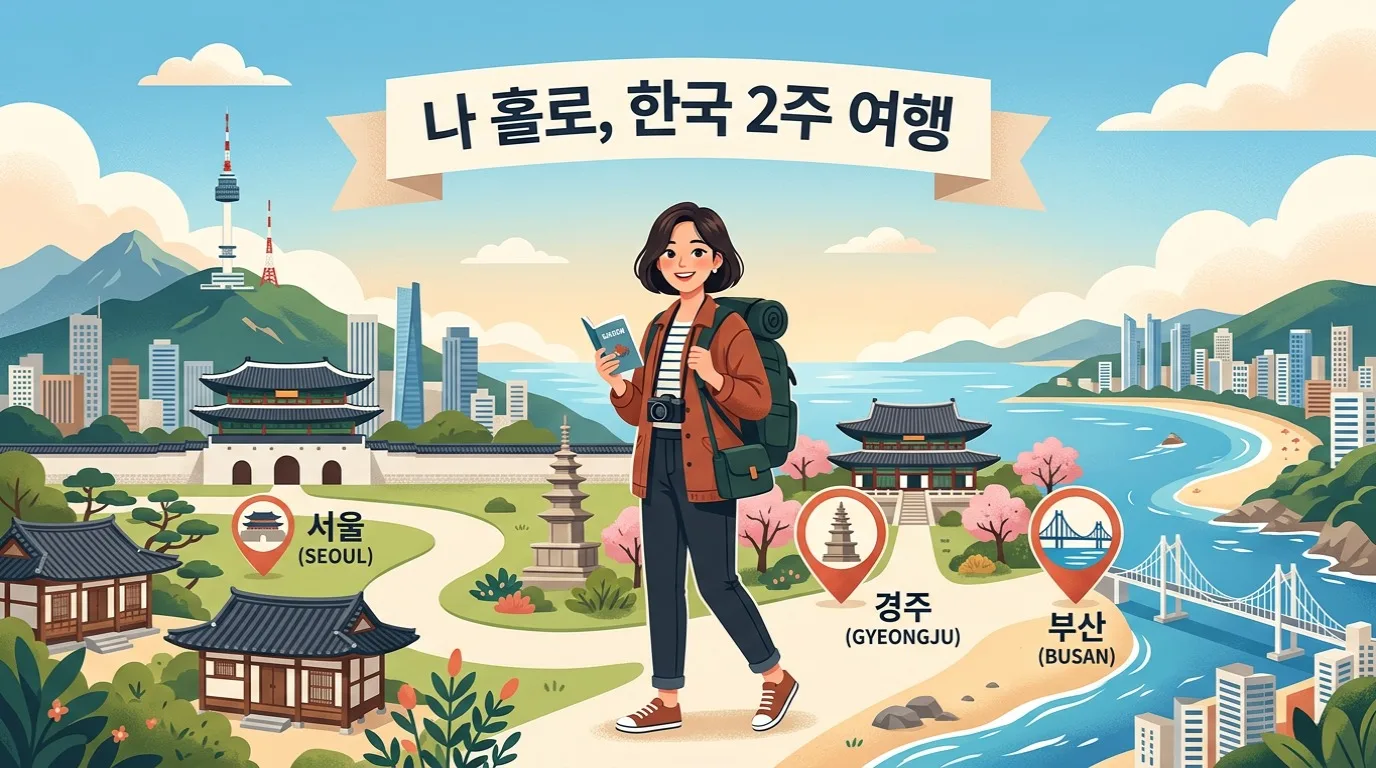
✈️ Korea Solo 2 Weeks — Seoul·Gyeongju·Busan Plan by Reader Request!
⚠️ Note — Prices, English support, opening hours, and closing days in this post vary by shop, tour company, and branch, and change often. DMZ tours in particular can be modified or suspended depending on the security situation, so always check official channels and map apps (Naver Map, Kakao Map) before booking. Popular restaurants and cafes can have long waits on weekends, and royal palaces have weekly closing days (e.g., Gyeongbokgung closes on Tuesdays).
⏱️ 30-Second Summary — Just Remember This!
🗓️ Skeleton → Seoul 2d → Gyeongju 2d → Busan 4d → Seoul 6d (keep it as is!)
🍂 Season → Sep–Oct is a comfortable time to visit; note Chuseok 2027 (Sep 14–16)
🚄 Trains → KTX Seoul Stn→Gyeongju Stn ~2h; Gyeongju Stn→Busan Stn ~30 min
🎫 Tours → DMZ needs advance booking + passport; Nami Island by shuttle or tour
👩 Safety → Big cities are quite solo-friendly; stay in busy hubs (Hongdae, Myeongdong, Seomyeon)
📱 Apps → Naver Map, Kakao Map, Kakao T, Papago cover navigation and language
💷 Budget → £3,000 excl. flights comfortably covers mid-range hotels + tours + shopping
1. 📮 The Request We Received
Here's the request that started this post, from a reader coming from the UK.
🇬🇧 First solo long trip abroad (has done solo weekend trips and day trips before)
🗓️ Next year (2027), September–October, 2 to 2.5 weeks
🧳 Seoul 2d → Gyeongju 2d → Busan 4d → Seoul 6d (Seoul last, to avoid hauling shopping)
🎫 Wants a DMZ tour and Nami Island — both if possible
💷 Budget: about £3,000 excluding flights
❓ Questions: recommended routes, good areas for a solo female traveler, places to avoid
We built the itinerary below around these conditions. If your situation is similar, feel free to follow it as is, or swap out legs to match your taste. Since there's plenty of planning time, use this post as the skeleton and flesh it out with the linked detailed guides.
2. 🗓️ Full Itinerary at a Glance — Day 1–14
Here's the big picture first. Detailed routes for each day are in sections 4–7 below.
Day 1 · Seoul → Arrive at Incheon, T-money card, check-in, easy stroll in Myeongdong·Gwanghwamun
Day 2 · Seoul → Classic course: Gyeongbokgung (hanbok)·Bukchon·Insadong·Gwangjang Market
Day 3 · Gyeongju → Morning KTX, Daereungwon·Cheomseongdae·Hwangnidan-gil, Donggung & Wolji night view
Day 4 · Gyeongju → Bulguksa·Seokguram or Woljeonggyo·National Museum, late-afternoon move to Busan
Day 5 · Busan → Haeundae·Blueline Park·Dongbaek Island·The Bay 101 night view
Day 6 · Busan → Gamcheon Culture Village·Jagalchi Market·Gukje Market·BIFF Square·Busan Tower
Day 7 · Busan → Haedong Yonggungsa & Gijang cafes, or Taejongdae & Huinnyeoul Village
Day 8 · Busan → Seomyeon·Jeonpo cafe street, Gwangalli at night; back to Seoul that night or next morning
Day 9 · Seoul → KTX back, Seongsu-dong cafes & pop-ups + Seoul Forest
Day 10 · Seoul → DMZ (advance booking required)
Day 11 · Seoul → Nami Island day trip (+autumn foliage if timing works!)
Day 12 · Seoul → Shopping day 1: Myeongdong K-beauty·Hongdae fashion
Day 13 · Seoul → Shopping day 2: Seongsu·Garosu-gil + catch up on missed spots
Day 14 · Seoul → Han River park picnic, pack, prepare for departure
If your trip stretches to 2.5 weeks (~17 days), we recommend adding: +1 day in Busan (Songjeong·Gijang coast), +1 day for a Suwon Hwaseong day trip from Seoul, and +1 completely unplanned "rest day." On a 2-week trip, having one rest day makes a bigger difference than you'd think.
3. 🍂 Sep–Oct Weather, What to Pack & Holiday Alerts
September and October are both comfortable months to travel, but they feel quite different.
🌤️ September → Early September is still late summer — hot and humid, around 25–30°C in the daytime. It cools down toward the end of the month. Short sleeves + a light outer layer is the base outfit, and early-autumn typhoons pass through in some years, so check the forecast right before your trip.
🍁 October → Crisp and clear: roughly 15–22°C by day, around 10°C mornings and evenings. You'll definitely want a cardigan or jacket, and foliage starts late in the month. Nami Island's foliage usually peaks late October to early November (varies by year).
🏮 Chuseok holiday alert (for a 2027 trip) → Chuseok, Korea's biggest holiday, follows the lunar calendar so dates shift every year — in 2027 the Chuseok holiday is September 14–16. Domestic travel demand spikes: KTX tickets sell out early and some restaurants and shops close. On the flip side, there are free palace openings and traditional events. Decide first whether to avoid or embrace this window, and be extra careful with KTX and hotel booking timing.
🎆 Autumn festivals → October brings big events — the Seoul Fireworks Festival on the Han River, and Busan's fireworks festival and film festival (BIFF). Fantastic to see, but hotels for those weekends book out early and prices rise.
4. 🏙️ Seoul, First 2 Days — Getting Your Bearings (Day 1–2)
You'll be jet-lagged right after arrival (UK time +8–9 hours), so the key is not to overdo the first two days.
Day 1 (arrival — take it easy) → At Incheon Airport, go in this order: ① immigration & baggage ② connectivity (pick up or buy a SIM/eSIM) ③ exchange a small amount of cash ④ buy and top up a T-money transit card (at airport convenience stores or the station — you'll use it on subways, buses, and in convenience stores for two weeks) ⑤ take the AREX airport railroad into the city (express about 43 min / all-stop about 1 hr to Seoul Station; the express costs a bit more — fares for reference). If it's before check-in time, leave your bags at the hotel front desk (completely normal in Korea). Keep the evening light — browse Myeongdong street food (hotteok, tornado potato, fried dumplings) or take a night stroll from Gwanghwamun Square along Cheonggyecheon Stream. A first convenience-store run for water, sheet masks, and snacks is its own small pleasure. Flights from Europe often land in the afternoon or evening, so "see one thing, sleep early" is the real jet-lag strategy.
Day 2 (classic course — palace·hanok·market) → Around 9 am, rent a hanbok near Gyeongbokgung (roughly ₩10,000–20,000 for 2–4 hours, for reference; hair accessories and bags vary by shop) → visit Gyeongbokgung (closed Tuesdays). Gyeongbokgung offers free admission if you wear traditional or modern hanbok that meets the official free-entry criteria — partial outfits (e.g., jeogori top + jeans) don't qualify, so confirm with the rental shop. Geunjeongjeon Hall and Gyeonghoeru Pavilion are the signature photo spots, and the royal guard changing ceremony at Gwanghwamun Gate is worth catching (times: check official channels). Lunch: samgyetang (ginseng chicken soup) or a Korean set meal in the Seochon lanes west of the palace (₩10,000–20,000 per person, for reference). Afternoon: Bukchon Hanok Village lanes (it's hilly — comfortable shoes!) → walk down to Insadong for the Ssamziegil complex and a rest in a traditional tea house. Evening: Gwangjang Market for bindaetteok (mung bean pancake), mayak gimbap, yukhoe and more — sitting alone at a market stall is completely normal, and it's the kind of place where conversations with your neighbors just start. If you have energy left, walk home along the lit-up Cheonggyecheon.
⚠️ Bukchon visiting tip → Parts of Bukchon, notably the Bukchon-ro 11-gil "red zone," restrict tourist visits to 10:00–17:00 to protect residents (fines apply for violations). Check the designated zones and hours on signs on site, and keep quiet — people live there.
🚇 Getting around → Seoul's subway has good English signage. For maps, Naver Map and Kakao Map are especially useful for transit, walking directions, and local business info; Google Maps' features in Korea are also evolving, so compare what works best when you travel. Koreans navigate by station name and exit number.
🗺️ Related guide: Seoul Districts Guide for Foreigners
🍻 Solo travel tips: Seoul Solo Travel Complete Guide — Neighborhoods·Nightlife·Meeting People·Day Trips
5. 🏯 Gyeongju, 2 Days — Silla History in a Hanbok (Day 3–4)
Gyeongju, the thousand-year capital of the Silla kingdom, is often called "a museum without walls." The city is compact and its sights are clustered, making it one of Korea's easiest cities to explore alone.
Day 3 (move + city core + night views) → Morning: KTX from Seoul Station to Gyeongju Station, about 2 hours (fare around ₩50,000, for reference; varies by train — note the station was renamed from "Singyeongju" to "Gyeongju Station" in late 2023). Book tickets in advance on the official Korail app/site, and stow big luggage on the racks at the ends of each car. From Gyeongju Station to the center (Hwangnidan-gil area) it's about 30–40 min by bus or 20 min by taxi — the tourist information booth in front of the station is the most reliable place to confirm bus routes. Drop your bags, then afternoon: hanbok rental (there are shops around Hwangnidan-gil too) → Daereungwon (strolling between giant royal tombs; you can enter Cheonmachong tomb) → the Gyerim forest path → Cheomseongdae (known as one of the oldest observatories in East Asia) → a break with sip-won bread and desserts in a Hwangnidan-gil hanok cafe. Evening: head to Donggung Palace & Wolji Pond about 30 minutes after sunset when the lights come on — the pavilion reflected in the pond is Gyeongju's most famous scene. Night entry cut-off times vary by season, so check ahead, and if you continue about 10 minutes on foot to the lit-up Woljeonggyo Bridge, the evening is perfect.
Day 4 (your pick, then to Busan) → Choose your morning. Option A (deep history): Bulguksa Temple (home of the Dabotap and Seokgatap pagodas, UNESCO World Heritage, 40–50 min by bus from the center) + if time allows, Seokguram Grotto up the mountain (extra bus or taxi leg, for reference). Option B (city wrap-up): Woljeonggyo Bridge & Gyochon Village (historic estates and the ssambap alley) + the Gyeongju National Museum (gold crowns, the Divine Bell of King Seongdeok — the essence of Silla artifacts, with an easy layout for its size). After a late lunch, move to Busan around 4–6 pm — KTX (Gyeongju Stn→Busan Stn, around 30 min) or intercity bus (about 1 hr, for reference). For Busan, one base for all 4 nights is easiest: transit-hub Seomyeon (easy to get anywhere) or beachfront Haeundae (morning and evening beach walks) — your call. Once you arrive, initiate yourself with a bowl of dwaeji-gukbap pork soup near your hotel!
🍞 Gyeongju bites → Hwangnam-ppang (red bean pastry), ssambap (rice with wraps) in Gyochon Village, hanok cafe desserts on Hwangnidan-gil. Almost everything works for solo diners.
🏯 Related guide: Gyeongju — The Spots Foreign Travelers Actually Love
6. 🌊 Busan, 4 Days — Sea, Alleys, Markets, Slowly (Day 5–8)
Four days lets you enjoy Busan without rushing. We split it into one theme per day.
Day 5 (Haeundae line) → Morning: start with a walk on Haeundae's sand — the beach is quiet and lovely on Sep–Oct mornings. Then Haeundae Blueline Park: the beach train and sky capsules running the Mipo–Cheongsapo–Songjeong coast are popular, so book ahead (fares and operations: official channels). Get off at Cheongsapo and walk to the Daritdol Skywalk, a glass-floored observation deck over the sea. Lunch: eomuk fish cakes and snacks or a raw-fish restaurant at Haeundae Market. Afternoon: loop Dongbaek Island — from Nurimaru APEC House and the lighthouse viewpoint you get a full view of Gwangan Bridge. Evening: The Bay 101 for the Marine City skyline night view — the lights reflecting on the water are famous, and photos are prettiest at "blue hour," just after sunset.
Day 6 (old downtown & markets line) → Morning: Gamcheon Culture Village (village bus uphill from Toseong Station) — pastel houses stacked like stairs on the hillside; the Little Prince photo spot can have a long line, so go early. The lanes are a maze, so grab the stamp map at the entrance, and keep quiet — residents actually live there. Afternoon: Jagalchi Market (the live-fish alley is fun even just to watch; check prices before ordering hoe) → Gukje Market·Kkangtong Market (vintage goods and sundries) → seed hotteok at BIFF Square — don't miss it! If time allows, the retro Bosu-dong Book Alley nearby is worth a stop. Evening: finish with the old-downtown night view from Busan Tower in Yongdusan Park, then stroll down the Gwangbok-ro shopping street — the route flows perfectly.
Day 7 (coastal scenery line — your pick) → Option A (east·Gijang): Haedong Yonggungsa — a rare temple built on seaside cliffs; go early in the morning for quiet (public transit involves transfers, so allow time). Then half a day of rest at an ocean-view cafe in Gijang's Osiria area. Option B (west·Yeongdo): Huinnyeoul Culture Village — clifftop lanes famous as a film location, with a beautiful walking path right beside the sea. Then Taejongdae: ride the Danubi train around the observatory and lighthouse course, and finish at one of Yeongdo's converted-warehouse view cafes — every bit as atmospheric as Seongsu-dong. Either way involves travel time, so trim this day to 2–3 stops and take it slow.
Day 8 (downtown + night sea) → Morning: brunch in Seomyeon, then Jeonpo cafe street — small shops and roasteries hide in every alley, great for gift shopping too. Afternoon: keep it light with a Busan Citizens Park stroll or Seomyeon's underground shopping arcade. Evening: Gwangalli Beach — the Gwangan Bridge night view is a scene that's arguably even better alone. Weekends sometimes have drone shows (days and times: official channels). The second-floor window seats of the cafes lining the beach are the prime viewing spots. Take the KTX back to Seoul that night or the next morning (Busan Stn→Seoul Stn about 2h40m–3h, around ₩60,000, for reference) — going at night buys you a day in Seoul, going in the morning buys you one last morning by the sea. Your choice!
🍜 Busan bites → Dwaeji-gukbap pork soup (Seomyeon·near Busan Station), milmyeon noodles, eomuk fish cakes (artisan fish cake bakeries), seed hotteok. Dwaeji-gukbap comes in single-serving hot pots — the easiest solo meal there is.
🌊 Related guide: Busan Essential Course Roundup
7. 🛍️ Back to Seoul, 6 Days — Tours, Shopping, Cafes (Day 9–14)
The highlight stretch: 2 tour days + 2 shopping days + 2 flexible days.
Day 9 (Seongsu-dong + Seoul Forest) → If you came up from Busan in the morning, starting gently in the afternoon is fine. Seongsu Station on subway Line 2 — a factory district turned cafe town, "the Brooklyn of Seoul." Around Yeonmujang-gil you'll find warehouse cafes, specialty coffee, and global brand pop-up stores packed together (americano roughly ₩5,000–7,000, for reference). Pop-ups change weekly, so search social media or Naver Map during your visit week so you don't miss them. Weekday mornings are quietest; in the afternoon, walk next door to Seoul Forest (the ginkgo paths are beautiful in autumn) → continue to Ttukseom Han River Park and the day fills itself.
Day 10 (DMZ) → Major sights inside the Civilian Control Line — like the 3rd Infiltration Tunnel and Dora Observatory — can't be visited freely on your own; entry is through official DMZ tourism procedures or authorized tours. Book via tour platforms (Klook, GetYourGuide, etc.), tour companies' official sites, or local official programs, and bring your passport or valid ID (there's an identity check on site). Tours typically leave the city center at 7–8 am and run half-day to full-day courses covering Imjingak, the 3rd Tunnel, observatories, and more; photography is restricted in some zones — just follow your guide. Courses can change or be canceled depending on the security situation, so check the latest notices right before departure. It's an early, tiring day, so keep the evening simple near your hotel.
Day 11 (Nami Island) → Three ways to go: ① a round-trip shuttle bus from central Seoul (reservation-based — departure points vary by season and operator, so confirm when booking) ② a tour package (some bundle the Garden of Morning Calm or Petite France) ③ by rail — ITX-Cheongchun from Yongsan Station to Gapyeong Station (~1 hr), then a shuttle or taxi to the dock and a ferry across (thrill-seekers can arrive by zip wire — check whether it's operating). On the island, rent a bicycle for a loop or walk the Metasequoia and ginkgo lanes slowly — that's the classic way, and it's spectacular in foliage season. Lunch on the island, or try Gapyeong's famous dak-galbi. The earlier you leave, the quieter it is, and it's one of the most solo-friendly day trips around Seoul.
Day 12 (shopping 1 — K-beauty & fashion) → Morning–afternoon: Myeongdong — K-beauty central, including Olive Young's flagship; comparing prices across stores item by item is half the fun of skincare and sheet-mask shopping. The flagship department stores within walking distance let you cover the cosmetics brands in one sweep. At Tax Refund member stores, purchases generally become refund-eligible from ₩15,000 per transaction. Whether instant refunds apply, and their limits, depends on the store and amount — confirm before paying and have your passport ready (criteria and methods can change). Evening: move to Hongdae for trendy fashion and accessories + busking on the pedestrian street. Walking on to the Gyeongui Line Forest Park in Yeonnam-dong makes a perfect evening stroll.
Day 13 (shopping 2 + catch-up) → Morning: Seongsu (K-fashion and brand pop-ups) or Garosu-gil (select shops and designer brands) — your taste. Afternoon: wrap up budget-friendly souvenirs at Daiso and Insadong — stationery and traditional trinkets are especially popular as gifts. It also works as a catch-up day for spots you missed: Euljiro's retro alleys (old-school eateries coexisting with hip bars) and Ikseon-dong's hanok lanes (converted hanok cafes and boutiques) are our picks. If your luggage has grown, doing a suitcase pre-pack this evening makes the last day much easier.
Day 14 (wrap-up & departure) → Morning: one last picnic at a Han River park — grab fried chicken and gimbap from a convenience store and head to an easy-access park like Yeouido or Banpo (try the instant ramyeon cooking machines!). Mats can be rented on site. Afternoon: pack — if you shopped a lot, check airport delivery services or extra-baggage fees in advance. Arrive at Incheon 2–3 hours before departure, and allow extra time if you have tax-refund collection procedures (kiosk scan·customs export check). Confirming the airport railroad timetable the night before buys peace of mind. And finally — spending your leftover T-money balance on snacks at the airport convenience store is a beloved little closing ritual among travelers to Korea.
🍗 Seoul eats, anytime → Gwangjang Market bindaetteok, Dongdaemun dak-hanmari (whole chicken hot pot — many places serve 2-person portions by default, but some accept solo diners), Ikseon-dong alley restaurants, Euljiro's nogari alley.
☕ Related guide: Seongsu-dong Cafe Complete Guide — How a Factory District Became Seoul's Hottest Spot
👭 Course reference: Two Friends, 3 Days in Seoul — Hanbok·Seongsu Cafes·Dongdaemun Dak-hanmari
8. 👩 Solo Female Travel — Accommodation & Safety in Detail
Big cities like Seoul and Busan have excellent public transport, plenty of businesses open late, and busy, well-lit districts, which makes solo travel quite comfortable. That said, late at night the same basic precautions apply as anywhere in the world.
🏨 Four rules for choosing where to stay → ① within a 5-minute walk of a subway station ② in a district that stays lively at night (Seoul: Hongdae·Myeongdong·Jongno·Euljiro / Busan: Seomyeon·Haeundae / Gyeongju: near Hwangnidan-gil) ③ lots of reviews with high scores — read reviews by female travelers in particular ④ 24-hour reception or smart door locks. Some hostels offer female-only floors or dorms — check when booking.
🏠 By accommodation type → Mid-range hotels (roughly ₩60,000–120,000/night, for reference) are the safest bet; female dorms in hostels (₩20,000–40,000/night) save money and make it easy to meet fellow travelers. A hanok stay in Bukchon (Seoul) or Gyeongju is worth one night for the experience.
🌙 At night → Busy districts stay lively past 11 pm, but quiet alleys, parks, and riverside paths late at night are best avoided — as anywhere. For late rides, use an app taxi like Kakao T, which records the route and driver. Street touts ("good bar this way!") can simply be ignored.
🍺 Nightlife → Going to bars and clubs alone is doable — just keep your eyes on your drink and be cautious about moving locations with people you've just met. Clubs check passports (ID). For safer socializing, try hostel events, pub crawls, Meetup language exchanges, or one-day classes (cooking, pottery).
📱 Essential apps 4+2 → Naver Map·Kakao Map (great for transit and walking, English supported — Google Maps' Korea features are also evolving, so compare at travel time), Kakao T (taxi), Papago (translation — the menu photo translation is a lifesaver). Plus: a tour booking app like Klook, and the Korail app (KTX booking). Emergencies: 112 (police), 119 (ambulance), and 1330 (Korea Tourism Organization helpline — 24-hour English support for interpretation and travel help).
🚫 Places to avoid? → There are few places that deserve the label "dangerous." Just use standard caution in nightlife districts (parts of Itaewon and Gangnam) very late at night, with pushy bars, and with unlicensed taxis. Theft is remarkably rare — Koreans famously reserve cafe seats with their phones — but keeping your passport and wallet on you is still the good habit.
9. 💷 Budget £3,000 — A Detailed Split
Excluding flights, £3,000 (very roughly ₩5,000,000, depending on the exchange rate) is a comfortable budget for two weeks. Here's a sample split assuming £1 ≈ ₩1,700–1,900 (subject to change).
🏨 13 nights → about £1,000–1,300 — mid-range hotel basis (£70–100/night). Mixing in hostel female dorms for half the nights can cut this to £400–600. Savings go to shopping!
🍜 Food → about £400–500 — £25–40/day covers a cafe breakfast + local lunch (₩8,000–12,000 range) + a nice dinner. Market-food-heavy days come in lower.
🚄 Transport → about £100–150 — KTX Seoul→Gyeongju (~₩50,000) + Gyeongju→Busan (~₩10,000s) + Busan→Seoul (~₩60,000), totaling roughly ₩120,000–130,000 (for reference), plus city transit and airport rail. The foreigner-only Korail Pass may or may not beat individual tickets for this three-leg route — compare before deciding.
🎫 Tours & admissions → about £150–250 — DMZ tour (₩50,000–90,000 range), Nami shuttle + entry (₩30,000–50,000 range), hanbok rental (₩10,000–20,000 range), palace admissions (a few thousand won), Blueline Park, etc. (all for reference).
📱 Connectivity & misc → about £30–50 — 2-week eSIM/SIM (₩20,000–40,000 range); travel insurance is separate and essential.
🛍️ Shopping → the remaining £750–1,300 — ammo for those final 6 days in Seoul! Many K-beauty items cost far less than in the UK.
Payment tips: cards work almost everywhere in Korea, but cash is handy at markets and some street stalls. We recommend a low-fee travel card + a small cash reserve (₩100,000–200,000). Exchange rates tend to be better at city banks and Myeongdong exchange booths than at the airport (for reference). All figures are for reference and vary by season and exchange rate.
❓ Frequently Asked by Foreign Visitors (FAQ)
Q1. Isn't 2 days in Seoul too short? Not at all — you have 6 more days at the end! Spend the first 2 days on jet-lag recovery plus the palace-and-tradition course, and push everything else to the final stretch. Booking the same neighborhood for both Seoul stays makes the city feel instantly familiar the second time.
Q2. How do I visit the DMZ? Sights inside the Civilian Control Line — the 3rd Tunnel, Dora Observatory — can't be visited freely on your own; you need official DMZ tourism procedures or an authorized tour. You can book via platforms like Klook and GetYourGuide or tour companies' official sites, and you must bring your passport or valid ID. Course content and operation can change with the security situation, so check right before departure — and book 1–2 weeks ahead, as popular dates sell out.
Q3. Is Nami Island awkward to visit alone? Not at all! It's a stroll-and-photos island with plenty of solo visitors. Choose whichever way suits you — shuttle bus, tour, or train (ITX-Cheongchun to Gapyeong) — and prefer weekdays during peak foliage, when weekend crowds surge.
Q4. I don't speak Korean — will I manage? Tourist areas, hotels, and major shopping districts usually have basic English, and the Papago app solves most of the rest — its menu photo translation is especially handy. Subways and KTX have solid English signage. At local restaurants, use kiosks or photo translation, and if you're truly stuck, the 1330 helpline interprets for you.
Q5. Is eating alone (honbap) uncomfortable? Solo dining culture is well established in both Seoul and Busan. Gukbap soups, bunsik snack bars, markets, and cafes are solo-by-default; just pre-check menus that assume two people, like Korean BBQ or dak-hanmari. Finding restaurants with counter seats via map app reviews works well too.
Q6. What do I do with big luggage between cities? KTX trains have luggage racks, and major rail and subway stations have lockers. Leaving bags at your hotel front desk before check-in is completely standard in Korea. And as the requester planned — pushing the shopping to the final Seoul leg cuts the luggage stress dramatically.
✅ Quick Checklist
Check passport validity + 🌍 K-ETA — the temporary K-ETA exemption for some nationalities currently runs through December 31, 2026. This trip is planned for 2027, so re-check whether UK passport holders need K-ETA on the official K-ETA site before departure
Check the 2027 Chuseok holiday (September 14–16) overlap → book KTX and hotels early for that week
Book the DMZ tour in advance + bring your passport on the day
Decide how to reach Nami Island (shuttle / tour / ITX-Cheongchun)
Book KTX tickets (official Korail app/site — secure the three long-distance legs early)
Get a T-money card + eSIM/SIM at the airport
Install Naver Map, Kakao Map, Kakao T, Papago, Korail apps
Book accommodation in busy, station-side districts; check female-only options and reviews
Bring a low-fee travel card + small cash reserve
Buy travel insurance
September: light outer layer + watch typhoon forecasts / October: jacket or cardigan
Save emergency numbers: 112 (police), 119 (ambulance), 1330 (tourist helpline with interpretation)
🟦 This guide was prepared by the JoyStoria team.
📅 Written as of 2026 · ⚠️ Prices, English support, information, and operations may vary by season, company, and branch.
JoyStoria does not endorse any specific business. Before visiting or booking, please check each operator's official channels and map apps for the latest information. DMZ tour operations and entry rules, and entry requirements such as K-ETA, can change at any time — we recommend reconfirming with the relevant official sources.